5th Grade Science Worksheets: 10 Fun Ways to Build Knowledge and Confidence
Science gets really exciting in 5th grade. Students begin asking deeper questions, testing ideas, and connecting classroom lessons to the real world. From understanding ecosystems to exploring the solar system, every topic opens the door to curiosity. And that’s exactly why 5th grade science worksheets remain one of the most useful learning tools for both teachers and parents.
They’re simple. They’re flexible. And they work.
Whether you’re teaching in a classroom, homeschooling, or just helping your child review after school, the right worksheets can make science easier to understand without making it feel like extra homework.
Let’s explore why these worksheets matter and which types are worth adding to your learning routine.
Why 5th Grade Science Worksheets Are So Effective
By fifth grade, students aren’t just memorizing facts anymore. They’re learning to investigate, compare, predict, and explain scientific ideas.
Worksheets provide a structured way to practice these skills.
They help students:
- Reinforce lessons taught in class
- Improve scientific vocabulary
- Develop observation and reasoning skills
- Practice reading charts and diagrams
- Prepare for quizzes and standardized tests
- Build confidence through independent learning
And honestly… kids often enjoy checking off completed activities. It gives them a sense of accomplishment.
1. Life Science Worksheets
Life science introduces students to living things and how they interact with their environments.
Popular worksheet topics include:
- Plant and animal cells
- Food chains and food webs
- Ecosystems
- Animal adaptations
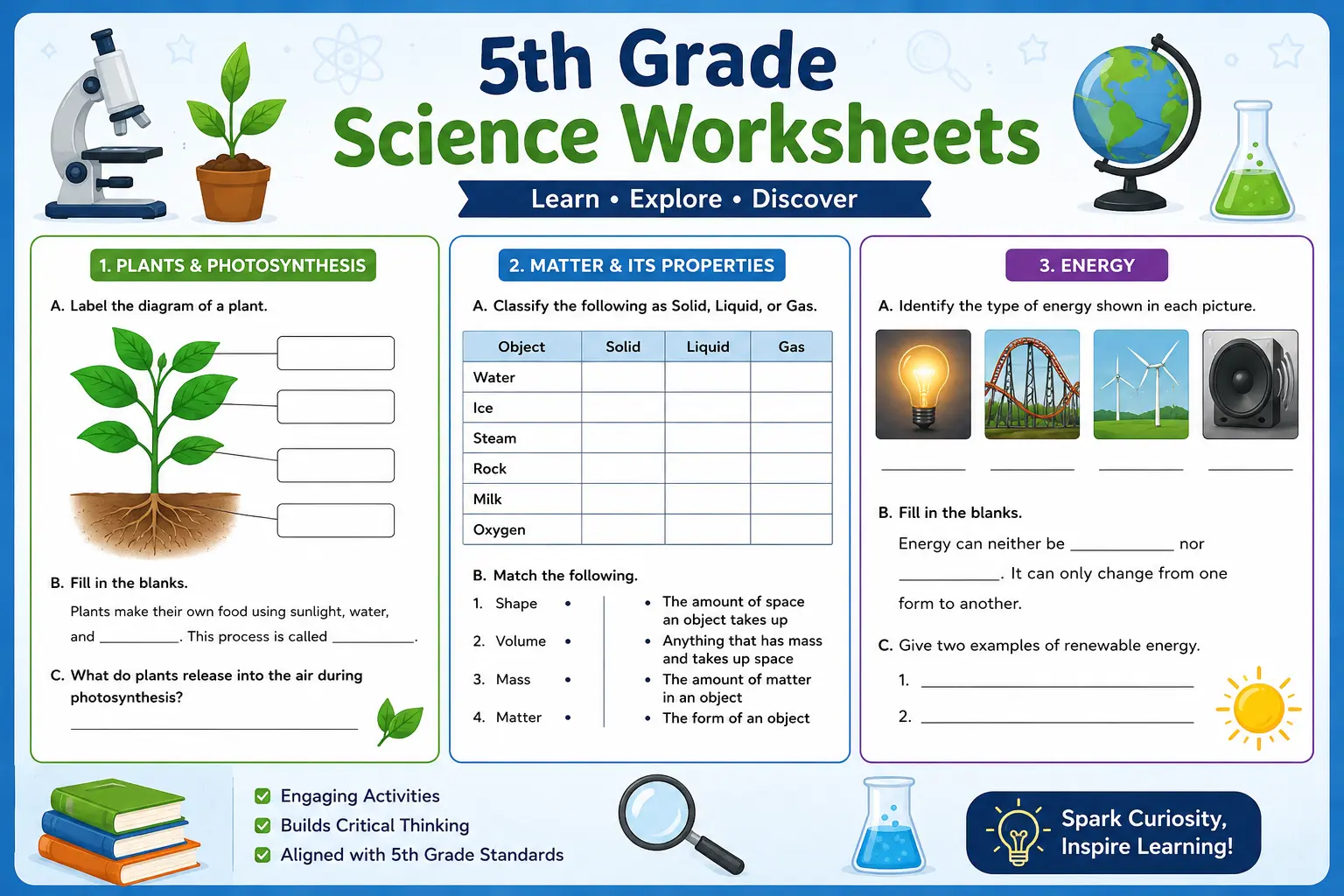
- Photosynthesis
- Human body systems
- Classification of organisms
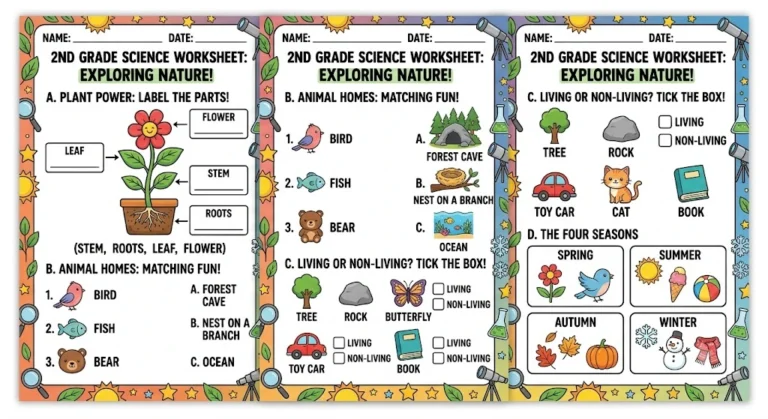
Many worksheets include diagrams to label, matching exercises, and short-answer questions that encourage critical thinking rather than simple memorization.
2. Earth Science Worksheets
Earth science helps children understand the planet they live on.
Common worksheet activities cover:
- Weather patterns
- Climate vs. weather
- Rocks and minerals
- Soil layers
- Volcanoes
- Earthquakes
- Water cycle
- Natural resources
Students often enjoy coloring diagrams or sequencing events like the water cycle. It makes abstract concepts much easier to remember.
3. Space Science Worksheets
Few science topics capture children’s imagination quite like space.
Great 5th grade science worksheets on astronomy often include:
- The solar system
- Moon phases
- Planets
- Stars
- Galaxies
- Gravity
- Space exploration
Some worksheets even include fun puzzles, crosswords, and planet fact sheets that combine learning with entertainment.
4. Physical Science Worksheets
Physical science introduces students to matter, energy, and forces.
These worksheets typically focus on:
- States of matter
- Physical and chemical changes
- Magnetism
- Electricity
- Heat transfer
- Sound waves
- Light energy
- Motion and force
Hands-on experiments paired with printable worksheets often create the strongest learning experience.
Kids complete the activity first…
Then record observations on the worksheet.
Simple. Effective.
5. Scientific Method Practice Worksheets
One of the most important skills students learn in elementary science is how scientists solve problems.
Scientific method worksheets teach children to:
- Ask questions
- Form hypotheses
- Conduct experiments
- Collect data
- Analyze results
- Draw conclusions
These activities encourage logical thinking that extends far beyond science class.
6. Vocabulary and Science Terms Worksheets
Science introduces many new words every year.
Vocabulary worksheets help students understand terms such as:
- Habitat
- Organism
- Condensation
- Evaporation
- Mixture
- Solution
- Energy
- Ecosystem
- Producer
- Consumer
Instead of simply memorizing definitions, students use the words in context through matching activities, fill-in-the-blanks, and sentence completion exercises.
That makes a huge difference over time.
7. Reading Comprehension Science Worksheets
Science isn’t only about experiments.
Students also need to read informational texts carefully.
Reading comprehension worksheets combine short science passages with questions about:
- Main idea
- Supporting details
- Cause and effect
- Comparing information
- Drawing conclusions
- Using evidence
This strengthens both literacy and scientific understanding at the same time.
A nice bonus, really.
8. Experiment Observation Worksheets
Many classrooms include simple science experiments.
Observation worksheets allow students to record:
- Materials
- Predictions
- Observations
- Measurements
- Results
- Final conclusions
These worksheets help children think like young scientists instead of simply following directions.
9. Review and Test Prep Worksheets
As exams approach, review worksheets become incredibly useful.
They usually combine multiple science topics into one printable resource.
Examples include:
- Mixed-topic quizzes
- Multiple-choice practice
- Diagram labeling
- True or false questions
- Short-answer reviews
- Vocabulary checks
Teachers appreciate these because they quickly identify learning gaps before assessments.
10. Fun Science Activity Worksheets
Not every worksheet needs to feel academic.
Some of the most engaging activities include:
- Science word searches
- Crosswords
- Mazes
- Matching games
- Picture labeling
- Hidden word puzzles
- Science coloring pages
- Logic challenges
These lighter activities still reinforce key concepts while giving students a break from traditional assignments.
Sometimes learning happens best when children don’t even realize they’re studying.
How Parents Can Use 5th Grade Science Worksheets at Home
Parents don’t need to recreate an entire classroom.
Just 20 to 30 minutes a few times each week can make a noticeable difference.
Try these simple ideas:
- Complete one worksheet after reading a science book.
- Pair worksheets with short educational videos.
- Visit a museum and complete related activities afterward.
- Encourage children to explain their answers aloud.
- Review incorrect answers together instead of simply marking them wrong.
- Celebrate progress with positive feedback.
Consistency matters far more than long study sessions.
Tips for Teachers
Teachers can get even more value from 5th grade science worksheets by mixing different activity types throughout the week.
For example:
- Monday: Vocabulary review
- Tuesday: Reading comprehension
- Wednesday: Experiment worksheet
- Thursday: Diagram labeling
- Friday: Quiz or science game
This variety keeps students engaged and supports different learning styles.
And yes… it helps reduce worksheet fatigue, too.
What Makes a Great Science Worksheet?
Not every printable is equally helpful.
The best worksheets usually include:
- Clear instructions
- Age-appropriate language
- Attractive visuals
- Real-world examples
- Interactive questions
- Critical thinking tasks
- Answer keys for easy review
- Balanced difficulty levels
A worksheet shouldn’t overwhelm students.
It should challenge them just enough to encourage growth.
Benefits Beyond Science
One surprising advantage of science worksheets is that they strengthen many other academic skills.
Students improve:
- Reading comprehension
- Writing skills
- Logical reasoning
- Data interpretation
- Graph reading
- Problem-solving
- Organization
- Attention to detail
Those are skills they’ll continue using throughout middle school… and beyond.
Final Thoughts
The best 5th grade science worksheets do much more than fill class time. They encourage curiosity, strengthen understanding, and help students build confidence with every completed activity.
Whether the lesson focuses on ecosystems, electricity, weather, or the solar system, quality worksheets transform challenging concepts into manageable, enjoyable learning experiences. Mix review pages with hands-on experiments, vocabulary practice, reading passages, and interactive games to keep learning fresh and engaging.
Science is all about asking questions and exploring the world. With thoughtfully designed worksheets, fifth graders can practice those skills every day—one activity, one discovery, and one exciting lesson at a time.