2nd Grade English Worksheets: 10 Fun Ways to Build Reading and Writing Skills
Second grade is an exciting stage in every child’s learning journey. This is the year when children move beyond simple reading and begin understanding stories, writing complete sentences, improving vocabulary, and using grammar with greater confidence. It’s a big leap. And honestly… practice makes all the difference.
That’s where 2nd grade English worksheets become incredibly useful. They provide structured learning without making children feel overwhelmed. Whether you’re a parent helping with homework, a teacher planning classroom activities, or a homeschool educator, the right worksheets can make daily learning much more enjoyable.
In this guide, you’ll discover the best types of second-grade English worksheets, why they matter, and how to use them effectively to support long-term language development.
Why 2nd Grade English Worksheets Matter
By second grade, children are expected to read longer passages, understand story details, spell more challenging words, and write organized sentences.
Worksheets help reinforce these essential skills because they offer repeated practice in a simple, engaging format.
Some of the biggest benefits include:
- Strengthening reading comprehension
- Building vocabulary naturally
- Improving grammar and punctuation
- Developing sentence-writing confidence
- Supporting independent learning
- Preparing students for classroom assessments
And perhaps the biggest advantage? Kids can practice at their own pace.
1. Reading Comprehension Worksheets
Reading comprehension forms the foundation of every English lesson.
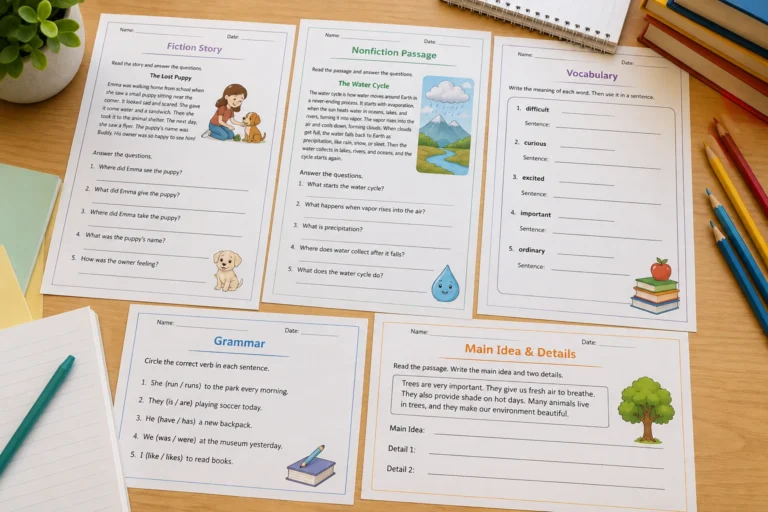
These worksheets typically include short stories, informational passages, poems, or simple articles followed by questions that encourage students to think about what they’ve read.
Students learn how to:
- Identify the main idea
- Find supporting details
- Understand character actions
- Make predictions
- Answer “who,” “what,” “when,” “where,” and “why” questions
Over time, these activities improve both reading fluency and critical thinking.
2. Vocabulary Building Worksheets
A strong vocabulary helps children become better readers and writers.
Vocabulary worksheets introduce new words through fun activities rather than simple memorization.
Common exercises include:
- Matching words with meanings
- Picture vocabulary
- Fill-in-the-blank activities
- Word searches
- Synonyms and antonyms
- Context clue exercises
Kids often remember words much better when they actually use them in sentences.
3. Grammar Practice Worksheets
Grammar doesn’t have to feel boring.
Good 2nd grade English worksheets introduce grammar through colorful examples and interactive activities that make learning easier.
Popular grammar topics include:
- Nouns
- Verbs
- Adjectives
- Pronouns
- Articles
- Capitalization
- Punctuation
- Singular and plural nouns
Instead of memorizing rules, children practice them repeatedly until they become natural.
4. Sentence Writing Worksheets
Writing complete sentences is one of the biggest goals during second grade.
Sentence-building worksheets encourage students to organize their thoughts while improving grammar at the same time.
Activities often include:
- Rearranging mixed-up words
- Completing unfinished sentences
- Expanding simple sentences
- Writing descriptive sentences
- Using picture prompts
These exercises gradually prepare students for paragraph writing in later grades.
And yes… confidence grows with every completed worksheet.
5. Phonics and Spelling Worksheets
Even confident readers continue learning spelling patterns during second grade.
Phonics worksheets reinforce letter combinations, word families, blends, and vowel sounds while improving pronunciation and spelling accuracy.
Students commonly practice:
- Long vowels
- Short vowels
- Silent letters
- Digraphs
- Prefixes
- Suffixes
- Compound words
The repetition may seem simple, but it’s incredibly effective.
6. Parts of Speech Activities
Understanding parts of speech helps children communicate more clearly.
These worksheets teach students how different words function within sentences.
Lessons often cover:
- Naming nouns
- Identifying action verbs
- Choosing adjectives
- Recognizing pronouns
- Finding adverbs
Many worksheets include games, matching exercises, and sentence sorting activities that keep learning interesting.
Kids usually don’t even realize they’re studying grammar.
7. Punctuation and Capitalization Practice
Small writing mistakes can change the meaning of a sentence.
That’s why punctuation worksheets are so valuable during second grade.
Students practice using:
- Periods
- Question marks
- Exclamation points
- Commas
- Capital letters
- Proper nouns
Repeated editing exercises teach children to proofread their own work—a skill they’ll use for years.
8. Creative Writing Worksheets
Creative writing encourages imagination while improving language skills.
Rather than focusing only on grammar, these worksheets inspire children to express ideas creatively.
Popular prompts include:
- Finish the story
- Describe your favorite animal
- Write about your dream vacation
- Create a superhero
- Imagine a magical school
Some children write only a few sentences at first.
And that’s perfectly okay.
Consistency matters far more than length.
9. Alphabetical Order and Dictionary Skills
Second graders begin learning how to organize information alphabetically.
Worksheets help students practice:
- ABC order
- Guide words
- Using simple dictionaries
- Finding word meanings
- Basic reference skills
These activities improve both vocabulary and independent research abilities.
They’re simple lessons that become incredibly useful later in school.
10. Fun Mixed Review Worksheets
Sometimes the best worksheets combine several English skills into one activity.
Mixed review pages often include:
- Reading
- Vocabulary
- Grammar
- Writing
- Spelling
- Critical thinking
This variety keeps learning fresh while reinforcing previously learned concepts.
Children stay engaged because every section feels a little different.
Tips for Using 2nd Grade English Worksheets Effectively
Even the best worksheet works better with a little planning.
Here are a few helpful ideas:
- Practice for 15–20 minutes daily.
- Mix reading, grammar, and writing activities.
- Praise effort instead of perfection.
- Read instructions together when needed.
- Encourage children to explain their answers.
- Review mistakes without criticism.
- Make learning part of a regular routine.
A little practice every day often produces better results than long study sessions once a week.
What Makes a Great English Worksheet?
Not every worksheet offers the same value.
High-quality 2nd grade English worksheets should include:
- Age-appropriate vocabulary
- Clear instructions
- Engaging illustrations
- Progressive difficulty
- Real-life examples
- Space for independent writing
- A balance between fun and learning
Worksheets should challenge students—but not frustrate them.
Finding that balance is important.
Printable vs. Digital Worksheets
Today’s learners often use both printed and online resources.
Printable worksheets are excellent because they:
- Reduce screen time
- Improve handwriting
- Allow highlighting and coloring
- Encourage focused learning
Digital worksheets offer benefits too:
- Interactive activities
- Instant feedback
- Easy access from anywhere
- Convenient for remote learning
Many parents combine both formats depending on the day’s schedule.
It works surprisingly well.
Final Thoughts
Choosing the right 2nd grade English worksheets can make learning more enjoyable while helping children develop stronger reading, writing, grammar, and vocabulary skills.
The best worksheets don’t simply fill time—they build confidence one activity at a time. Whether students are practicing sentence structure, improving spelling, or reading short stories, every completed page adds another layer of understanding.
Keep lessons short, celebrate progress, and remember that every child learns differently. Some skills develop quickly, while others take extra practice. That’s completely normal.
With consistent use of engaging worksheets and positive encouragement, second graders can develop the English skills they need to succeed both inside and outside the classroom.