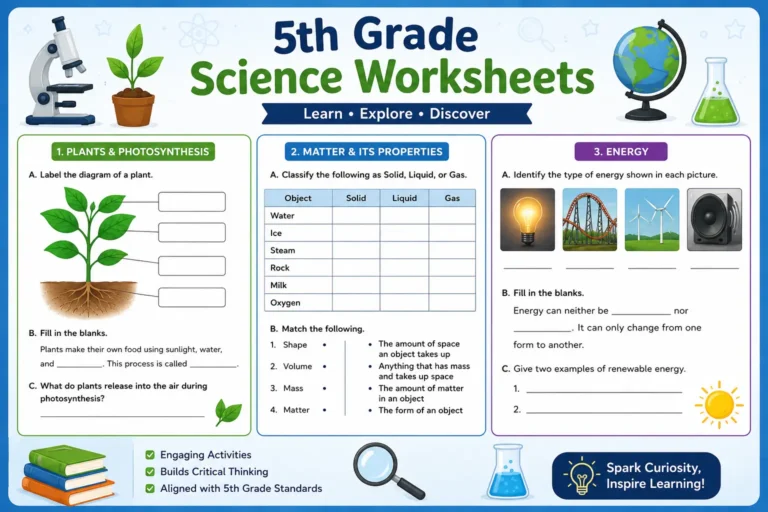
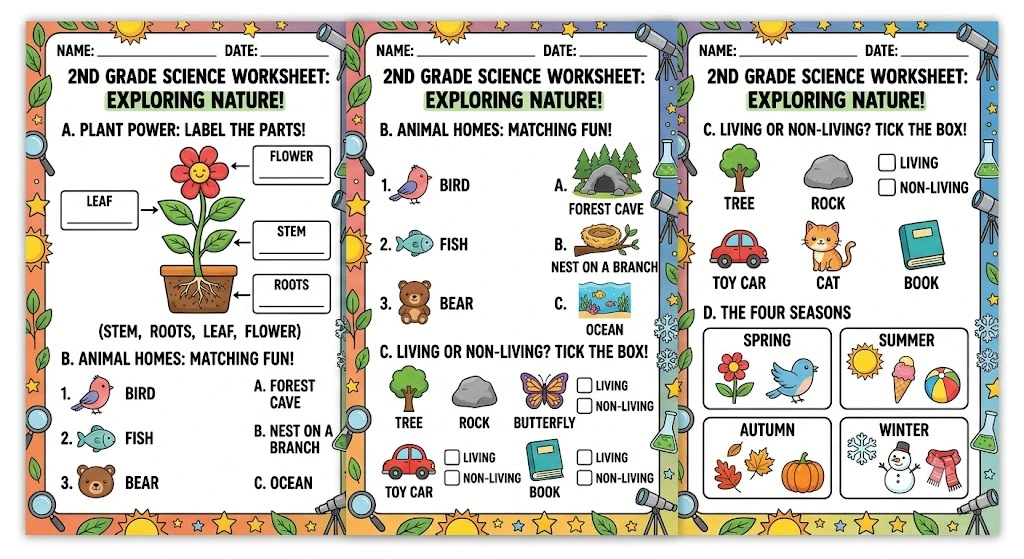
2nd Grade Science Worksheets: 10 Fun Ways to Make Science Exciting for Young Learners
Science becomes much more exciting when children can see, touch, and explore the world around them. That’s exactly why 2nd grade science worksheets remain one of the most useful learning tools for parents, teachers, and homeschool families. They turn simple lessons into engaging activities while helping children build confidence in science.
At this stage, second graders are naturally curious. They ask questions about animals, plants, weather, space, and how everyday things work. And honestly… that’s the perfect time to nurture their curiosity. A well-designed worksheet doesn’t just test knowledge. It encourages observation, critical thinking, and problem-solving in a fun, low-pressure way.
Whether you’re looking for classroom resources or extra practice at home, this guide covers everything you need to know about using 2nd grade science worksheets effectively.
Why 2nd Grade Science Worksheets Matter
Second grade is when children begin connecting scientific ideas to real life. Instead of memorizing facts, they start asking “why” and “how.”
Worksheets support this learning by helping students:
- Practice observation skills
- Improve reading comprehension
- Learn scientific vocabulary
- Strengthen logical thinking
- Build confidence through independent work
And here’s something many parents notice… children often enjoy worksheets more when they’re colorful, interactive, and connected to everyday experiences.
Rather than feeling like homework, the activities become mini adventures.
1. Life Science Worksheets
Life science introduces children to the living world around them.
Popular worksheet topics include:
- Plant life cycles
- Animal habitats
- Living vs. nonliving things
- Parts of plants
- Insects and bugs
- Food chains
- Human body basics
These activities encourage children to observe nature and recognize patterns.
For example, a worksheet asking students to label the parts of a flower can become much more meaningful after spending five minutes looking at real flowers outside.
Small connections like that make learning stick.
2. Earth Science Worksheets
Children are naturally fascinated by weather and the planet they live on.
Earth science worksheets often cover:
- Weather patterns
- Seasons
- Clouds
- Rocks and minerals
- Landforms
- Water cycle
- Recycling
- Natural resources
Many worksheets also include weather journals where students record daily temperatures, sunshine, rainfall, or cloud types.
It doesn’t sound complicated. But those simple observations build scientific habits that last for years.
3. Physical Science Worksheets
Physical science helps children understand how objects move and interact.
Common worksheet topics include:
- Pushes and pulls
- Magnets
- Light
- Shadows
- Sound
- Heat
- Matter
- Simple machines
These worksheets often include prediction questions before experiments.
For example:
“What do you think will happen if you place a magnet near a paper clip?”
Children love making guesses. Sometimes they’re right. Sometimes not. Either way, they’re learning.
4. Animal Classification Activities
Kids rarely get tired of learning about animals.
That’s why animal worksheets remain among the most downloaded 2nd grade science worksheets available online.
Students may learn to identify:
- Mammals
- Birds
- Fish
- Reptiles
- Amphibians
- Insects
Sorting games, matching exercises, and coloring pages make these lessons much more enjoyable than reading a textbook alone.
And yes… many children remember facts better when they’re paired with fun illustrations.
5. Plant Growth Worksheets
Watching a seed become a plant feels almost magical to young learners.
Plant worksheets often include:
- Seed germination
- Plant needs
- Photosynthesis (basic introduction)
- Flower parts
- Plant life cycles
- Plant observations
Teachers frequently combine worksheets with classroom planting projects.
Students can track daily growth, measure plant height, and draw changes over time.
That mix of science and creativity works really well.
6. Space Science Worksheets
Space always captures children’s imagination.
Second-grade worksheets usually introduce:
- The Sun
- The Moon
- Planets
- Stars
- Day and night
- Solar system basics
- Space vocabulary
Many worksheets include puzzles, coloring pages, and planet matching activities.
Children begin recognizing Earth’s place in the solar system without feeling overwhelmed by complex astronomy concepts.
Sometimes one worksheet about planets sparks an interest that lasts for years.
7. Science Vocabulary Practice
Science introduces many new words.
Worksheets help children understand terms like:
- Habitat
- Observe
- Predict
- Experiment
- Energy
- Weather
- Temperature
- Organism
Vocabulary exercises often include:
- Crossword puzzles
- Word searches
- Matching definitions
- Fill-in-the-blank activities
- Picture labeling
The more often children use scientific language, the more comfortable they become discussing scientific ideas.
8. Observation and Experiment Worksheets
Science isn’t just about reading facts.
It’s about asking questions.
Observation worksheets encourage students to:
- Make predictions
- Record results
- Compare objects
- Measure changes
- Draw conclusions
Even simple classroom experiments become more meaningful when students write down what they notice.
For example:
- Which object floats?
- Which melts faster?
- Which plant grew taller?
They’re learning the scientific method without even realizing it.
9. Seasonal Science Worksheets
Seasonal activities keep science fresh throughout the school year.
Popular themes include:
Spring
- Plant growth
- Rain
- Butterflies
- Flowers
Summer
- Sun safety
- Ocean animals
- Insects
- Weather
Fall
- Leaves
- Pumpkins
- Animal migration
- Harvest
Winter
- Snow
- Ice
- Hibernation
- Arctic animals
These seasonal worksheets help children connect science lessons with what they actually see outdoors.
And that’s a powerful learning experience.
10. Interactive Printable Science Worksheets
Today’s printable worksheets are much more engaging than older black-and-white pages.
Many now feature:
- Coloring sections
- Cut-and-paste activities
- Matching games
- Mazes
- Picture sorting
- Science journals
- Mini quizzes
- STEM challenges
Some even encourage children to complete small hands-on experiments before answering questions.
That combination keeps students active instead of simply filling in blanks.
Tips for Using 2nd Grade Science Worksheets Effectively
A worksheet should support learning—not replace exploration.
Here are a few ways to make them more effective:
- Pair worksheets with outdoor observations.
- Ask open-ended questions during activities.
- Encourage children to explain their answers.
- Celebrate effort rather than perfection.
- Use colorful pencils or markers to increase engagement.
- Mix worksheets with simple science experiments.
- Keep sessions short to maintain focus.
Children remember experiences much longer than lectures.
That’s worth remembering.
Choosing High-Quality 2nd Grade Science Worksheets
Not every worksheet is equally helpful.
Look for resources that include:
- Age-appropriate language
- Clear illustrations
- Accurate scientific information
- Interactive activities
- Critical thinking questions
- Hands-on learning suggestions
- Printable formats
- Answer keys for parents and teachers
The best worksheets encourage curiosity instead of simple memorization.
After all, science begins with asking questions.
Final Thoughts
The best 2nd grade science worksheets do far more than provide extra practice. They inspire curiosity, encourage observation, and help children see science everywhere—from the clouds overhead to the plants growing in the backyard.
Whether you’re teaching in a classroom or supporting learning at home, choosing engaging, age-appropriate worksheets can make science feel exciting instead of intimidating. Mix printable activities with hands-on experiments, outdoor exploration, and everyday conversations about the natural world. Those little moments matter… perhaps even more than a perfect score on a worksheet.
Keep learning playful, encourage questions, and let children explore at their own pace. When curiosity leads the way, science becomes an adventure they’ll remember long after second grade ends.