5th Grade Volume Worksheets: 10 Fun Ways to Help Kids Master Volume
If you’re searching for 5th grade volume worksheets, you’re probably looking for something that makes math feel a little less intimidating. And honestly… that’s exactly what good worksheets should do.
Volume is one of those topics that seems tricky at first. Students suddenly move from measuring flat shapes to calculating the space inside three-dimensional objects. Cubes, rectangular prisms, composite figures—it can feel like a lot. But with the right practice, everything starts to click.
The best worksheets don’t just ask students to memorize formulas. They encourage kids to visualize shapes, solve real-life problems, and build confidence one question at a time.
Let’s explore why 5th grade volume worksheets are so effective and what makes them worth adding to every student’s learning routine.
Why Volume Is an Important 5th Grade Math Skill
By fifth grade, students have already learned about area and perimeter. Volume is the next logical step.
Instead of measuring a flat surface, they’re learning how much space a three-dimensional object can hold.
This concept appears throughout later math classes, including:
- Geometry
- Measurement
- Engineering basics
- Architecture
- Science experiments
- Everyday problem-solving
Once students understand volume, they’re better prepared for middle school math—and beyond.
What Students Learn in 5th Grade Volume
Most fifth-grade math standards introduce volume using rectangular prisms.
Students typically learn to:
- Understand what volume represents
- Count unit cubes
- Measure objects using cubic units
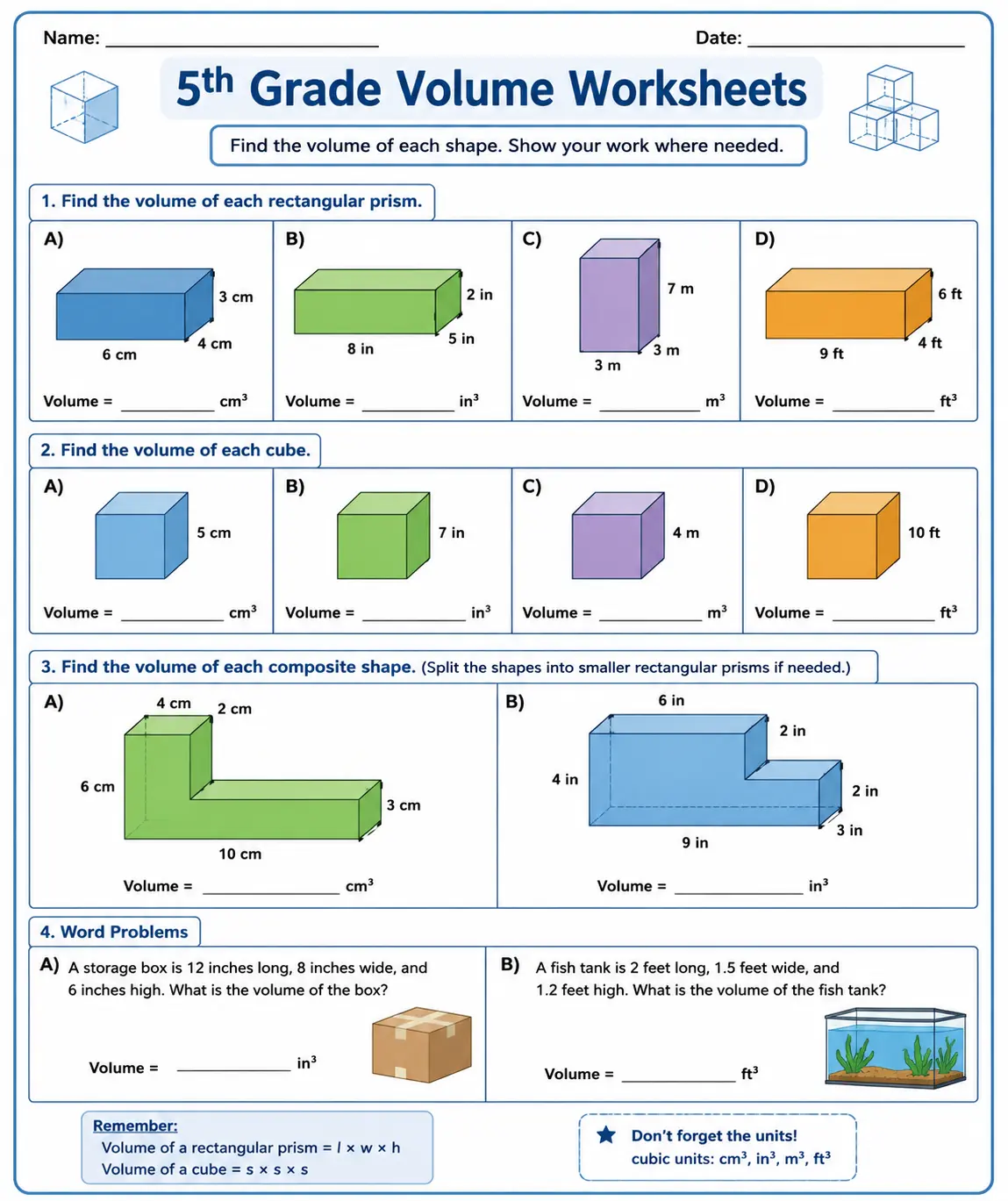
- Use the formula:
Volume = Length × Width × Height
or
V = l × w × h
Later, they begin solving missing measurements and multi-step word problems.
At first, that formula can seem abstract.
But after enough worksheet practice… it becomes second nature.
1. Build Formula Confidence
One major benefit of 5th grade volume worksheets is repeated exposure to the volume formula.
Students practice problems like:
- Length = 6
- Width = 4
- Height = 3
They calculate:
6 × 4 × 3 = 72 cubic units
Simple.
After solving several examples, kids stop guessing and start recognizing patterns naturally.
2. Understand Unit Cubes
Before introducing formulas, many worksheets use pictures of stacked cubes.
This visual approach helps students understand that:
Volume measures how many cubes fit inside an object.
Instead of memorizing numbers, children actually “see” why multiplication works.
That’s a huge difference.
Visual learning creates stronger long-term understanding.
3. Practice Real-Life Word Problems
Good worksheets don’t stay stuck on basic equations.
They introduce practical situations like:
- Filling a fish tank
- Packing moving boxes
- Building toy storage bins
- Designing garden beds
- Organizing shipping containers
These examples answer the common question:
“When will I ever use this?”
Turns out…
Quite often.
4. Improve Multiplication Skills
Volume calculations depend heavily on multiplication.
Every worksheet becomes extra multiplication practice without feeling repetitive.
Students strengthen facts while solving meaningful problems.
It’s almost like getting two math lessons in one.
5. Strengthen Spatial Thinking
Volume isn’t only about numbers.
It’s about imagining objects in three dimensions.
Children learn to visualize:
- Height
- Width
- Depth
- Interior space
These spatial reasoning skills later help with:
- Geometry
- Engineering
- Design
- Robotics
- Computer graphics
Even puzzle solving becomes easier.
6. Prepare for Standardized Tests
Many state assessments include measurement and geometry questions involving volume.
Students who regularly complete 5th grade volume worksheets become familiar with:
- Formula questions
- Word problems
- Missing dimensions
- Multiple-choice formats
- Multi-step reasoning
Less surprise means less test anxiety.
Confidence matters.
7. Encourage Independent Learning
One great thing about worksheets?
Kids can complete many of them on their own.
Parents don’t always need to explain every question.
Many printable worksheets include:
- Step-by-step examples
- Visual hints
- Answer keys
- Mixed difficulty levels
Students gradually become independent learners.
And that’s a skill worth developing.
8. Make Homework Less Stressful
Homework battles happen.
Especially when math feels confusing.
Volume worksheets usually break concepts into manageable chunks instead of overwhelming students with large assignments.
For example:
Section One:
Find the volume.
Section Two:
Solve word problems.
Section Three:
Challenge questions.
Small victories build motivation.
Before long, kids start saying,
“I actually get this.”
9. Offer Different Difficulty Levels
Not every fifth grader learns at the same pace.
That’s why quality 5th grade volume worksheets come in multiple levels.
Beginner Worksheets
These focus on:
- Counting cubes
- Basic multiplication
- Simple rectangular prisms
Intermediate Worksheets
Students solve:
- Formula practice
- Missing measurements
- Mixed review problems
Advanced Worksheets
These often include:
- Composite figures
- Multi-step reasoning
- Higher-level word problems
- Critical thinking exercises
This flexibility helps teachers meet every student’s needs.
10. Keep Learning Fun
Worksheets don’t have to feel boring.
Many modern printable activities include:
- Coloring sections
- Mazes
- Mystery pictures
- Matching games
- Cut-and-paste activities
- Escape room challenges
- Math puzzles
Kids often don’t even realize how much practice they’re getting.
And that’s kind of the goal.
Tips for Using 5th Grade Volume Worksheets
A few simple strategies can improve learning dramatically.
Start With Visual Models
Always begin with pictures before introducing formulas.
Visual understanding comes first.
Practice a Little Every Day
Ten or fifteen minutes daily works better than one long study session.
Consistency wins.
Encourage Students to Explain Their Thinking
Ask questions like:
- Why did you multiply these numbers?
- What does this answer represent?
- Could there be another way?
Talking through math improves understanding.
Use Real Objects
Grab a tissue box.
A cereal box.
A toy storage container.
Measure them together and calculate their volume.
Learning suddenly becomes real.
Common Mistakes Students Make
Knowing common errors helps prevent frustration.
Some frequent mistakes include:
- Forgetting one dimension
- Mixing up area and volume
- Using square units instead of cubic units
- Incorrect multiplication
- Ignoring measurement labels
Fortunately, repeated worksheet practice fixes these issues surprisingly fast.
What Makes a Great Volume Worksheet?
Not every worksheet offers the same quality.
Look for resources that include:
- Clear instructions
- Large diagrams
- Progressive difficulty
- Word problems
- Answer keys
- Real-life applications
- Mixed review questions
- Printable formats
The best worksheets balance challenge with encouragement.
Students should feel successful—but still think a little.
Benefits for Parents and Teachers
Parents appreciate worksheets because they’re easy to print and simple to use at home.
Teachers love them because they:
- Reinforce classroom lessons
- Support homework
- Provide quick assessments
- Help with small-group instruction
- Offer independent practice
- Prepare students for quizzes
Everyone wins.
Especially the students.
Final Thoughts
Learning volume doesn’t have to feel overwhelming. With the right 5th grade volume worksheets, students gradually build understanding through visuals, hands-on practice, and real-world problem-solving. They learn to apply formulas with confidence, strengthen multiplication skills, and develop the spatial reasoning they’ll rely on in future math classes.
The key is steady practice rather than rushing through dozens of problems at once. A few well-designed worksheets completed regularly can make a noticeable difference. Over time, what once seemed confusing starts to feel familiar—and even enjoyable. Whether you’re a parent helping with homework, a teacher planning lessons, or a student eager to improve, quality volume worksheets are a simple yet powerful way to make fifth-grade math both meaningful and rewarding.