3rd Grade Multiplication Worksheets: 10 Fun Ways to Help Kids
Learning multiplication is one of the biggest milestones in third grade. It’s the point where simple addition starts turning into something much more exciting—and yes, sometimes a little challenging too.
That’s exactly why 3rd grade multiplication worksheets have become one of the most useful learning tools for parents, teachers, and homeschool families. They give children the repetition they need without making practice feel overwhelming.
The best part? Worksheets don’t have to be boring.
Today’s printable multiplication activities include puzzles, games, coloring pages, word problems, mystery pictures, and real-life challenges that make math feel more like play than homework.
If you’re looking for ways to help a third grader build confidence with multiplication, this guide covers everything you need to know.
Why Multiplication Matters in 3rd Grade
Third grade is where multiplication becomes part of everyday math.
Instead of repeatedly adding numbers together, students begin learning multiplication facts, patterns, and strategies that prepare them for:
- Division
- Fractions
- Area and perimeter
- Multi-digit multiplication
- Algebra later in school
Without a strong multiplication foundation, future math lessons become much harder.
That’s why regular practice—even just 10–15 minutes a day—can make a huge difference.
1. Times Table Practice Worksheets
The classic multiplication worksheet still works incredibly well.
Children practice:
- 2 times table
- 3 times table
- 4 times table
- 5 times table
- 6 times table
- 7 times table
- 8 times table
- 9 times table
- 10 times table
- 11 and 12 times tables
Repeating facts helps move answers from short-term memory into long-term memory.
And honestly…that’s exactly what kids need.
2. Skip Counting Worksheets
Before children memorize multiplication facts, they should understand how multiplication works.
Skip counting worksheets teach patterns like:
- Count by 2s
- Count by 3s
- Count by 4s
- Count by 5s
- Count by 10s
For example:
2, 4, 6, 8, 10…
Kids begin noticing multiplication instead of simply memorizing numbers.
It’s a surprisingly effective strategy.
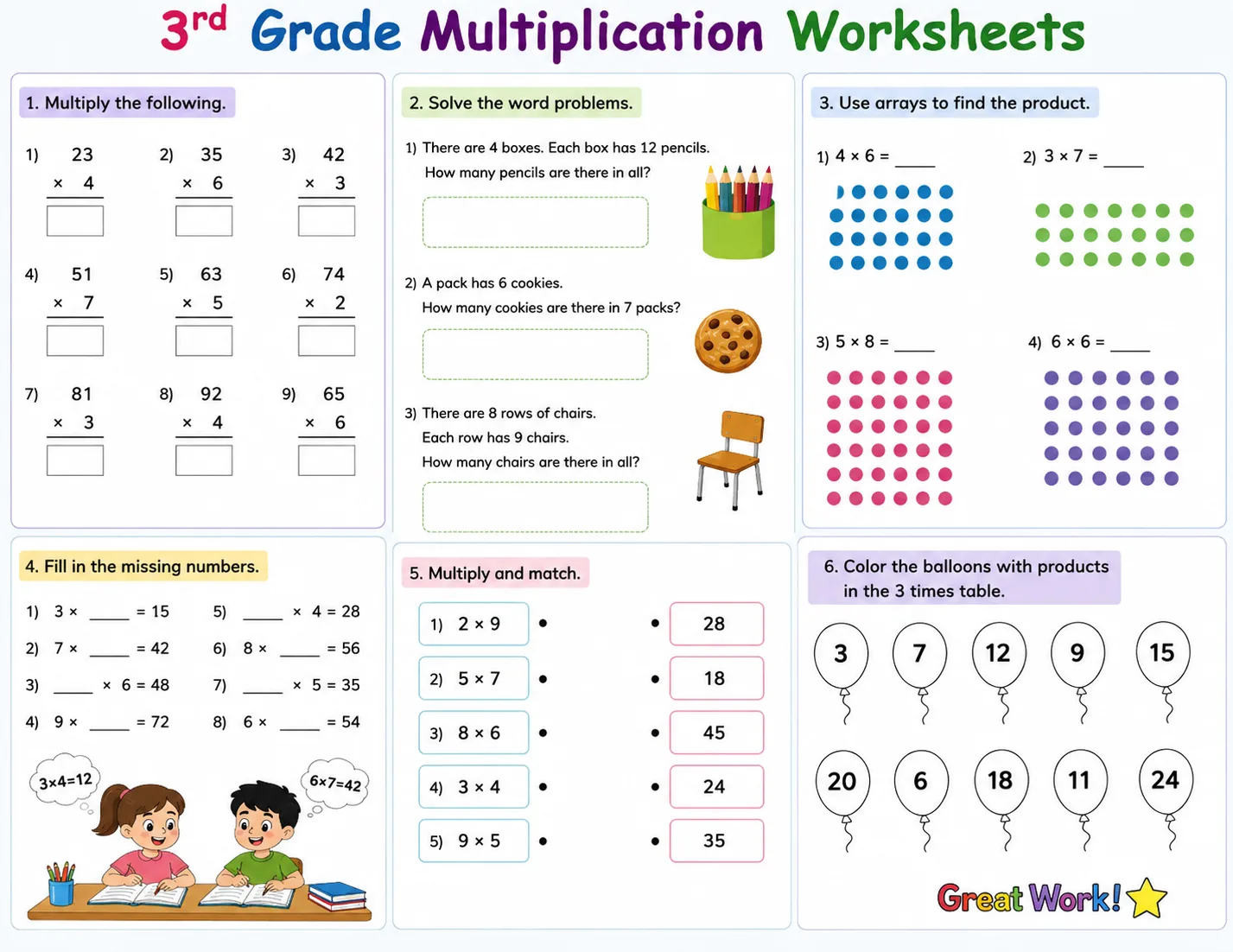
3. Multiplication Arrays
Visual learners love arrays.
Instead of seeing:
4 × 3 = 12
They see:
● ● ●
● ● ●
● ● ●
● ● ●
Now multiplication suddenly makes sense.
Arrays help students understand that multiplication means equal groups—not random numbers.
4. Picture Multiplication Worksheets
Some worksheets replace numbers with pictures.
Example:
🍎🍎🍎
🍎🍎🍎
🍎🍎🍎
How many apples?
Children count rows and columns before writing the multiplication sentence.
Simple.
Fun.
Very effective.
5. Multiplication Coloring Worksheets
Let’s be honest.
Kids enjoy coloring more than filling blank boxes.
Color-by-answer worksheets combine:
- Multiplication facts
- Number recognition
- Coloring activities
Every correct answer reveals part of a hidden picture.
Without realizing it, children solve dozens of multiplication problems while creating artwork.
That’s a win for everyone.
6. Word Problem Worksheets
Real-life examples help multiplication feel useful.
For instance:
Sarah has 5 baskets.
Each basket contains 4 apples.
How many apples does she have altogether?
Instead of memorizing equations, students learn when multiplication should be used.
These worksheets improve:
- Reading comprehension
- Critical thinking
- Problem-solving
- Mathematical reasoning
All at the same time.
7. Missing Number Worksheets
These worksheets encourage logical thinking.
Examples include:
□ × 5 = 20
7 × □ = 56
□ × 8 = 64
Students work backward to find missing numbers.
It strengthens multiplication and prepares children for division concepts later.
8. Multiplication Puzzle Worksheets
Kids naturally enjoy solving puzzles.
Multiplication puzzles include:
- Crosswords
- Number mazes
- Matching games
- Domino multiplication
- Sudoku-style math puzzles
Instead of repetitive drills, students solve challenges while practicing multiplication facts.
And yes—it usually keeps their attention much longer.
9. Timed Multiplication Worksheets
Speed isn’t everything.
Accuracy comes first.
But after children understand multiplication concepts, timed worksheets help improve recall.
Popular formats include:
- 1-minute drills
- 2-minute challenges
- 5-minute multiplication tests
These activities prepare students for classroom quizzes while building confidence.
Just don’t overdo it.
The goal is steady improvement—not stress.
10. Mixed Multiplication Review Worksheets
Eventually children should practice everything together.
Mixed worksheets combine:
- Basic facts
- Word problems
- Arrays
- Missing numbers
- Skip counting
- Multiplication tables
This helps students switch between different thinking strategies instead of relying on memorization alone.
It’s closer to how math works in everyday life.
Benefits of Using 3rd Grade Multiplication Worksheets
Consistent worksheet practice offers several important advantages.
Builds Confidence
Children who practice regularly feel less anxious during math lessons.
Small successes quickly add up.
Improves Memory
Frequent repetition strengthens multiplication fact recall.
Over time, answers become automatic.
Encourages Independent Learning
Many worksheets are designed so children can complete them without constant help.
That independence matters.
Supports Different Learning Styles
Some children learn visually.
Others prefer hands-on practice.
Some need repetition.
Worksheets come in many formats, making it easier to match each child’s learning style.
Makes Homework Easier
When multiplication facts become familiar, homework takes less time and causes less frustration.
Parents appreciate that too.
Tips for Making Worksheet Practice More Fun
Worksheets don’t have to feel like schoolwork.
Try these simple ideas:
- Use colorful pencils or markers.
- Offer small rewards after completing a page.
- Turn practice into a race against yesterday’s score.
- Mix worksheets with educational games.
- Practice together instead of watching from the sidelines.
- Celebrate improvement—not perfection.
Even ten minutes a day can create noticeable progress over a few weeks.
What Should a 3rd Grader Know About Multiplication?
By the end of third grade, most students should be comfortable with:
- Multiplication facts through 10 or 12
- Equal groups
- Arrays
- Repeated addition
- Basic word problems
- Multiplication patterns
- Relationship between multiplication and division
Children don’t need to be perfect.
But they should understand how multiplication works—not just memorize answers.
How Often Should Kids Practice?
A little practice each day usually works better than one long session every weekend.
A simple routine might look like this:
- 5 minutes reviewing multiplication facts
- 10 minutes completing a worksheet
- 5 minutes checking answers together
That’s only about 20 minutes.
And it’s often enough to build strong skills over time.
Choosing the Best 3rd Grade Multiplication Worksheets
Not every worksheet is equally helpful.
Look for worksheets that include:
- Clear instructions
- Large, easy-to-read numbers
- Fun illustrations
- Mixed question types
- Answer keys
- Age-appropriate difficulty
- Gradually increasing challenges
The best worksheets teach understanding first, then speed.
That’s an important difference.
Final Thoughts
Finding high-quality 3rd grade multiplication worksheets can make math practice far more enjoyable for children. Whether you’re a parent helping with homework, a classroom teacher planning lessons, or a homeschool educator building a curriculum, the right worksheets provide structure, repetition, and variety without making learning feel repetitive.
From skip counting and arrays to puzzles, coloring pages, and real-world word problems, every worksheet offers another opportunity for children to strengthen their multiplication skills. Keep practice short, encourage progress, and make learning as engaging as possible. Over time, those daily efforts turn into lasting confidence—and a solid foundation for future math success.