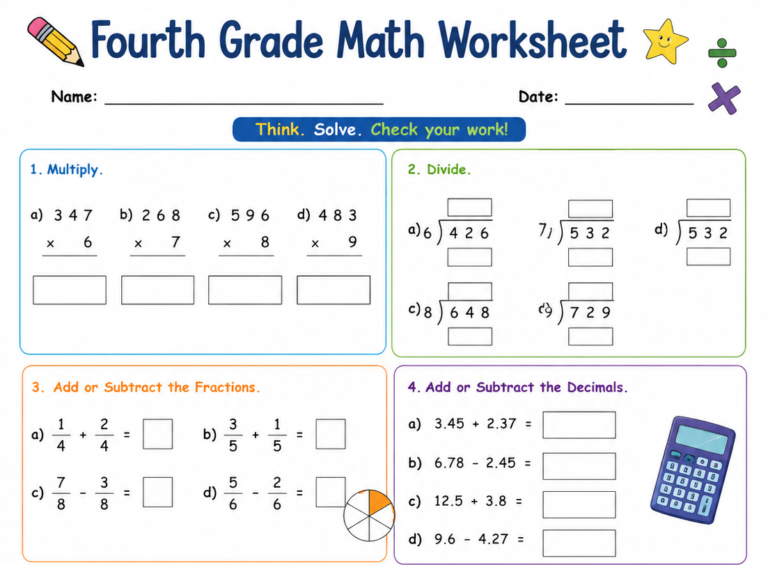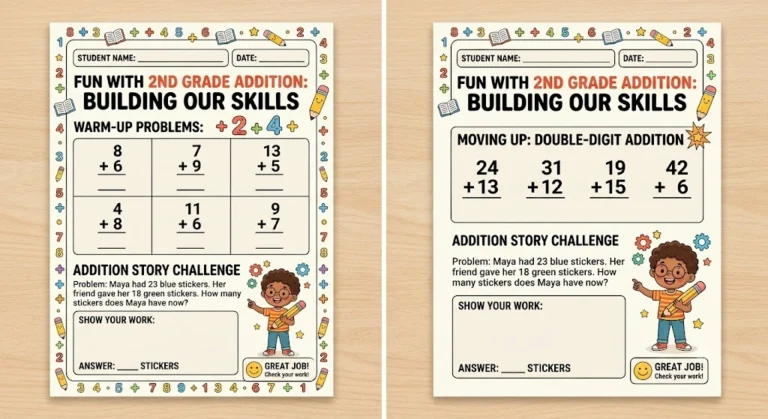
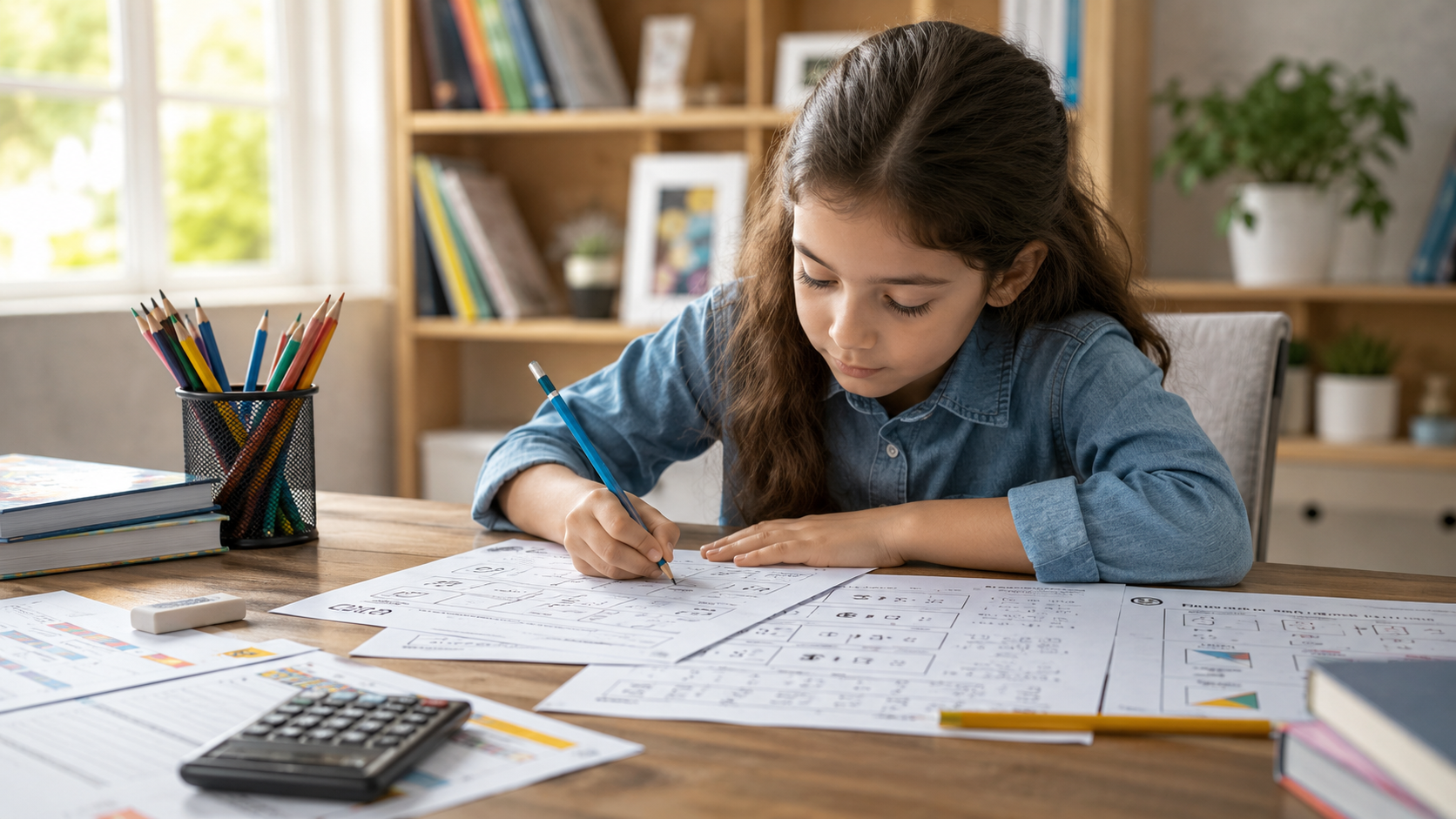
Free 3rd Grade Math Worksheets (Printable PDF) | Updated for 2026
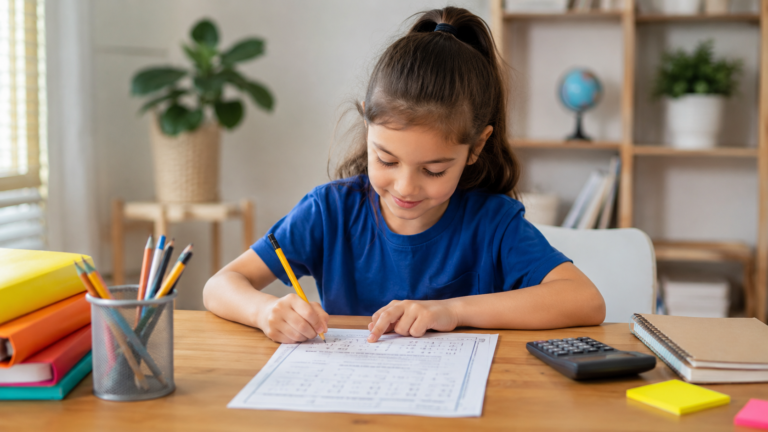
3rd grade math worksheets are one of the easiest ways to help children build confidence in math while practicing important classroom skills. Whether your child is learning at home, completing homework, or preparing for quizzes, printable worksheets provide extra practice in a fun and structured way.
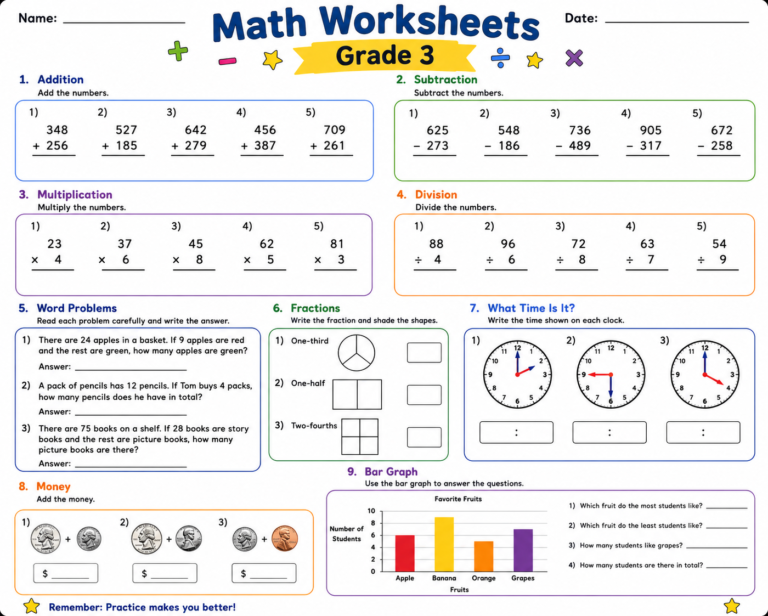
Our collection of free 3rd grade math worksheets covers essential topics like addition, subtraction, multiplication, division, fractions, place value, measurement, geometry, and word problems. Every worksheet is designed to strengthen problem-solving skills while making daily math practice simple for parents, teachers, and students.
Download your favorite worksheets, print them in seconds, and let kids enjoy engaging math practice anytime.
Whether you’re a parent helping with homework, a teacher preparing classroom activities, or a homeschool educator creating lesson plans, this collection of free 3rd grade math worksheets provides structured practice for every major Grade 3 math topic. Most worksheets are printable, easy to understand, and suitable for daily review or test preparation.
Instead of searching through dozens of websites, this guide explains which worksheets children need, when to use them, and how each topic supports long-term math success.
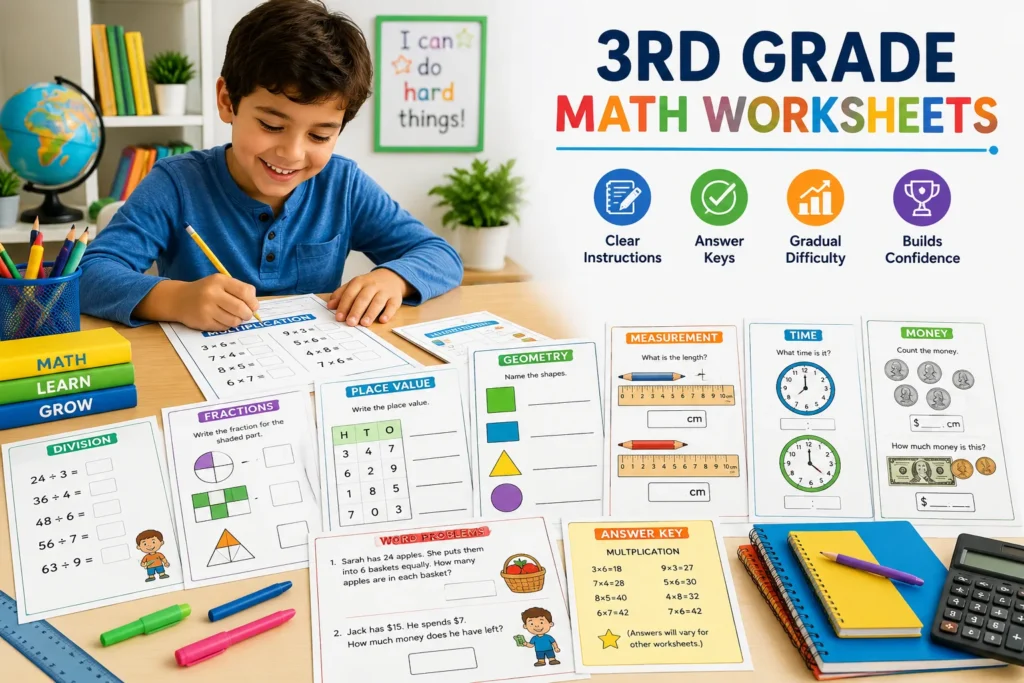
3rd grade math worksheets are printable practice pages that help children strengthen essential Grade 3 math skills, including multiplication, division, fractions, place value, geometry, measurement, time, money, and word problems. The best worksheets include clear instructions, answer keys, and a gradual increase in difficulty so students can build confidence through regular practice
Why Regular Math Practice Matters in 3rd Grade
Third grade is an important stage where students move beyond basic arithmetic and begin solving more challenging math problems. Practicing with worksheets regularly helps children improve accuracy, increase confidence, and understand mathematical concepts more effectively.
These printable worksheets can be used for classroom activities, homework, homeschooling, independent practice, or test preparation. Even 15–20 minutes of daily practice can make a noticeable difference in a student’s performance.
What Are 3rd Grade Math Worksheets?
Third grade is an important stage in elementary mathematics. During this school year, students move beyond simple calculations and begin solving more challenging problems that require logical thinking and problem-solving skills.
3rd grade math worksheets provide structured practice that allows children to review concepts learned in class while improving speed and accuracy. They are commonly used for homework, classroom exercises, homeschooling, tutoring sessions, and summer learning.
Unlike random practice questions found online, high-quality worksheets focus on one skill at a time before combining multiple concepts into mixed review exercises.
Who Should Use These Worksheets?
These worksheets are suitable for:
- Parents supporting learning at home
- Elementary school teachers
- Homeschool families
- Private tutors
- After-school learning centers
- Students preparing for classroom tests
Children who practice consistently often become more confident when solving everyday math problems.
Benefits of Daily Practice
Regular worksheet practice offers many advantages.
- Improves calculation speed
- Strengthens multiplication and division facts
- Builds confidence before classroom tests
- Develops independent learning habits
- Reinforces concepts learned at school
- Helps identify weak areas early
- Encourages consistent study routines
- Makes homework less stressful
Even spending 10 to 15 minutes each day working through printable worksheets can make a noticeable difference over time.
Grade 3 Math Skills Covered
A complete set of grade 3 math worksheets should cover every major topic introduced during the school year.
Addition
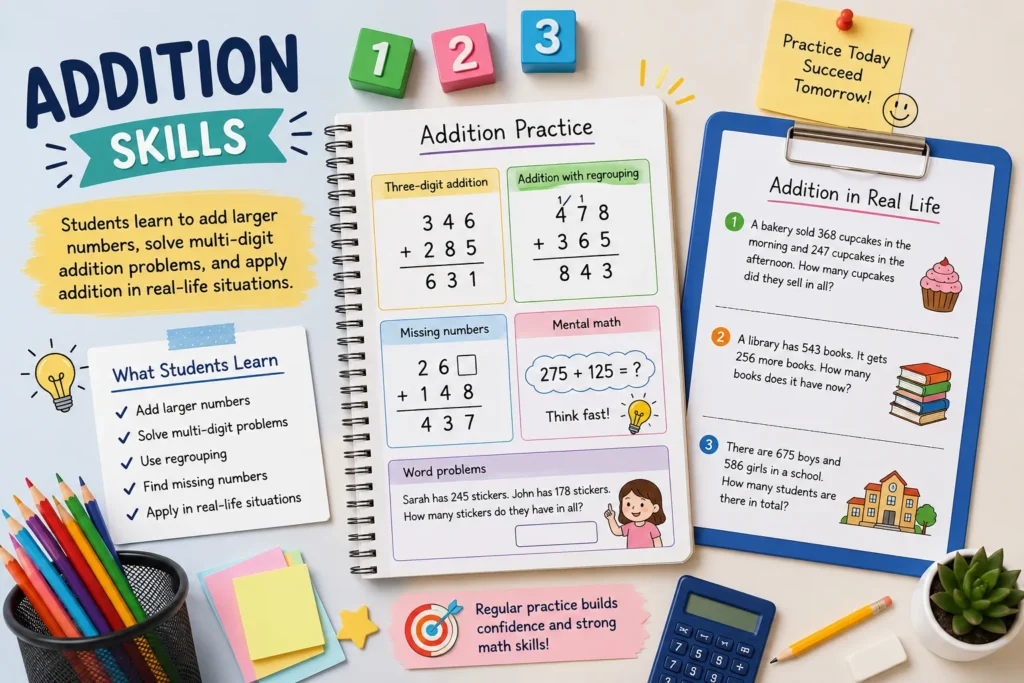
Students learn to add larger numbers, solve multi-digit addition problems, and apply addition in real-life situations.
Typical worksheet activities include:
- Three-digit addition
- Addition with regrouping
- Missing numbers
- Mental math
- Word problems
Subtraction
Third graders continue practicing subtraction while learning to borrow across multiple digits.
Common worksheet topics include:
- Three-digit subtraction
- Regrouping
- Missing numbers
- Mixed addition and subtraction
- Story problems
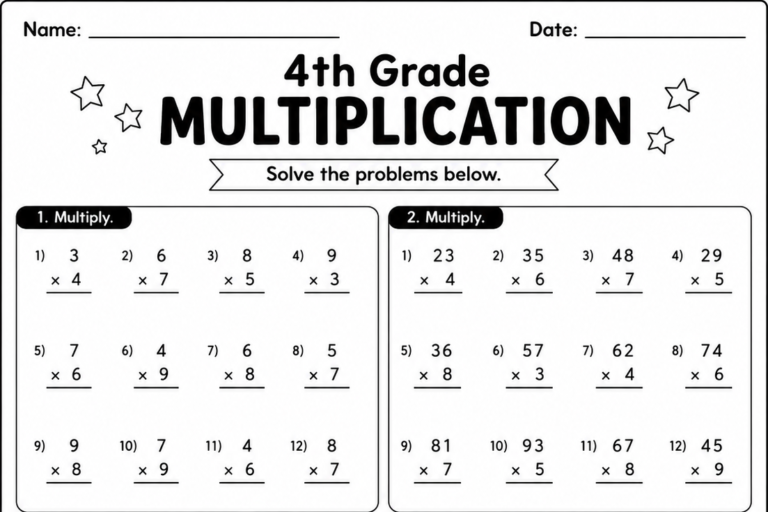
Multiplication
Multiplication becomes one of the biggest learning milestones during Grade 3.
Students practice:
- Multiplication facts
- Arrays
- Equal groups
- Skip counting
- Times tables
- Multiplication word problems
Daily multiplication practice helps children develop speed and confidence.
Division
Division is introduced alongside multiplication.
Worksheets usually include:
- Basic division facts
- Equal sharing
- Grouping
- Missing dividends
- Division word problems
Understanding multiplication first often makes division much easier.
Fractions
Students begin learning basic fractions by identifying equal parts and comparing simple fractions.
Typical worksheets cover:
- Halves
- Thirds
- Fourths
- Equivalent fractions
- Comparing fractions
- Fraction word problems
Place Value
Place value helps students understand how numbers are built.
Worksheets often include:
- Hundreds
- Tens
- Ones
- Expanded form
- Standard form
- Comparing numbers
- Ordering numbers
Strong place value skills support almost every future math topic.
Rounding
Children learn how to round numbers to the nearest ten and hundred.
Practice usually includes:
- Number lines
- Rounding rules
- Real-world examples
- Estimation
Measurement
Measurement worksheets help students work with:
- Length
- Weight
- Capacity
- Temperature
- Metric units
- Customary units
Many worksheets include practical word problems.
Time
Learning to tell time remains an important Grade 3 skill.
Students practice:
- Reading clocks
- Elapsed time
- Calendars
- AM and PM
- Time intervals
Money
Money worksheets teach practical financial skills.
Topics often include:
- Counting coins
- Counting bills
- Making change
- Comparing prices
- Shopping word problems
Geometry
Geometry introduces students to shapes and spatial thinking.
Worksheets typically include:
- 2D shapes
- 3D shapes
- Perimeter
- Area
- Symmetry
- Angles
Graphing
Children learn to read and interpret data.
Activities include:
- Bar graphs
- Picture graphs
- Line plots
- Data tables
Word Problems
Word problems combine multiple skills into real-life situations.
Students learn to:
- Read carefully
- Identify important information
- Choose the correct operation
- Show their work
- Explain answers
These worksheets strengthen both math and reading comprehension.
Free Printable 3rd Grade Math Worksheets by Topic
Choosing worksheets by topic allows students to focus on one skill before moving to the next.
Multiplication Worksheets
These worksheets help children master multiplication facts through repeated practice.
Common activities include:
- Times tables
- Missing factors
- Multiplication puzzles
- Arrays
- Mixed multiplication review
Best for:
- Daily practice
- Homework
- Test preparation
Division Worksheets
Division worksheets focus on understanding equal groups and inverse operations.
Students practice:
- Basic facts
- Long division basics
- Equal sharing
- Division word problems
Addition Worksheets
These printable worksheets strengthen addition skills through:
- Three-digit problems
- Regrouping
- Mental math
- Mixed review
Subtraction Worksheets
Students improve subtraction by practicing:
- Borrowing
- Multi-digit subtraction
- Missing numbers
- Story problems
Fraction Worksheets
Fraction practice includes:
- Identifying fractions
- Comparing fractions
- Equivalent fractions
- Fraction models
Place Value Worksheets
Students learn:
- Expanded form
- Standard form
- Comparing numbers
- Number patterns
Measurement Worksheets
Practice includes:
- Length
- Weight
- Capacity
- Unit conversions
- Measurement word problems
Geometry Worksheets
Topics include:
- Shapes
- Symmetry
- Area
- Perimeter
- Angles
Time Worksheets
Children practice:
- Reading clocks
- Elapsed time
- Calendar activities
Money Worksheets
Students learn:
- Coin values
- Bills
- Making change
- Shopping scenarios
Word Problem Worksheets
These worksheets combine:
- Addition
- Subtraction
- Multiplication
- Division
- Fractions
- Measurement
into realistic situations that improve problem-solving skills.
Mixed Review Worksheets
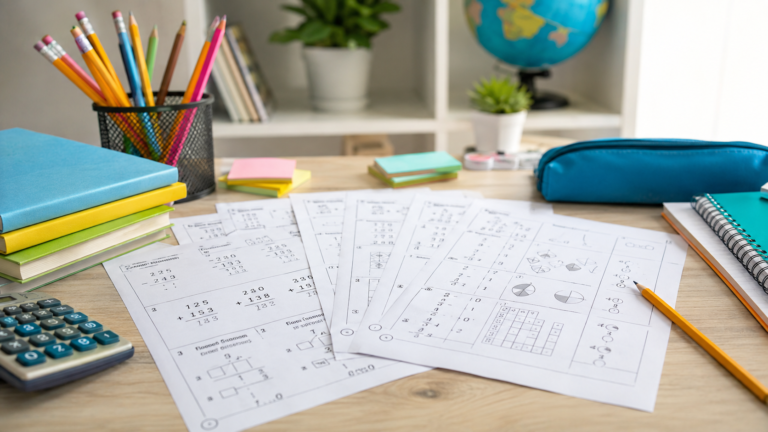
Mixed review pages combine several topics in one worksheet, making them ideal before quizzes or exams.
Benefits include:
- Identifying weak areas
- Building confidence
- Reinforcing previous lessons
- Preparing for assessments
Worksheet Comparison Table
Choosing the right worksheet depends on your child’s current skill level and learning goals. The table below makes it easier to decide where to begin.
| Worksheet Type | Main Skill | Difficulty | Best For | Recommended Practice |
| Addition Worksheets | Multi-digit addition | Easy | Beginners | 10–15 minutes daily |
| Subtraction Worksheets | Regrouping | Easy | Homework | 3–4 times per week |
| Multiplication Worksheets | Times tables | Medium | Daily practice | Every day |
| Division Worksheets | Basic division | Medium | Building confidence | Every day after multiplication |
| Fraction Worksheets | Understanding fractions | Medium | Concept learning | 2–3 times per week |
| Place Value Worksheets | Number sense | Easy | Foundation skills | Weekly review |
| Measurement Worksheets | Length, weight, capacity | Medium | Classroom review | Weekly |
| Geometry Worksheets | Shapes, area, perimeter | Medium | Visual learners | Weekly |
| Time Worksheets | Reading clocks | Easy | Everyday life skills | Weekly |
| Money Worksheets | Counting money | Easy | Practical math | Weekly |
| Word Problem Worksheets | Problem solving | Hard | Advanced learners | 2–3 times per week |
| Mixed Review Worksheets | Multiple skills | Medium–Hard | Test preparation | Weekly |
A balanced study routine should include both topic-specific worksheets and mixed review worksheets. This approach helps children master individual concepts before applying them together.
Skill Progression Guide
One common mistake parents make is giving children difficult worksheets before they have mastered the basics. Following a structured progression keeps learning enjoyable and reduces frustration.
Beginner Level
Children should first become comfortable with:
- Addition within 1,000
- Subtraction with regrouping
- Place value
- Number patterns
- Basic measurement
- Reading time
- Counting money
At this stage, accuracy is more important than speed.
Intermediate Level
Once the basics are understood, students can move on to:
- Multiplication facts
- Basic division
- Fractions
- Geometry
- Bar graphs
- Multi-step addition and subtraction
Encourage children to explain how they found each answer instead of simply writing the result.
Advanced Level
Students who are confident with intermediate topics can practice:
- Multi-step word problems
- Mixed operations
- Area and perimeter
- Equivalent fractions
- Challenging logic questions
- Mixed review worksheets
These activities prepare students for Grade 4 while strengthening problem-solving skills.
Daily Practice Plan
Children learn best through short, consistent practice sessions rather than long study periods.
10-Minute Daily Routine
Monday
- Addition practice
- Multiplication review
Tuesday
- Division
- Place value
Wednesday
- Fractions
- Geometry
Thursday
- Measurement
- Time
Friday
- Money
- Word problems
Saturday
- Mixed review worksheet
Sunday
- Review incorrect answers
- Practice difficult questions again
This simple routine helps students revisit every major Grade 3 math topic each week without feeling overwhelmed.
Weekly Learning Plan
| Day | Main Topic | Extra Practice |
| Monday | Addition | Mental Math |
| Tuesday | Multiplication | Times Tables |
| Wednesday | Division | Word Problems |
| Thursday | Fractions | Place Value |
| Friday | Geometry & Measurement | Mixed Review |
| Saturday | Full Practice Test | Error Review |
| Sunday | Light Revision | Math Games |
How to Choose the Right Worksheet
Not every worksheet is suitable for every student. Choosing the right level keeps children motivated and encourages steady improvement.
Choose by Skill
If a child struggles with one specific topic, focus on worksheets covering only that skill before introducing mixed exercises.
Examples include:
- Multiplication facts
- Fractions
- Word problems
- Geometry
- Place value
Mastering one topic at a time builds confidence.
Choose by Difficulty
Most worksheet collections can be divided into three levels.
| Level | Best For |
| Easy | Students learning a new concept |
| Medium | Students who understand the basics |
| Challenging | Students preparing for tests or needing enrichment |
Avoid moving to the next level until the current one feels comfortable.
Choose by Learning Goal
Think about what you want your child to achieve.
If the goal is to improve multiplication speed, choose focused multiplication worksheets.
If the goal is exam preparation, use mixed review worksheets that include several topics.
If classroom homework is the priority, choose worksheets that match the current school lesson.
Pros & Cons of Printable Math Worksheets
Like every learning tool, printable worksheets have advantages and limitations.
| Pros | Cons |
| Easy to print at home | Requires paper and ink |
| Encourages independent learning | Some children prefer interactive activities |
| Supports classroom learning | Adult guidance may be needed for difficult topics |
| Helps build confidence | Printing costs can add up |
| Useful for homework | Not every worksheet matches every curriculum |
| Great for homeschooling | Needs consistent practice to be effective |
For most families, combining printable worksheets with hands-on activities creates the best learning experience.
Tips for Parents
Parents play an important role in helping children develop positive study habits. The goal is not simply to finish worksheets but to help children understand mathematical ideas.
Encourage Daily Practice
Even ten minutes of focused work each day is often more effective than one long study session at the weekend.
Consistency builds confidence.
Celebrate Small Wins
Praise effort instead of only correct answers.
Simple encouragement such as:
- “You solved that much faster today.”
- “Your multiplication is improving.”
- “You remembered the rounding rule.”
can motivate children to keep learning.
Use Real-Life Examples
Math becomes easier when children see it in everyday situations.
For example:
- Count coins while shopping.
- Measure ingredients during cooking.
- Read clocks throughout the day.
- Compare prices in supermarkets.
- Measure furniture around the house.
Connecting worksheets to real life makes learning more meaningful.
Tips for Teachers
Teachers often use 3rd grade math worksheets to reinforce classroom instruction and assess student understanding.
Classroom Activities
Printable worksheets work well for:
- Morning work
- Independent practice
- Small-group instruction
- Exit tickets
- Learning stations
- Early finisher activities
Rotating worksheet types throughout the week keeps students engaged.
Homework Ideas
Homework should reinforce classroom learning without becoming overwhelming.
A good homework routine may include:
- One focused worksheet
- Five minutes of multiplication review
- One or two word problems
- Quick correction the following day
Short homework assignments encourage regular practice without causing frustration.
Assessment Tips
Worksheets can also be used as informal assessments.
Teachers can:
- Monitor common mistakes.
- Identify struggling students.
- Group learners by skill level.
- Track improvement over time.
- Adjust lesson plans based on results.
Using worksheets as ongoing assessments often provides a clearer picture than relying only on formal tests.
Homeschool Learning Tips
Printable worksheets are especially valuable for homeschool families because they provide structure while remaining flexible.
Create a Weekly Lesson Plan
A simple weekly schedule helps children know what to expect.
Example:
- Monday – Addition and subtraction
- Tuesday – Multiplication
- Wednesday – Division
- Thursday – Fractions and geometry
- Friday – Mixed review
- Saturday – Fun math activities
- Sunday – Rest or light revision
Following a routine makes learning more consistent.
Build a Printable Learning Folder
Keep completed worksheets in one folder.
Separate sections for:
- Addition
- Multiplication
- Fractions
- Geometry
- Word problems
- Tests
allow parents to monitor progress throughout the school year.
Track Progress
Instead of focusing only on scores, monitor:
- Accuracy
- Speed
- Confidence
- Independence
- Topics needing additional practice
This information makes it easier to choose future worksheets that match the child’s needs.
Common Mistakes Students Make
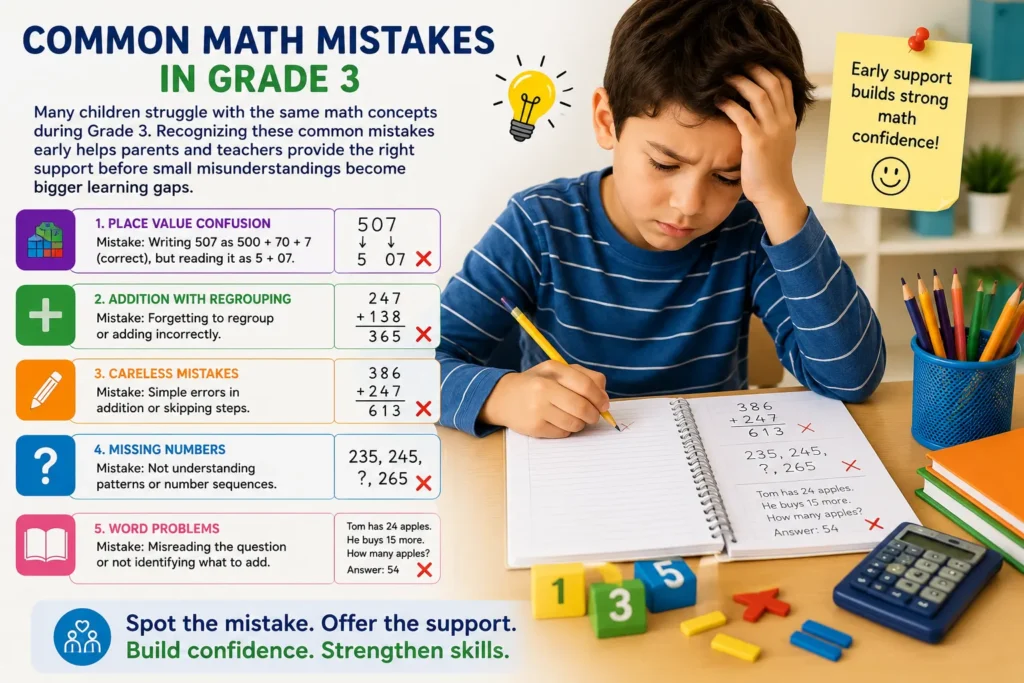
Many children struggle with the same math concepts during Grade 3. Recognizing these common mistakes early helps parents and teachers provide the right support before small misunderstandings become bigger learning gaps.
Multiplication Errors
Multiplication is one of the biggest challenges for third graders.
Common mistakes include:
- Guessing instead of using multiplication facts
- Confusing multiplication with addition
- Forgetting times tables
- Misreading multiplication symbols
- Skipping numbers while counting
How to help:
- Practice multiplication facts for 10 minutes each day.
- Use arrays and equal groups to show how multiplication works.
- Review incorrect answers together instead of simply marking them wrong.
Fraction Confusion
Fractions are often a child’s first introduction to numbers that are not whole numbers.
Students may:
- Confuse the numerator and denominator.
- Believe a larger denominator always means a larger fraction.
- Have difficulty identifying equal parts.
- Struggle to compare simple fractions.
How to help:
- Use pictures and fraction circles.
- Practice with everyday examples such as slicing pizza or fruit.
- Start with halves, thirds, and fourths before moving to more difficult fractions.
Place Value Mistakes
Place value forms the foundation for many future math skills.
Common errors include:
- Mixing up hundreds, tens, and ones.
- Writing numbers incorrectly in expanded form.
- Comparing numbers without checking each digit.
- Reading large numbers incorrectly.
How to help:
- Use place value charts.
- Practice building numbers with blocks or counters.
- Compare numbers using visual models before introducing worksheets.
Word Problem Challenges
Many students understand math operations but struggle to apply them in written problems.
Common issues include:
- Reading too quickly.
- Choosing the wrong operation.
- Ignoring important information.
- Missing keywords.
- Forgetting to show working.
How to help:
Teach children to follow four simple steps:
- Read the question carefully.
- Underline important numbers.
- Decide which operation is needed.
- Check the answer after solving.
Expert Tips
Children usually improve faster when worksheets are used as part of a balanced learning routine rather than as standalone homework.
Start with Easy Successes
Choose worksheets that match the child’s current ability.
Completing easier questions correctly builds confidence and prepares students for more challenging work.
Mix Different Worksheet Types
Avoid repeating the same type of worksheet every day.
Instead, rotate topics such as:
- Addition
- Multiplication
- Fractions
- Geometry
- Measurement
- Word problems
This keeps learning interesting while improving long-term retention.
Review Mistakes Together
Wrong answers provide valuable learning opportunities.
Rather than simply correcting mistakes, ask questions such as:
- Which step was difficult?
- Could another method work?
- What should be done differently next time?
Reflection helps children understand mathematical concepts instead of memorizing answers.
Keep Practice Sessions Short
Children learn more effectively during short, focused sessions.
Aim for:
- 10–15 minutes for younger learners
- 20 minutes for confident students
Regular practice is more effective than occasional long study sessions.
Focus on Understanding
Fast answers are useful, but understanding is even more important.
Encourage children to explain:
- Why they chose a particular method.
- How they found the answer.
- Whether another solution is possible.
Explaining mathematical thinking develops deeper understanding and stronger problem-solving skills.
FAQs
What math should a 3rd grader know?
By the end of Grade 3, students should confidently understand addition, subtraction, multiplication, division, fractions, place value, measurement, geometry, time, money, graphing, and basic word problems. These skills prepare children for more advanced topics in Grade 4.
Are these 3rd grade math worksheets free?
Many websites offer free 3rd grade math worksheets that can be downloaded and printed at home. Some platforms also provide premium worksheet bundles with additional activities and teaching resources.
Do printable worksheets include answer keys?
Many high-quality worksheet collections include answer keys. They help parents, teachers, and tutors quickly check answers while also giving students an opportunity to review and learn from their mistakes.
Can I print these worksheets at home?
Yes. Most printable 3rd grade math worksheets are available in PDF format and can be printed using a standard home printer.
Are these worksheets suitable for homeschooling?
Absolutely. Homeschool families frequently use grade 3 math worksheets as part of daily lessons, revision sessions, assessments, and independent learning activities.
Are these worksheets aligned with school standards?
Many worksheet collections are designed to support common Grade 3 learning objectives and curriculum standards. However, it is always a good idea to compare the topics with your local school curriculum to ensure they match classroom lessons.
How often should children practice math?
Short daily practice sessions usually produce the best results.
A simple routine of 10–15 minutes per day helps children improve accuracy, confidence, and problem-solving skills without becoming overwhelmed.
Which worksheets should beginners start with?
Children should begin with:
- Addition
- Subtraction
- Place value
- Number patterns
Once they become confident with these topics, they can gradually move on to multiplication, division, fractions, and word problems.
What are the most important Grade 3 math topics?
The core topics include:
- Addition
- Subtraction
- Multiplication
- Division
- Fractions
- Place value
- Measurement
- Time
- Money
- Geometry
- Word problems
Mastering these concepts creates a strong mathematical foundation for future learning.
How can teachers use these worksheets in the classroom?
Teachers can use worksheets for:
- Independent practice
- Homework
- Small-group instruction
- Revision
- Assessment
- Learning centers
- Early finisher activities
- Test preparation
Using a variety of worksheet types throughout the school year keeps lessons engaging while reinforcing key concepts.
Are these 3rd grade math worksheets free?
Yes. All worksheets can be downloaded and printed for free, making them perfect for home or classroom learning.
How often should 3rd graders practice math?
Around 15 to 20 minutes of daily practice is usually enough to reinforce key math concepts and improve confidence.
What topics are included in these worksheets?
The worksheets cover addition, subtraction, multiplication, division, fractions, place value, geometry, measurement, time, money, and word problems.
Final Verdict
3rd grade math worksheets remain one of the most effective tools for helping children strengthen their mathematical skills through regular practice. Whether the goal is improving multiplication facts, understanding fractions, mastering place value, or solving challenging word problems, well-designed worksheets provide focused practice that builds confidence step by step.
The best results come from using a balanced approach. Begin with one skill at a time, gradually increase the level of difficulty, and include regular mixed review worksheets to reinforce previously learned concepts. Short daily practice sessions, consistent feedback, and encouragement from parents or teachers can make a significant difference in a child’s progress.
For the most effective learning experience, choose free printable 3rd grade math worksheets that:
- Cover every major Grade 3 topic
- Include clear instructions
- Provide answer keys
- Offer a gradual progression from easy to challenging questions
- Support classroom learning, homeschooling, and independent practice
With consistent effort and the right collection of 3rd grade math worksheets, students can develop stronger number sense, improve problem-solving skills, and build the confidence needed for future success in mathematics.