4th Grade Math Worksheets – Free Printable PDF for Kids
Fourth-grade math is an important step in helping students build stronger problem-solving and critical-thinking skills. Regular practice with well-designed worksheets gives children the confidence to solve multi-step word problems, improve calculation speed, and understand key concepts like fractions, decimals, geometry, and measurement. Whether you’re a parent teaching at home or a teacher preparing classroom activities, these free 4th grade math worksheets provide an easy and effective way to support daily learning while making math practice more engaging.
This collection is designed to help students practice multiplication, long division, fractions, decimals, geometry, measurement, place value, and word problems through easy-to-use printable worksheets. Every worksheet should encourage independent learning while giving students the chance to strengthen the skills they use every day in school.
Many parents look for free printable 4th grade math worksheets, while teachers often need classroom-ready resources with answer keys. The good news is that well-designed worksheets can support both home and classroom learning without making practice feel overwhelming.
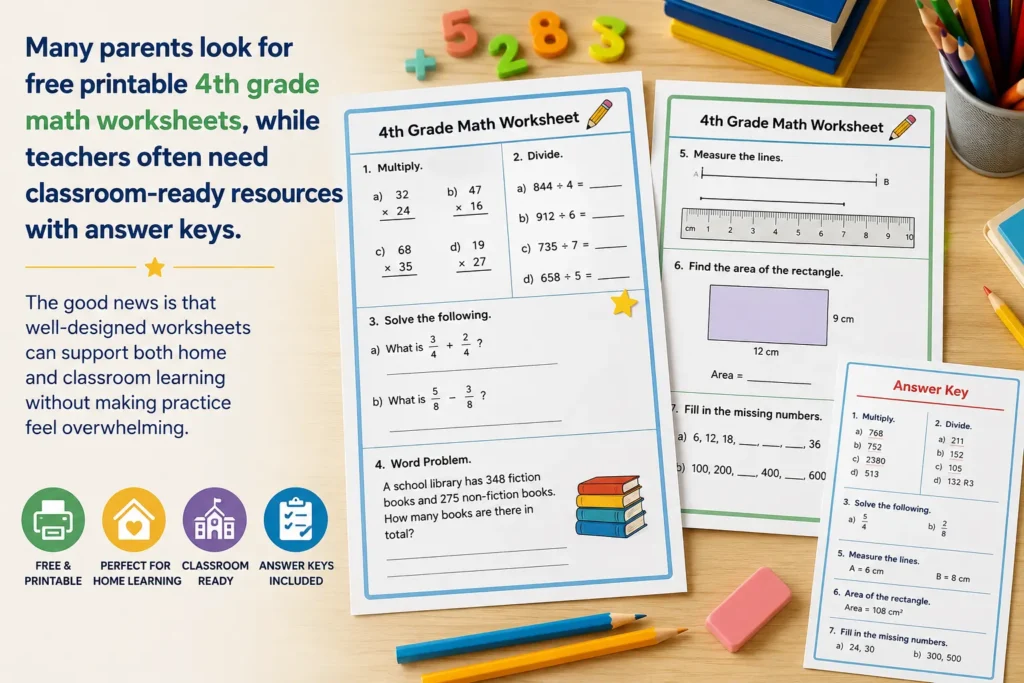
What Are 4th Grade Math Worksheets?
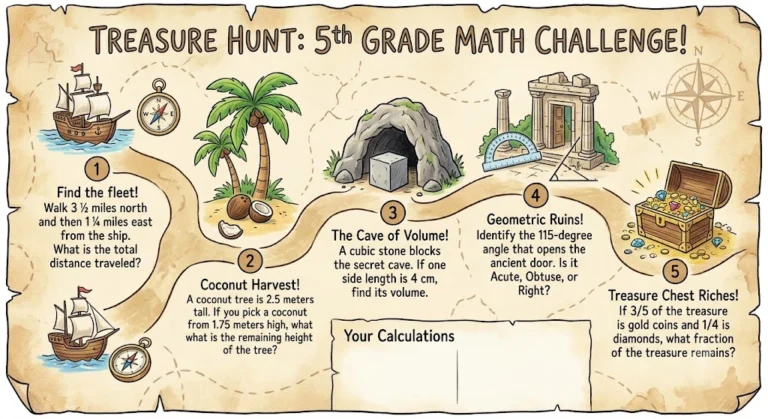
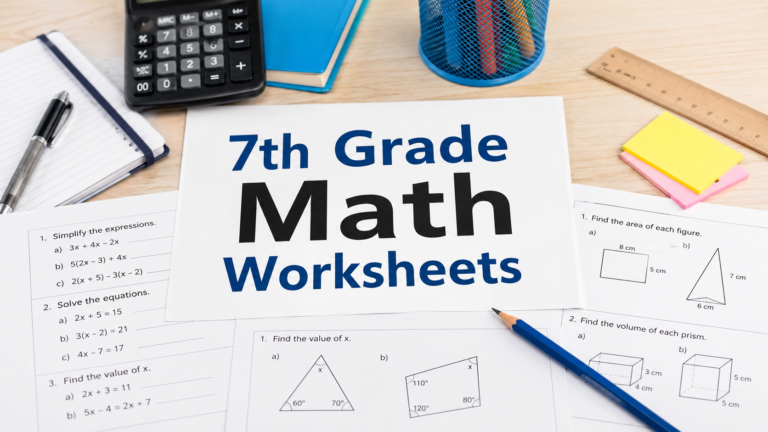
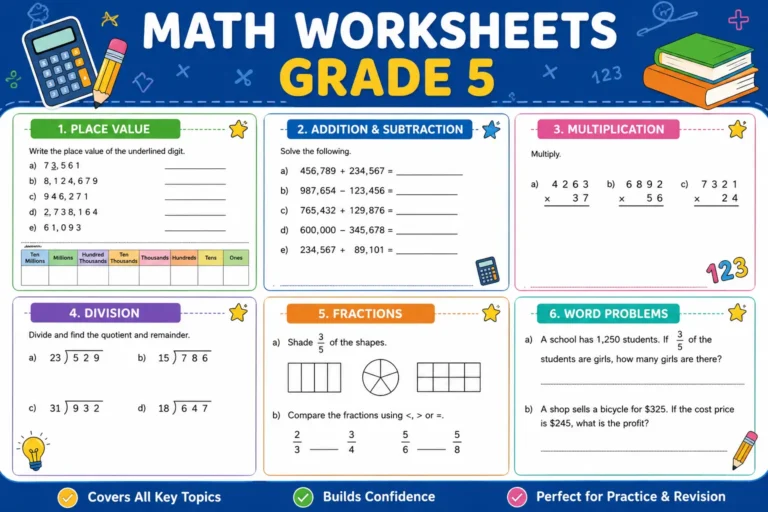
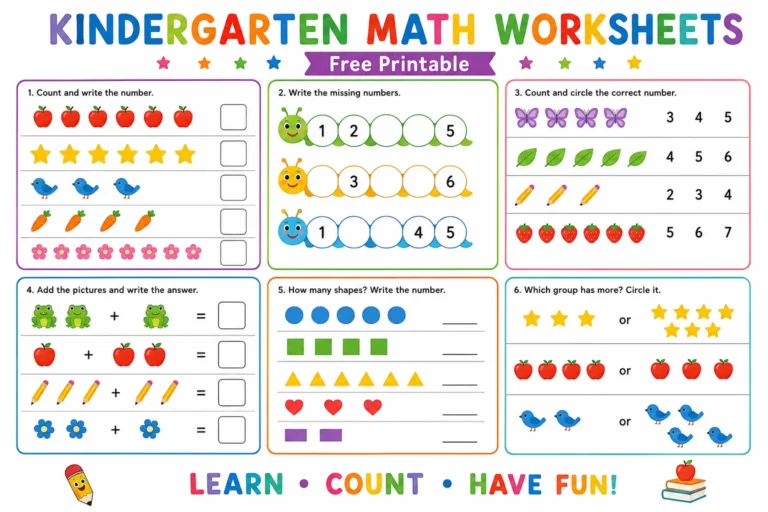
4th grade math worksheets are printable practice pages designed to help students master Grade 4 mathematics through repeated exercises, problem-solving activities, and real-world examples. They typically cover multiplication, division, fractions, decimals, geometry, measurement, and word problems.
Unlike random practice questions, organized worksheets focus on one skill at a time while gradually increasing difficulty. This helps children build confidence before moving to more challenging concepts.
Why Use 4th Grade Math Worksheets
Students in fourth grade move beyond simple arithmetic and begin learning more advanced mathematical concepts. Regular practice helps them understand these new topics instead of simply memorizing answers.
Printable worksheets are useful because they provide focused practice without unnecessary distractions.
Benefits for Students
Students benefit from worksheets because they:
- Improve calculation speed
- Build confidence
- Strengthen problem-solving skills
- Encourage independent learning
- Reinforce classroom lessons
- Prepare for quizzes and exams
Daily practice also helps children remember concepts that might otherwise be forgotten between lessons.
Benefits for Parents
Parents often need simple resources that support learning at home.
Worksheets make it easier to:
- Practice after school
- Review difficult topics
- Prepare for tests
- Monitor progress
- Identify weak areas
Since many printable worksheets include answer keys, parents can quickly check their child’s work without needing advanced math knowledge.
Benefits for Teachers
Teachers can use worksheets for:
- Independent practice
- Homework assignments
- Classroom warm-up activities
- Exit tickets
- Small group instruction
- Assessment preparation
- Extra practice for struggling learners
Because worksheets are organized by topic, teachers can easily select activities that match current classroom lessons.
Free Printable 4th Grade Math Worksheets by Topic
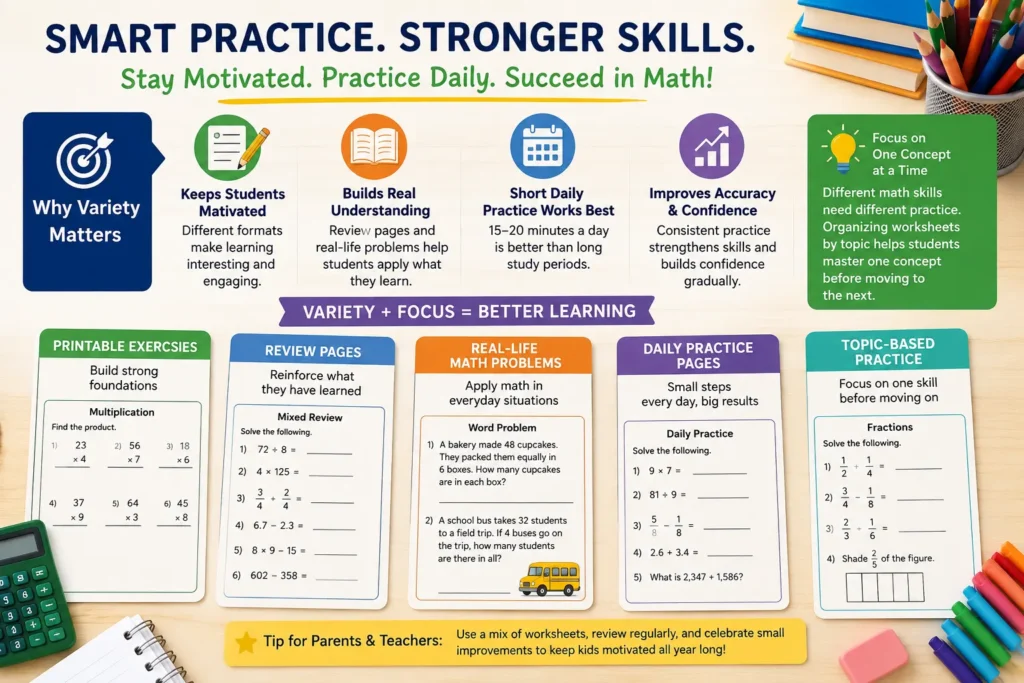
Using a variety of worksheet formats can also keep students motivated throughout the school year. Mixing printable exercises, review pages, and real-life math problems helps children apply classroom knowledge in practical situations. Short daily practice sessions are often more effective than long study periods, allowing students to strengthen their understanding while gradually improving accuracy and confidence.Different math skills require different types of practice. Organizing worksheets by topic helps students focus on one concept before moving to another.
Place Value Worksheets
Understanding place value forms the foundation for many Grade 4 math skills.
Practice worksheets often include:
- Reading large numbers
- Writing numbers
- Comparing numbers
- Ordering numbers
- Expanded form
- Standard form
- Rounding numbers
Students who understand place value usually perform better in multiplication, division, and decimals later in the year.
Addition Worksheets
Although addition begins in earlier grades, Grade 4 introduces larger numbers and more complex problems.
Students practice:
- Multi-digit addition
- Regrouping
- Mental addition
- Estimation
- Word problems
These worksheets improve calculation accuracy while building confidence.
Subtraction Worksheets
Subtraction worksheets focus on solving increasingly challenging problems.
Activities include:
- Multi-digit subtraction
- Borrowing
- Estimation
- Missing numbers
- Real-life subtraction problems
Regular practice helps students avoid common borrowing mistakes.
Multiplication Worksheets
Multiplication is one of the most important Grade 4 skills.
Worksheets usually include:
- Multiplication facts
- Two-digit multiplication
- Three-digit multiplication
- Multiplying by multiples of ten
- Multi-step multiplication problems
- Word problems
Example Skills
| Skill | Difficulty |
| Multiplication Facts | Easy |
| Two-Digit Multiplication | Medium |
| Multi-Step Problems | Hard |
| Word Problems | Hard |
Learning multiplication fluently makes long division much easier later.
Long Division Worksheets
Long division is often the most challenging topic for fourth graders.
Worksheets help students practice:
- Basic division
- Long division steps
- Division with remainders
- Checking answers
- Multi-digit division
- Word problems
Breaking long division into smaller steps makes learning much easier.
Fraction Worksheets
Fractions become much more important during Grade 4.
Students learn to:
- Identify fractions
- Compare fractions
- Simplify fractions
- Equivalent fractions
- Add fractions
- Subtract fractions
Visual fraction models are especially useful for younger learners.
Decimal Worksheets
Decimal worksheets introduce students to another way of representing numbers.
Common activities include:
- Decimal place value
- Comparing decimals
- Ordering decimals
- Rounding decimals
- Adding decimals
- Subtracting decimals
Understanding decimals prepares students for later grades.
Geometry Worksheets
Geometry develops spatial thinking and reasoning skills.
Worksheets often cover:
- Lines
- Rays
- Angles
- Triangles
- Quadrilaterals
- Symmetry
- Shapes
- Coordinate basics
Visual exercises help students recognize geometric relationships.
Measurement Worksheets
Measurement worksheets teach students how to solve practical everyday problems.
Topics include:
- Time
- Money
- Length
- Weight
- Capacity
- Metric units
- Customary units
- Unit conversions
These activities connect mathematics to real-world situations.
Area and Perimeter Worksheets
Students learn how to measure two-dimensional shapes.
Practice includes:
- Finding area
- Finding perimeter
- Comparing shapes
- Multi-step problems
- Real-world examples
These worksheets improve both geometry and multiplication skills.
Data and Graphing Worksheets
Students learn how to understand and present information visually.
Worksheets include:
- Bar graphs
- Line plots
- Tables
- Picture graphs
- Reading charts
- Interpreting data
These activities build analytical thinking skills.
Word Problem Worksheets
Word problems help students apply mathematics in realistic situations.
Examples include:
- Shopping
- Travel
- Time calculations
- Money
- Measurement
- Multi-step reasoning
Students learn to identify important information before solving the problem.
Mixed Review Worksheets
Mixed review worksheets combine several topics into one practice page.
These are excellent for:
- Weekly review
- Homework
- Test preparation
- Summer learning
- End-of-unit revision
Because multiple skills appear together, students improve long-term retention.
Worksheet Comparison Table
| Worksheet Type | Main Skills | Difficulty | Printable | Answer Key |
| Place Value | Number Sense | Easy | Yes | Yes |
| Addition | Arithmetic | Easy | Yes | Yes |
| Subtraction | Arithmetic | Easy | Yes | Yes |
| Multiplication | Operations | Medium | Yes | Yes |
| Long Division | Operations | Medium | Yes | Yes |
| Fractions | Number Sense | Medium | Yes | Yes |
| Decimals | Number Sense | Medium | Yes | Yes |
| Geometry | Shapes | Medium | Yes | Yes |
| Measurement | Units | Medium | Yes | Yes |
| Word Problems | Problem Solving | Hard | Yes | Yes |
| Mixed Review | Multiple Skills | Mixed | Yes | Yes |
Grade 4 Math Skills Checklist
Students should gradually master these important skills throughout fourth grade.
Number Sense
- Compare numbers
- Round numbers
- Read large numbers
- Write numbers in expanded form
Operations
- Multi-digit addition
- Multi-digit subtraction
- Multiplication
- Long division
Fractions
- Equivalent fractions
- Comparing fractions
- Fraction models
- Fraction operations
Decimals
- Place value
- Compare decimals
- Add decimals
- Subtract decimals
Geometry
- Angles
- Lines
- Shapes
- Symmetry
Measurement
- Time
- Money
- Length
- Weight
- Capacity
Problem Solving
- Multi-step questions
- Real-world math
- Logical reasoning
- Mathematical thinking
How to Choose the Right Worksheet
Choosing the right worksheet is just as important as completing it. A worksheet that is too easy may not help a student improve, while one that is too difficult can lead to frustration. The goal is to match the worksheet to the student’s current skill level and gradually increase the challenge.
Beginner Level
Students who are still learning a concept should start with simple worksheets that focus on one skill at a time.
Good beginner worksheets include:
- Single-topic practice
- Large, easy-to-read questions
- Step-by-step problems
- Visual examples
- Plenty of practice questions
Examples:
- Basic multiplication facts
- Simple place value
- Easy fractions
- Basic measurement
These worksheets help students build confidence before moving to harder exercises.
Intermediate Level
Once students understand the basics, they should begin solving more challenging questions.
Intermediate worksheets usually include:
- Multi-step calculations
- Mixed question types
- Real-life examples
- Short word problems
- Timed practice
Examples:
- Two-digit multiplication
- Long division
- Decimal comparisons
- Area and perimeter
These worksheets strengthen problem-solving skills while improving speed and accuracy.
Advanced Level
Advanced worksheets prepare students for more complex classroom assignments and standardized assessments.
They often include:
- Multi-step word problems
- Critical thinking activities
- Logic puzzles
- Mixed review pages
- Challenge questions
Students should attempt these worksheets only after mastering the basics.
Daily Practice Plan
A short daily routine is often more effective than long study sessions once or twice a week. Practicing for just 15–20 minutes each day helps students retain concepts and build confidence.
Monday – Number Sense
Focus on:
- Place value
- Comparing numbers
- Rounding
- Expanded form
Goal:
Build a strong foundation for the rest of the week’s lessons.
Tuesday – Multiplication & Division
Practice:
- Multiplication facts
- Multi-digit multiplication
- Long division
- Division with remainders
Goal:
Improve calculation speed and accuracy.
Wednesday – Fractions & Decimals
Work on:
- Equivalent fractions
- Comparing fractions
- Decimal place value
- Ordering decimals
Goal:
Strengthen understanding of number relationships.
Thursday – Geometry & Measurement
Practice:
- Shapes
- Angles
- Perimeter
- Area
- Time
- Money
- Unit conversions
Goal:
Apply math skills to practical situations.
Friday – Mixed Review
Combine all topics from earlier in the week.
Include:
- Word problems
- Mixed operations
- Review questions
- Timed practice
Goal:
Identify strengths and areas that need more attention.
Printable Worksheets for Teachers
Teachers often need flexible resources that work for different classroom situations. Printable worksheets can be used before, during, or after instruction to reinforce important concepts.
Classroom Activities
Teachers can use worksheets as:
- Morning work
- Bell ringers
- Guided practice
- Independent work
- Learning centers
- Math stations
Because worksheets are organized by topic, they fit easily into daily lesson plans.
Homework Assignments
Homework worksheets allow students to review classroom lessons at home.
Good homework worksheets should:
- Match the lesson taught that day
- Include clear instructions
- Focus on one main skill
- Be completed in a reasonable amount of time
Parents can also use answer keys to review completed work.
Small Group Instruction
Students learn at different speeds. Small-group worksheets make it easier to provide targeted support.
Teachers can prepare different worksheets for:
- Students needing extra help
- On-level learners
- Advanced learners
This approach keeps every student engaged.
Printable Worksheets for Parents
Parents play an important role in helping children succeed in mathematics. A few minutes of daily practice can improve both confidence and understanding.
Homeschool Learning
Homeschool families often organize lessons by topic instead of following a traditional classroom schedule.
Printable worksheets help by providing:
- Structured lessons
- Independent practice
- Quick assessments
- Easy progress tracking
Parents can introduce one concept at a time before moving to review worksheets.
Weekend Practice
Weekend review helps students remember concepts learned during the week.
A simple weekend routine might include:
- One multiplication worksheet
- One fraction worksheet
- One word problem page
Completing just a few worksheets each weekend can prevent learning gaps.
Summer Review
Many students forget important math skills during long school breaks.
Summer practice worksheets help students:
- Review previous lessons
- Stay prepared for the next grade
- Build confidence
- Avoid the “summer slide”
Even two or three worksheets each week can make a noticeable difference.
Common Mistakes Students Make
Understanding common mistakes helps students improve faster because they learn what to watch for before making errors.
Multiplication Errors
Students often:
- Forget multiplication facts
- Misalign numbers
- Skip carrying digits
- Rush calculations
How to Avoid Them
- Practice multiplication facts daily.
- Check each step carefully.
- Review completed work before moving on.
Fraction Mistakes
Common errors include:
- Comparing denominators incorrectly
- Forgetting equivalent fractions
- Mixing numerators and denominators
- Incorrect simplification
How to Avoid Them
- Draw visual fraction models.
- Compare fractions using common denominators.
- Practice equivalent fractions regularly.
Decimal Mistakes
Students sometimes:
- Misplace decimal points
- Compare decimals incorrectly
- Ignore place value
- Line up numbers incorrectly
How to Avoid Them
- Write decimals vertically.
- Use place value charts.
- Read each decimal aloud.
Word Problem Mistakes
Word problems challenge many students because they require both reading and math skills.
Common mistakes include:
- Reading too quickly
- Choosing the wrong operation
- Missing important information
- Forgetting units
How to Avoid Them
- Read the question twice.
- Highlight important numbers.
- Decide which operation is needed.
- Solve carefully.
- Check the final answer.
Pros and Cons of Printable 4th Grade Math Worksheets
| Pros | Cons |
| Easy to print | Requires paper and ink |
| Great for homework | Less interactive than apps |
| Supports classroom learning | Some students prefer digital activities |
| Helps build confidence | Requires regular practice |
| Covers every major math topic | May need adult guidance for difficult concepts |
| Easy to organize by topic | Printing large collections can take time |
| Works well for homeschool | Doesn’t provide automatic feedback |
Pricing Table (If Premium Worksheets Are Offered)
Many websites provide both free and premium worksheet collections.
| Plan | Cost | Includes |
| Free | $0 | Printable worksheets, limited downloads, answer keys |
| Premium | Varies by website | Larger worksheet library, unlimited downloads, exclusive resources, advanced practice |
If you only need occasional practice, free worksheets are usually enough. Teachers or homeschool families who use worksheets every day may find premium libraries more convenient.
How to Make the Most of 4th Grade Math Worksheets
Regular worksheet practice is one of the most effective ways to strengthen a child’s math skills throughout fourth grade. Instead of completing many pages at once, students benefit more from short, focused practice sessions that target one concept at a time. This approach helps improve understanding, reduces frustration, and makes it easier to remember important math concepts over time.
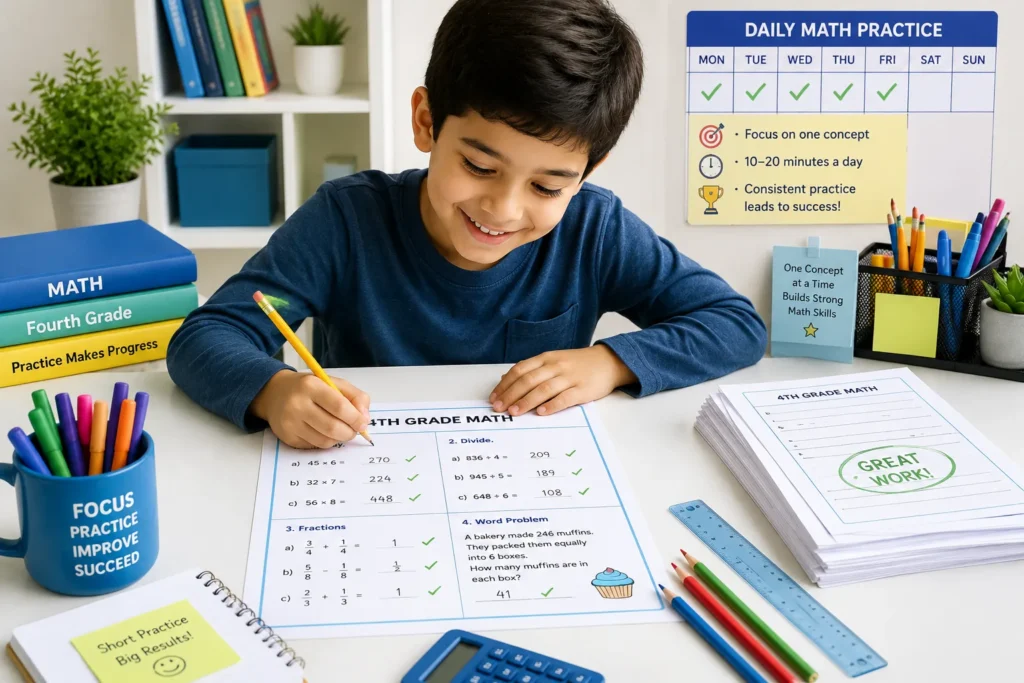
Parents and teachers can also use 4th grade math worksheets to identify learning gaps before they become bigger challenges. By reviewing completed worksheets together, children receive immediate feedback and gain confidence in solving similar problems independently. Whether used for classroom instruction, homework, homeschooling, or extra practice during school breaks, these printable worksheets provide a simple and effective way to build strong mathematical foundations while encouraging consistent learning habits
Expert Tips for Better Math Practice
Helping children improve in math does not require hours of study every day. Small habits often produce the best results.
Practice Every Day
Consistency matters more than long study sessions.
Even 15–20 minutes of daily practice helps students remember important concepts.
Mix Different Topics
Instead of practicing only multiplication every day, combine several skills.
For example:
- Multiplication
- Fractions
- Geometry
- Word problems
Mixed practice improves long-term retention.
Review Mistakes
Incorrect answers provide valuable learning opportunities.
Encourage students to:
- Find their mistake.
- Correct it.
- Solve a similar question.
This helps prevent repeating the same errors.
Use Timed Practice Carefully
Short timed activities improve speed, but accuracy should always come first.
Students should never rush simply to finish quickly.
Focus on Weak Areas
Every student has strengths and weaknesses.
Spend extra time practicing topics that feel difficult, such as:
- Long division
- Fractions
- Decimals
- Word problems
Targeted practice leads to faster improvement than repeating skills students already know.
FAQs
Are these 4th grade math worksheets free?
Many 4th grade math worksheets are available free of charge. Free worksheet collections usually cover essential topics such as multiplication, division, fractions, decimals, geometry, measurement, and word problems. Some websites also offer premium worksheet libraries with additional practice pages and teaching resources.
Do these worksheets include answer keys?
Many printable worksheets include answer keys so that parents, teachers, and students can quickly check their work. Answer keys also make it easier to identify mistakes and review difficult concepts.
Can I print these worksheets at home?
Yes. Most printable 4th grade math worksheets PDF files are designed for standard home or classroom printers. They can usually be printed on A4 or Letter-size paper without changing the layout.
Are these worksheets suitable for homeschool students?
Yes. Homeschool families frequently use printable worksheets because they provide structured lessons, independent practice, and simple progress tracking. Worksheets can also be combined with hands-on activities and math games for a more engaging learning experience.
What topics should a 4th grade math worksheet include?
A good 4th grade math worksheet should cover multiplication, division, fractions, decimals, geometry, measurement, place value, and multi-step word problems. Practicing these topics regularly helps students build a strong math foundation.
How often should 4th graders practice math worksheets?
Most students benefit from practicing math worksheets for about 15–20 minutes each day. Consistent daily practice helps improve problem-solving skills
Are printable 4th grade math worksheets useful for homeschooling?
Yes. Printable worksheets are an excellent resource for homeschooling because they provide structured practice, reinforce classroom concepts, and allow parents to track their child’s progress at their own pace
Are these worksheets useful for classroom teaching?
Absolutely. Teachers often use printable worksheets for:
- Morning work
- Independent practice
- Homework
- Math centers
- Small-group instruction
- Review lessons
- Assessment preparation
Because worksheets are organized by topic, they fit easily into almost any lesson plan.
Which math topics should a fourth grader master?
A fourth-grade student should become comfortable with:
- Place value
- Multi-digit addition
- Multi-digit subtraction
- Multiplication
- Long division
- Fractions
- Decimals
- Geometry
- Area and perimeter
- Measurement
- Data and graphing
- Multi-step word problems
Mastering these topics provides a strong foundation for fifth-grade mathematics.
How many worksheets should a child complete each day?
Quality matters more than quantity.
A practical routine is:
- 1–2 worksheets per day for regular practice.
- 15–20 minutes of focused study.
- A mixed review worksheet at the end of the week.
This approach reinforces learning without overwhelming students.
Are these worksheets aligned with Grade 4 learning standards?
Many worksheet collections are created to match common Grade 4 learning objectives, including multi-digit operations, fractions, decimals, geometry, measurement, and problem-solving. If your school follows a specific curriculum, compare the worksheet topics with your classroom lessons to ensure they match.
What is the best way to improve Grade 4 math skills?
The most effective approach combines several learning methods:
- Practice every day.
- Review incorrect answers.
- Focus on one topic at a time.
- Solve real-world word problems.
- Mix different worksheet types each week.
- Track progress regularly.
Consistent practice builds both confidence and long-term understanding.
Should students complete worksheets on paper or online?
Both methods have benefits.
Paper worksheets help students slow down, organize their work, and show each calculation step. Online practice offers instant feedback and convenience. Using a combination of printable worksheets and digital activities often provides the best learning experience.
Final Verdict
Printable 4th grade math worksheets remain one of the simplest and most effective ways to strengthen Grade 4 math skills. Whether a student is learning at home, in a classroom, or through a homeschool program, regular worksheet practice reinforces important concepts such as multiplication, long division, fractions, decimals, geometry, measurement, and word problems.
The best worksheet collections are easy to print, organized by topic, and include clear answer keys. They allow students to practice at their own pace while giving parents and teachers an easy way to monitor progress. Starting with individual topics and gradually moving to mixed review worksheets helps students build confidence before tackling more challenging problems.
For the best results:
- Practice for 15–20 minutes each day.
- Begin with one skill at a time before moving to mixed review.
- Check answers carefully and learn from mistakes.
- Revisit difficult topics regularly instead of waiting until test time.
- Combine worksheets with hands-on activities, math games, and real-world examples to keep learning engaging.
Over time, consistent practice with well-organized 4th grade math worksheets helps students improve accuracy, develop stronger problem-solving skills, and prepare confidently for future math lessons. Whether you’re looking for free printable 4th grade math worksheets, grade 4 math worksheets PDF, or printable 4th grade math worksheets with answer keys, choosing resources that are clear, structured, and matched to a student’s current skill level will provide the greatest long-term benefit.