3rd Grade Division Worksheets: 10 Fun Ways to Build Strong Division Skills
Division can feel like a big step for many third graders. One day they’re confidently solving multiplication problems, and the next they’re being asked to split numbers into equal groups. It can seem tricky at first—but that’s completely normal.
That’s where 3rd grade division worksheets make a huge difference.
The right worksheet doesn’t just give children a page full of numbers. It helps them understand why division works. It turns confusing concepts into simple, repeatable practice. And honestly… when worksheets include pictures, games, puzzles, and real-life examples, kids don’t even realize they’re learning.
If you’re a parent helping with homework or a teacher planning math lessons, this guide will show you exactly how division worksheets can make learning easier—and a lot more enjoyable.
Why Division Is Important in 3rd Grade
Third grade is usually when students are introduced to division as the opposite of multiplication.
Instead of memorizing random answers, children begin learning how to:
- Split objects into equal groups
- Share items fairly
- Understand multiplication and division relationships
- Solve simple word problems
- Build confidence before moving to harder math
These early lessons create the foundation for long division, fractions, and algebra later on.
And yes… taking time to master the basics now saves plenty of frustration later.
1. Equal Groups Worksheets
Every child should begin with equal groups.
Instead of showing only numbers, these worksheets include pictures of apples, stars, cookies, toys, or animals that students divide into matching groups.
For example:
12 apples ÷ 3 baskets = ?
Children simply place four apples in each basket.
This visual approach helps students understand what division actually means before introducing equations.
2. Division Facts Practice
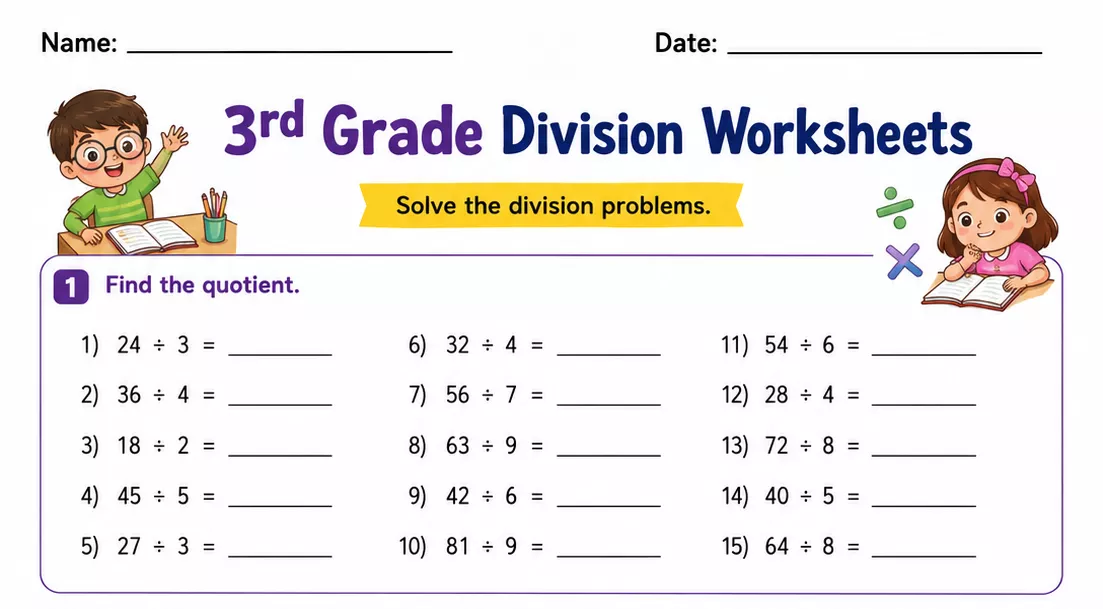
Once students understand grouping, it’s time to memorize basic division facts.
Good 3rd grade division worksheets include:
- Facts from 1 through 10
- Missing number problems
- Matching activities
- Timed practice pages
- Mixed review exercises
Short daily practice—just 10 minutes—is often enough to improve speed and accuracy without overwhelming young learners.
3. Multiplication and Division Fact Families
One of the easiest ways to understand division is by connecting it with multiplication.
For example:
- 4 × 5 = 20
- 5 × 4 = 20
- 20 ÷ 4 = 5
- 20 ÷ 5 = 4
Fact family worksheets help students recognize these relationships naturally.
And suddenly… division doesn’t seem like a completely new concept anymore.
4. Picture Division Activities
Visual learners benefit tremendously from picture-based worksheets.
Instead of solving equations alone, students:
- Circle groups
- Draw equal sets
- Count objects
- Connect matching answers
- Shade equal parts
These activities reduce anxiety because children can actually see the math happening.
Sometimes seeing is understanding.
5. Simple Division Word Problems
Real-life situations make math meaningful.
Quality worksheets include questions like:
- Emma has 24 cookies. She shares them equally with 6 friends. How many cookies does each friend receive?
- There are 18 pencils placed into 3 boxes. How many pencils are in each box?
Word problems encourage children to think rather than simply memorize answers.
That’s an important skill they’ll use throughout school.
6. Missing Number Worksheets
These worksheets encourage logical thinking.
Examples include:
- □ ÷ 5 = 6
- 36 ÷ □ = 9
- 48 ÷ 8 = □
Students must work backward using multiplication facts.
At first they may guess.
After enough practice… they begin recognizing patterns automatically.
7. Color-by-Answer Division Worksheets
Let’s be honest.
Kids love coloring.
Teachers love quiet classrooms.
Color-by-answer worksheets combine both.
Students solve each division problem before coloring the matching section of a picture.
When finished, they’ve completed a fun illustration while practicing dozens of math facts.
Learning doesn’t always need to look like work.
8. Division Puzzles and Games
Some worksheets turn math into a challenge.
Popular activities include:
- Division mazes
- Number riddles
- Crossword puzzles
- Matching cards
- Cut-and-paste activities
- Hidden picture worksheets
These game-style worksheets help students stay focused longer because every correct answer unlocks the next step.
A little curiosity goes a long way.
9. Mixed Review Worksheets
After learning individual skills, students need review.
Mixed worksheets combine:
- Multiplication
- Division
- Word problems
- Missing numbers
- Equal groups
- Fact families
This prevents students from relying on memorization alone.
Instead, they learn when and how to use each strategy.
10. Challenge Worksheets for Advanced Learners
Some third graders master basic division quickly.
Rather than repeating easy problems, challenge worksheets keep them engaged.
These may include:
- Larger numbers
- Two-step word problems
- Division with remainders
- Logic puzzles
- Mixed multiplication and division challenges
Giving advanced students something new keeps learning exciting instead of repetitive.
Benefits of Using 3rd Grade Division Worksheets
Regular worksheet practice offers many long-term advantages.
Students often:
- Build confidence with basic division facts
- Improve problem-solving skills
- Develop stronger number sense
- Learn independently
- Prepare for fourth-grade math
- Reduce homework stress
- Increase classroom participation
And perhaps the biggest benefit?
They stop feeling nervous about division.
Confidence changes everything.
Tips for Parents
Supporting math at home doesn’t require expensive learning programs.
Try these simple ideas:
- Practice for 10–15 minutes daily.
- Use snacks or toys to demonstrate equal groups.
- Celebrate improvement instead of perfection.
- Mix worksheets with games.
- Review mistakes together without rushing.
Children learn best when math feels positive instead of stressful.
Tips for Teachers
Teachers can make worksheets even more effective by:
- Starting with visual models
- Pairing students for discussion
- Using manipulatives before worksheets
- Providing differentiated difficulty levels
- Offering quick daily review pages
- Mixing independent work with small-group activities
Every classroom includes different learning styles, so variety matters.
What Makes a Great Division Worksheet?
Not every worksheet is equally helpful.
The best 3rd grade division worksheets usually include:
- Clear instructions
- Large, easy-to-read numbers
- Plenty of practice
- Fun illustrations
- Real-world examples
- Gradually increasing difficulty
- Answer keys for quick checking
Simple design often works better than pages packed with distractions.
Final Thoughts
Learning division is one of the biggest milestones in third-grade math, but it doesn’t have to feel overwhelming. With the right 3rd grade division worksheets, students gain confidence one problem at a time. They learn to recognize patterns, solve real-life problems, and understand how multiplication and division work together.
Some days progress will be quick. Other days… not so much. That’s okay.
Consistent practice, encouraging support, and engaging worksheets make all the difference. Whether you’re teaching a classroom full of students or helping one child at the kitchen table, these worksheets provide the structure and repetition young learners need to succeed.
And before long, those once-confusing division problems become just another part of everyday math.