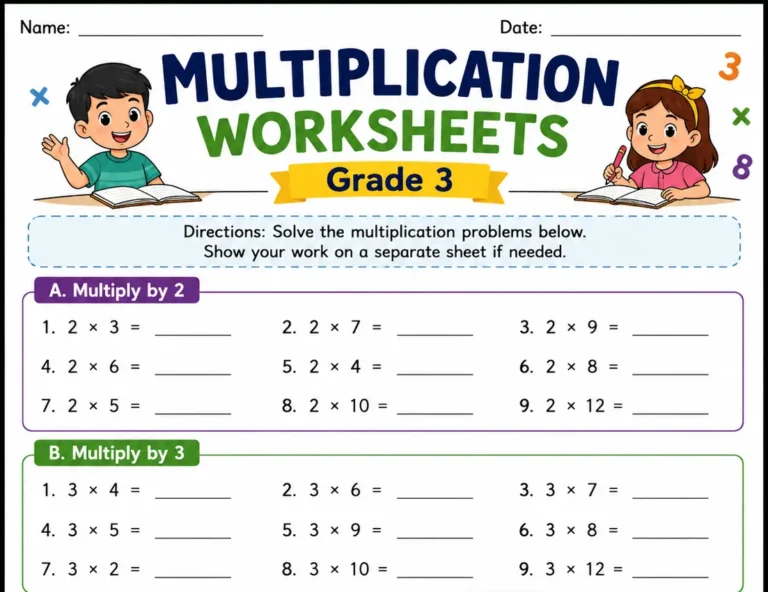
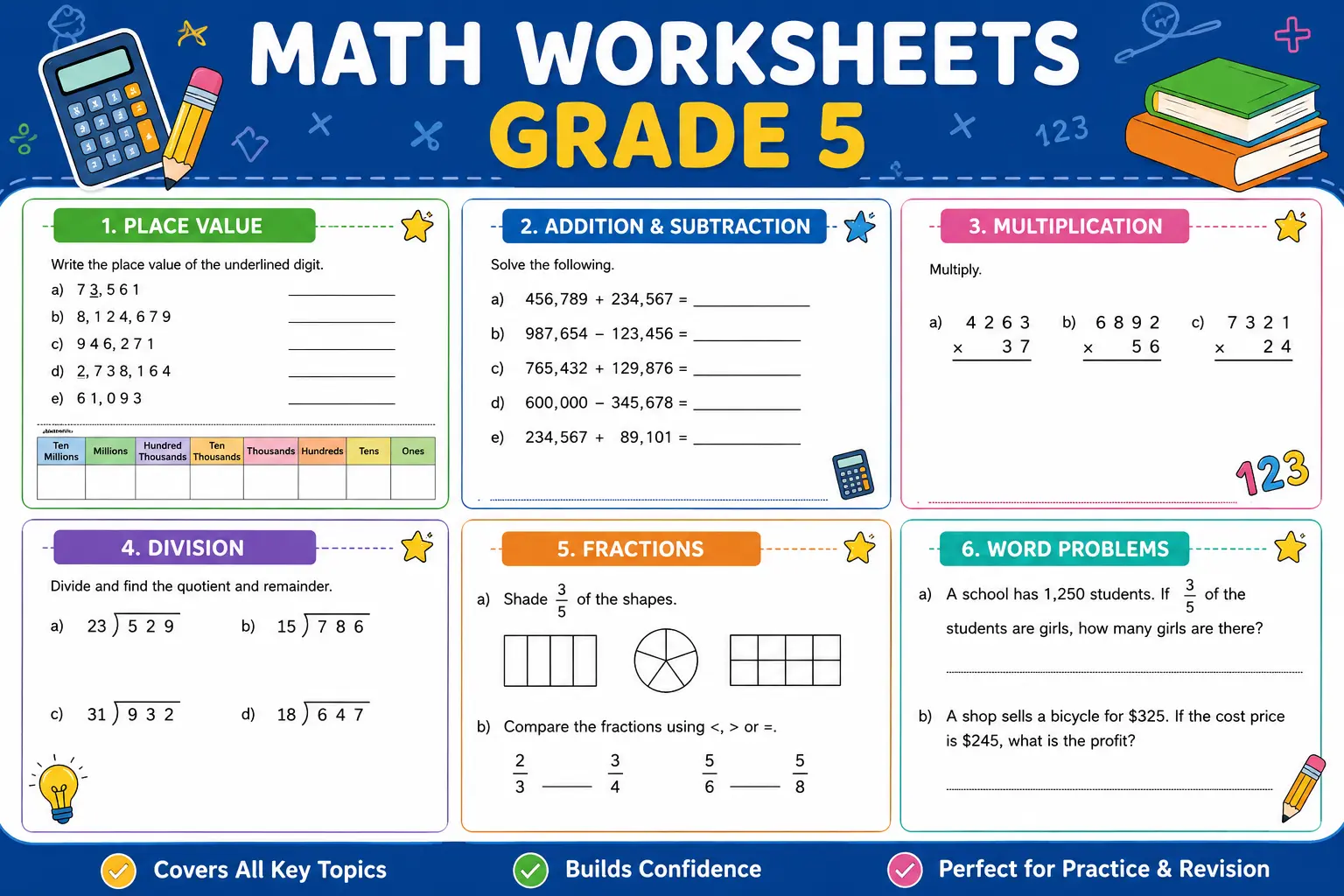
Math Worksheets Grade 5: 10 Fun Ways to Help Kids Build Strong Math Skills
Fifth grade is a big year for math. Kids move beyond simple arithmetic and begin solving more challenging problems involving fractions, decimals, geometry, measurement, and even early algebra concepts. It sounds like a lot—because it is.
That’s exactly why math worksheets grade 5 continue to be one of the most effective learning tools for students, parents, and teachers alike.
A well-designed worksheet gives children the chance to practice without pressure. They can make mistakes, learn from them, and gradually build confidence. And honestly…sometimes just a few extra problems each day make a bigger difference than an hour-long lesson.
Let’s explore why Grade 5 math worksheets matter and how you can use them to make learning enjoyable.
1. Why Grade 5 Math Worksheets Are So Effective
Worksheets provide structured practice that reinforces classroom learning.
Instead of introducing brand-new concepts, they help students strengthen what they’ve already learned. Repetition builds familiarity, and familiarity builds confidence.
Good math worksheets grade 5 also allow students to work at their own pace. Fast learners can move ahead, while others can spend extra time mastering difficult topics.
The best part?
Children often feel less stressed working independently than answering questions in front of the whole class.
2. Topics Every Grade 5 Math Worksheet Should Cover
A complete worksheet collection should include a wide range of mathematical concepts.
Some of the most important topics include:
- Addition and subtraction with large numbers
- Multiplication and long division
- Fractions
- Mixed numbers
- Decimals
- Percentages
- Geometry
- Area and perimeter
- Volume
- Measurement conversions
- Time
- Money
- Graphs
- Word problems
- Basic algebra
- Patterns
- Place value
Practicing each topic regularly helps students develop balanced mathematical skills instead of becoming strong in only one area.
3. Fraction Worksheets Build Real Understanding
Fractions become much more challenging in Grade 5.
Students begin comparing fractions, simplifying them, adding and subtracting unlike fractions, multiplying fractions, and even dividing them.
That’s a huge jump.
Regular worksheet practice makes these concepts feel less overwhelming.
Instead of memorizing procedures, students begin recognizing patterns naturally.
And that’s when math starts making sense.
4. Decimal Practice Improves Everyday Math
Decimals appear almost everywhere.
Shopping.
Money.
Measurements.
Sports statistics.
Science.
Grade 5 students learn to compare, round, add, subtract, multiply, and divide decimals.
Using math worksheets grade 5 focused on decimals gives children plenty of opportunities to practice calculations before using them in real-life situations.
Little by little, confidence grows.
5. Word Problems Develop Critical Thinking
Many students can solve equations.
But reading a paragraph and figuring out which operation to use?
That’s often much harder.
Word problem worksheets encourage children to:
- Read carefully
- Identify important information
- Ignore unnecessary details
- Choose the correct operation
- Explain their thinking
These skills don’t just improve math performance—they also strengthen reading comprehension and logical reasoning.
6. Geometry Worksheets Make Learning Visual
Geometry introduces shapes, angles, lines, symmetry, perimeter, area, and volume.
Some students love visual math.
Others struggle with it.
Worksheets containing diagrams, measurement activities, and drawing exercises help make abstract concepts easier to understand.
Instead of simply memorizing formulas, students actually see how mathematics works.
And that’s a game changer.
7. Daily Practice Beats Long Study Sessions
Parents sometimes believe children need to study for hours.
Actually…
Short, consistent practice usually works better.
Even 15–20 minutes using math worksheets grade 5 can produce noticeable improvement over time.
A simple weekly routine might look like this:
Monday: Fractions
Tuesday: Decimals
Wednesday: Multiplication and Division
Thursday: Geometry
Friday: Word Problems
Weekend: Mixed Review
This approach keeps learning fresh while preventing burnout.
8. Worksheets Help Teachers Save Valuable Time
Teachers already spend countless hours preparing lessons, grading assignments, and supporting students.
Printable worksheets simplify classroom management.
They can be used for:
- Homework
- Independent work
- Morning activities
- Math centers
- Review sessions
- Quizzes
- Fast finisher activities
- Test preparation
Many teachers also organize worksheets by difficulty level, making it easier to support students with different learning needs.
9. Parents Can Turn Worksheets Into Fun Activities
Worksheets don’t have to feel like homework.
A little creativity goes a long way.
Here are a few ideas:
Create a Math Challenge
Set a timer for 10 minutes and see how many questions your child can solve accurately.
Offer Small Rewards
Sticker charts, extra reading time, or choosing dinner can motivate younger learners.
Use Real-Life Examples
Ask children to calculate grocery totals, measure ingredients, or divide snacks equally among family members.
Celebrate Improvement
Focus on progress rather than perfection.
Even improving from 12 correct answers to 16 deserves recognition.
Kids notice encouragement more than criticism.
10. Choosing High-Quality Grade 5 Math Worksheets
Not every worksheet is equally useful.
Look for resources that include:
- Clear instructions
- Large, readable fonts
- Plenty of practice questions
- Answer keys
- Gradually increasing difficulty
- Real-life examples
- Colorful layouts (when appropriate)
- Mixed review sections
- Word problems
- Visual diagrams
Avoid worksheets that contain endless repetitive questions with little variety.
Children learn better when they’re challenged—not bored.
Tips for Getting the Best Results
To maximize learning, keep these simple strategies in mind:
- Practice consistently rather than occasionally.
- Review mistakes together.
- Encourage children to explain their answers aloud.
- Mix different math topics during the week.
- Keep sessions short and focused.
- Use positive feedback frequently.
- Track progress over time.
Math confidence doesn’t appear overnight.
It grows one worksheet at a time.
Common Mistakes Parents Should Avoid
Sometimes adults accidentally make math more stressful.
Try to avoid these habits:
- Rushing children through problems
- Giving answers too quickly
- Practicing only before tests
- Ignoring difficult topics
- Comparing siblings or classmates
- Expecting perfection every day
Mistakes are part of learning.
Actually…they’re often where the best learning happens.
Final Thoughts
Finding the right math worksheets grade 5 can make a remarkable difference in a child’s learning journey. Whether your goal is improving classroom performance, preparing for standardized tests, or simply building everyday confidence with numbers, consistent worksheet practice offers lasting benefits.
The secret isn’t completing hundreds of pages in one weekend.
It’s showing up regularly.
A few well-designed worksheets today become stronger problem-solving skills tomorrow. Over time, children begin tackling fractions, decimals, geometry, and word problems with less hesitation and more confidence.
And that’s exactly what great math learning should feel like—steady, encouraging, and surprisingly enjoyable.