5th Grade Division Worksheets: 10 Fun Ways to Build Stronger Math Skills
Division becomes much more interesting in 5th grade. At this stage, students aren’t just dividing small numbers anymore. They’re solving long division problems, working with multi-digit numbers, interpreting remainders, and even dividing decimals. It can feel like a big leap… but with the right practice, it becomes manageable.
That’s where 5th grade division worksheets really shine.
Instead of relying only on textbook exercises, worksheets give children a chance to practice different types of division in a structured, stress-free way. Some worksheets are quick review pages, while others challenge students with real-world word problems and puzzles. A good mix keeps learning fresh and helps build confidence over time.
If you’re a parent, teacher, or homeschool educator looking for effective practice materials, here’s everything you need to know.
Why Division Practice Matters in 5th Grade
Division is one of those math skills that students continue using long after elementary school. It’s connected to fractions, decimals, percentages, ratios, algebra—you name it.
The more comfortable children become with division now, the easier future math lessons will feel.
Regular practice helps students:
- Improve calculation speed
- Build confidence with larger numbers
- Reduce careless mistakes
- Understand mathematical patterns
- Strengthen logical thinking
- Prepare for standardized tests
And honestly… repetition works. Children who solve a variety of division problems every week usually gain accuracy much faster than those who practice only before exams.
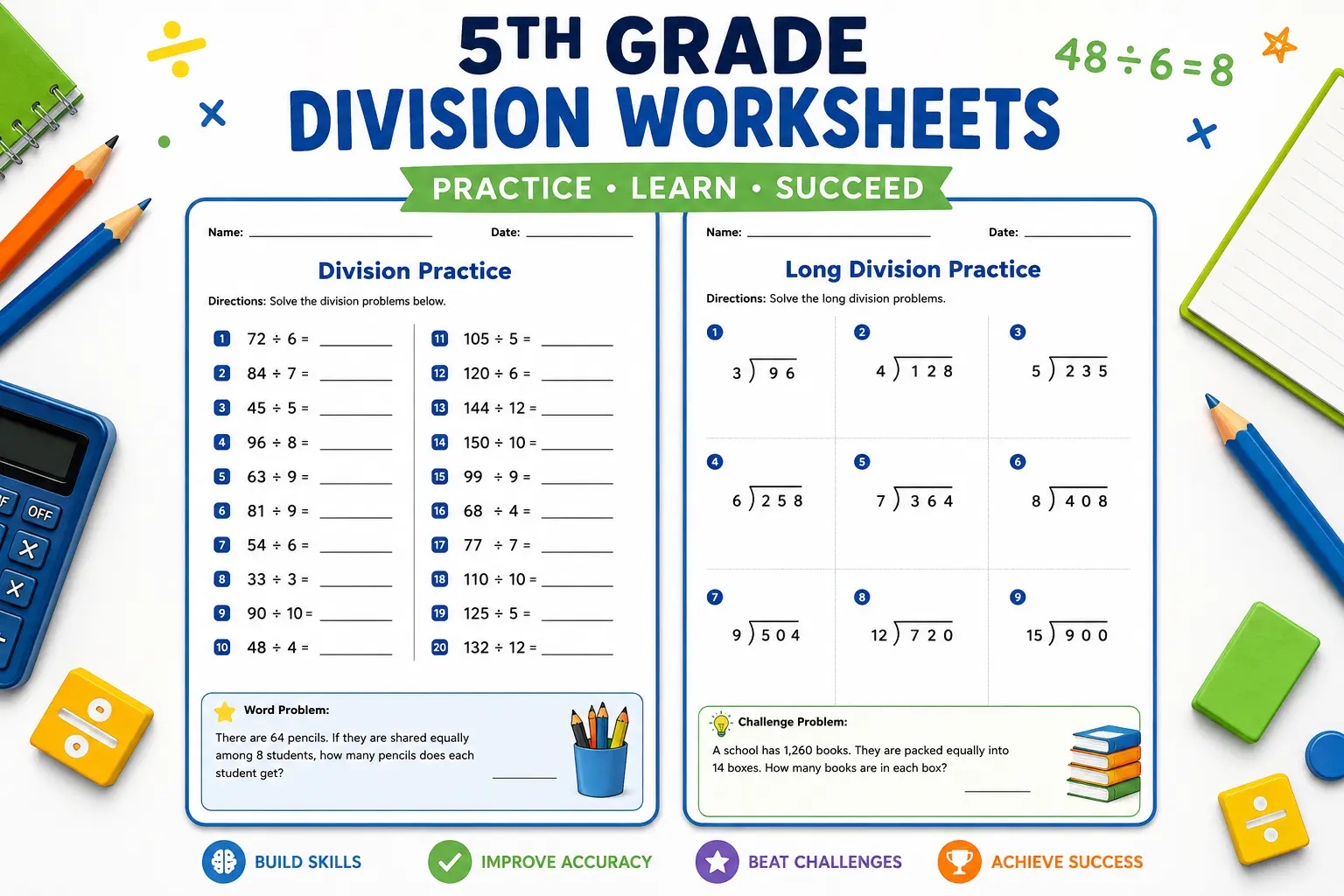
1. Long Division Worksheets
Long division is the biggest focus of 5th grade math.
Students learn how to divide numbers with two-digit divisors while carefully following each step.
Quality worksheets usually include:
- Two-digit divisors
- Three and four-digit dividends
- Step-by-step layouts
- Space for calculations
- Mixed difficulty levels
At first, students may take several minutes per problem. That’s completely normal. Speed comes later.
2. Division Word Problem Worksheets
Real-life math makes learning feel meaningful.
Instead of simply asking students to divide numbers, word problems encourage them to think before calculating.
Examples include:
- Sharing supplies equally
- Packing boxes
- Planning trips
- Buying groceries
- Organizing classroom materials
These activities improve both reading comprehension and mathematical reasoning at the same time.
3. Multi-Digit Division Practice
As students become more confident, worksheets should gradually introduce larger numbers.
Typical problems include:
- 2,864 ÷ 8
- 9,345 ÷ 15
- 6,720 ÷ 24
- 14,256 ÷ 36
Working through larger calculations teaches patience and accuracy. And yes… checking work becomes just as important as solving it.
4. Division with Remainders
Not every division problem ends perfectly.
Children need to understand what remainders actually mean rather than simply writing an extra number at the end.
Worksheets often ask students to:
- Write the remainder
- Round the answer
- Interpret the remainder
- Decide whether to ignore or use it
For example:
If 43 cookies are shared among 6 children, what happens to the extra cookie?
Situations like these help students connect math to everyday life.
5. Decimal Division Worksheets
Many 5th graders begin dividing decimals.
This can seem intimidating initially. But once students understand place value, the process becomes much easier.
Practice worksheets typically include:
- Decimal by whole number
- Whole number by decimal
- Decimal word problems
- Money calculations
- Measurement questions
Short daily practice sessions usually work better than one long study session.
6. Fact Fluency Review Pages
Even though students are learning advanced division, basic facts still matter.
If multiplication facts aren’t automatic, long division becomes much slower.
Review worksheets reinforce:
- Division facts through 12
- Related multiplication facts
- Timed practice
- Missing number problems
- Fact families
Just five or ten minutes each day can make a noticeable difference.
7. Mixed Division Worksheets
Once students understand individual skills, they should begin mixing them together.
These worksheets combine:
- Basic division
- Long division
- Decimals
- Remainders
- Word problems
- Multi-digit calculations
Mixed review helps students recognize which strategy to use instead of expecting every question to follow the same pattern.
That’s closer to how math appears on classroom assessments.
8. Puzzle and Game Worksheets
Learning doesn’t always have to feel like work.
Many teachers use puzzle-style 5th grade division worksheets because students often stay engaged much longer.
Popular activities include:
- Color-by-answer pages
- Division mazes
- Crack-the-code puzzles
- Mystery pictures
- Sudoku with division
- Escape room worksheets
Children usually don’t even realize how much practice they’re getting.
9. Challenge Worksheets for Advanced Learners
Some students master basic division quickly.
Rather than repeating similar questions, challenge worksheets introduce higher-level thinking.
Advanced activities might include:
- Multi-step word problems
- Division involving fractions
- Logic puzzles
- Missing divisor challenges
- Mathematical reasoning questions
These worksheets encourage students to explain their thinking instead of simply finding an answer.
10. Assessment and Review Worksheets
Every few weeks, it’s helpful to measure progress.
Review worksheets combine everything students have learned into one comprehensive practice set.
Teachers often use them for:
- Unit reviews
- Homework
- Weekly quizzes
- Test preparation
- Independent practice
Parents can also use them to identify which skills need a little extra attention.
Sometimes just two or three missed questions reveal an area that needs more practice.
Tips for Using 5th Grade Division Worksheets Effectively
Worksheets are most effective when they’re part of a consistent routine—not a last-minute cram session.
Here are a few ideas that work well:
- Practice 15–20 minutes daily.
- Review mistakes together.
- Encourage students to show every step.
- Mix easy and challenging questions.
- Celebrate improvement instead of perfection.
- Use real-life examples whenever possible.
- Let children explain their reasoning aloud.
And don’t rush.
Some students grasp long division quickly. Others need extra time. Both are perfectly normal.
Common Mistakes Students Make
Knowing where students struggle can help prevent frustration.
Some frequent errors include:
- Forgetting multiplication facts
- Skipping subtraction steps
- Misplacing digits
- Bringing down the wrong number
- Ignoring remainders
- Decimal placement errors
- Solving too quickly without checking work
Encouraging students to slow down often improves accuracy more than additional worksheets alone.
Choosing the Best 5th Grade Division Worksheets
Not all worksheets are equally helpful.
The best ones include:
- Clear instructions
- Progressive difficulty
- Plenty of practice
- Answer keys
- Real-world examples
- Attractive layouts
- Age-appropriate problems
Worksheets should challenge students—but not overwhelm them.
Finding that balance keeps motivation high.
Final Thoughts
The right 5th grade division worksheets can transform division from a frustrating topic into a skill students genuinely understand. Through regular practice, engaging activities, and a variety of problem types, children gradually develop both confidence and accuracy.
Remember, mastery doesn’t happen overnight. Some days the answers come easily. Other days… not so much. That’s simply part of learning.
With consistent practice, encouragement, and well-designed worksheets, 5th graders can build a strong mathematical foundation that supports future topics like fractions, decimals, ratios, algebra, and beyond. Keep practice enjoyable, celebrate small victories, and watch those division skills grow one worksheet at a time.