2nd Grade Addition Worksheets: 10 Fun Ways to Build Strong Math Skills at Home
If you’re searching for 2nd grade addition worksheets, you’re already taking a great step toward helping your child become more confident with math. The second grade is where addition starts becoming more than just counting on fingers. Children begin solving larger numbers, understanding place value, working with word problems, and even preparing for mental math.
And honestly… practice makes a huge difference.
The good news? Worksheets don’t have to feel boring. The best ones turn everyday math into short, enjoyable activities that keep kids interested while strengthening essential skills.
Let’s explore the types of worksheets that make learning addition easier—and a lot more fun.
Why 2nd Grade Addition Worksheets Matter
Second grade is a major milestone in elementary math. Students move beyond simple single-digit sums and begin working with two-digit and even three-digit numbers. At the same time, they learn strategies that help them solve problems faster without relying on memorization alone.
Regular practice helps children:
- Improve calculation speed
- Build confidence with larger numbers
- Develop logical thinking
- Strengthen problem-solving abilities
- Prepare for subtraction, multiplication, and future math concepts
Even just 15–20 minutes of worksheet practice a few days each week can create noticeable improvement over time.
1. Basic Two-Digit Addition Worksheets
Every learning journey starts with the basics.
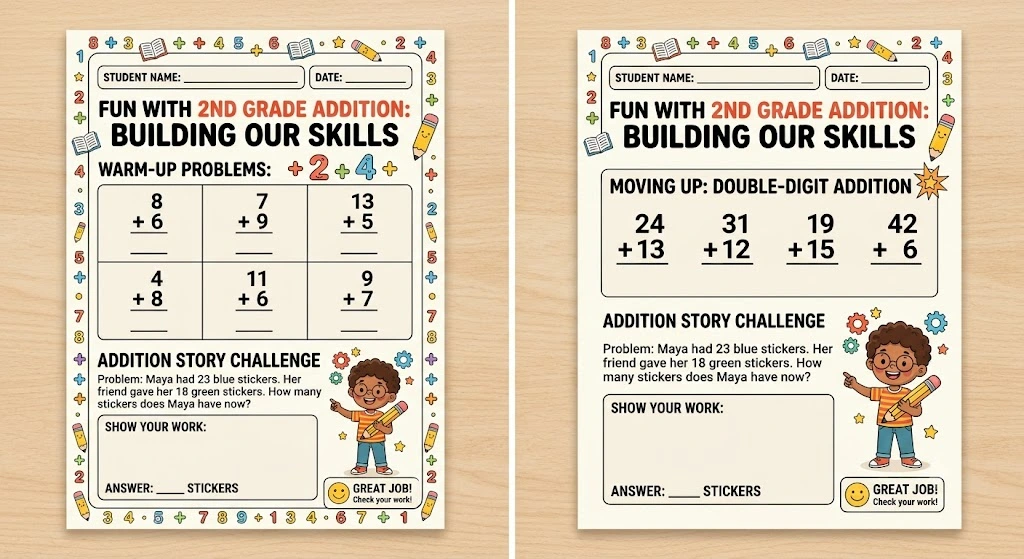
These worksheets focus on adding two-digit numbers without regrouping. They’re perfect for helping children understand number relationships before introducing more challenging problems.
Examples include:
- 24 + 15
- 43 + 26
- 52 + 17
Children gradually recognize patterns instead of simply guessing answers.
And that’s exactly what you want.
2. Addition with Regrouping Worksheets
Once students understand simple addition, regrouping becomes the next challenge.
These worksheets teach children how carrying works when the ones column totals ten or more.
For example:
  37
+ 28
----
  65
At first, regrouping feels confusing.
But after enough practice, it becomes second nature.
Many children actually enjoy the challenge once they understand the process.
3. Three-Digit Addition Practice
As confidence grows, students begin adding three-digit numbers.
Worksheets may include:
- 235 + 412
- 564 + 321
- 189 + 276
These exercises strengthen place-value understanding while preparing students for more advanced arithmetic in later grades.
Short daily practice works better than long study sessions.
Always.
4. Missing Number Addition Worksheets
Instead of solving complete equations, students find the missing number.
For example:
- □ + 18 = 43
- 25 + □ = 67
- □ + 52 = 81
These worksheets encourage logical thinking rather than memorizing procedures.
Kids begin asking themselves:
“What number would make this equation true?”
That’s real mathematical reasoning.
5. Addition Word Problems
Math exists everywhere—not just inside textbooks.
Word problem worksheets help children apply addition in real-life situations.
Examples include:
- Emma has 27 stickers. Her friend gives her 18 more. How many stickers does she have now?
- A bakery sold 35 muffins in the morning and 24 in the afternoon. How many muffins were sold altogether?
These problems improve reading comprehension alongside math skills.
Two subjects improving together… not bad.
6. Picture Addition Worksheets
Visual learners often understand concepts better when images are involved.
Picture-based worksheets include:
- Apples
- Balloons
- Animals
- Toys
- Stars
- Shapes
Instead of only seeing numbers, children count pictures before writing the answer.
This makes learning feel more like a game than homework.
Especially for younger second graders.
7. Addition Color-by-Number Activities
Few worksheet styles are as popular as color-by-number pages.
Students solve each addition problem and use the answer to determine which color belongs in each section.
The result?
A hidden picture slowly appears.
Children stay motivated because they’re creating artwork while practicing math.
Honestly, many don’t even realize how much learning is happening.
8. Timed Addition Worksheets
Speed isn’t everything…
But developing quick recall certainly helps.
Timed worksheets encourage students to complete simple addition problems within a set amount of time, usually:
- 1 minute
- 2 minutes
- 5 minutes
These activities strengthen mental math while helping children become more comfortable with basic facts.
The goal isn’t perfection.
It’s steady progress.
9. Holiday and Seasonal Addition Worksheets
Seasonal worksheets keep practice fresh throughout the year.
Popular themes include:
- Christmas
- Halloween
- Easter
- Valentine’s Day
- Thanksgiving
- Summer
- Winter
- Spring
Children often become more engaged when familiar holidays appear in their assignments.
A pumpkin worksheet somehow feels more exciting than a plain page of numbers.
Funny how that works.
10. Mixed Addition Review Worksheets
Once students have practiced different addition skills individually, mixed review worksheets bring everything together.
They may combine:
- Two-digit addition
- Three-digit addition
- Regrouping
- Missing numbers
- Word problems
- Mental math
This variety prepares children for classroom quizzes and standardized assessments.
More importantly, it reinforces everything they’ve already learned.
Tips for Using 2nd Grade Addition Worksheets Effectively
Worksheets are most effective when they’re part of a balanced learning routine.
Here are a few simple strategies:
- Practice for 15–20 minutes instead of long study sessions.
- Celebrate improvement rather than perfect scores.
- Allow children to explain how they found the answer.
- Mix easy and challenging worksheets.
- Use colorful pencils, stickers, or rewards for motivation.
- Review mistakes together without creating pressure.
- Repeat difficult worksheet types after a few days.
Children learn best when they feel relaxed and encouraged.
Common Addition Skills Second Graders Learn
A well-designed collection of 2nd grade addition worksheets usually covers a wide range of skills.
These include:
- Two-digit addition
- Three-digit addition
- Addition with regrouping
- Mental addition
- Place value understanding
- Number bonds
- Fact families
- Missing addends
- Story problems
- Estimation
- Multi-step problems
- Math fluency
Mastering these concepts builds a strong mathematical foundation for future grades.
Choosing High-Quality Addition Worksheets
Not every worksheet offers the same learning experience.
The best resources typically include:
- Clear instructions
- Age-appropriate questions
- Large, readable numbers
- Plenty of practice without overwhelming students
- Fun illustrations
- Progressive difficulty
- Answer keys for parents and teachers
Simple layouts often work better than overly crowded pages.
Less distraction means better focus.
Final Thoughts
The right 2nd grade addition worksheets can make a remarkable difference in a child’s confidence and mathematical ability. They transform everyday practice into manageable, engaging activities that reinforce classroom learning while encouraging independent thinking.
Whether your child is just beginning two-digit addition, mastering regrouping, or solving real-world word problems, consistent worksheet practice helps build both skill and confidence.
Remember, math success rarely comes from one long study session. It grows through small victories, repeated practice, and steady encouragement. Keep learning enjoyable, celebrate progress along the way, and your young learner will develop the strong addition skills needed for future math challenges.