6th Grade Algebra Worksheets: 10 Fun Ways to Build Math
Algebra can feel like a huge leap for many sixth graders. One day they’re adding fractions, and the next they’re solving equations with variables. It’s a big transition… but it doesn’t have to be overwhelming.
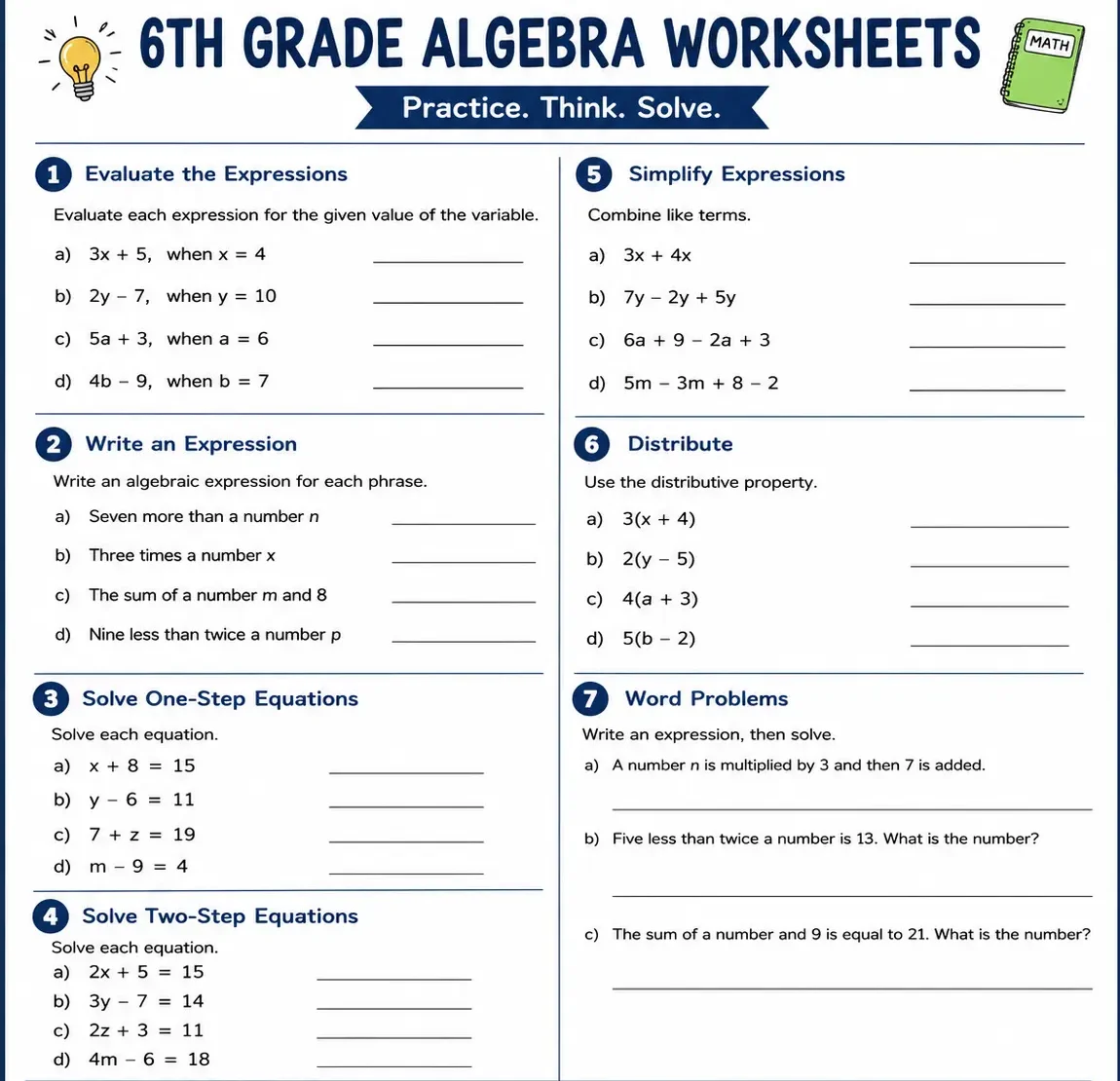
That’s where 6th grade algebra worksheets come in. A well-designed worksheet gives students the chance to practice one skill at a time, build confidence through repetition, and gradually understand how algebra works in everyday situations.
Whether you’re a parent helping with homework, a teacher planning lessons, or a homeschool educator creating a math routine, the right worksheets can make learning both productive and enjoyable.
Let’s explore why these worksheets matter and which types are most helpful.
Why 6th Grade Algebra Worksheets Are So Important
Sixth grade is often the first time students encounter algebra in a structured way. Instead of working only with numbers, they begin using letters to represent unknown values.
That shift requires practice.
Worksheets help students:
- Strengthen problem-solving skills
- Learn algebraic vocabulary
- Understand variables and expressions
- Build confidence before quizzes and tests
- Develop logical thinking
And honestly, the more students practice, the less intimidating algebra becomes.
1. One-Step Equation Worksheets
One-step equations are usually the first algebra concept students learn.
These worksheets ask students to solve simple equations such as:
- x + 7 = 15
- y − 9 = 12
- 4a = 20
- b ÷ 5 = 8
Students learn how to isolate the variable while keeping both sides of the equation balanced.
After enough practice, solving equations starts feeling almost automatic.
2. Algebraic Expressions Worksheets
Before solving equations, students must understand expressions.
These 6th grade algebra worksheets focus on:
- Writing expressions from word phrases
- Identifying terms
- Recognizing coefficients
- Understanding variables
- Simplifying expressions
Example:
“Five more than a number.”
Answer:
x + 5
This helps students translate everyday language into mathematical expressions.
3. Order of Operations with Variables
PEMDAS becomes even more interesting once variables are introduced.
Students practice problems like:
- 3x + 4 × 2
- 5(a + 2)
- 8 − 2y
These worksheets improve calculation accuracy while reinforcing proper operation order.
It seems simple… until multiple operations appear in one expression.
Practice makes all the difference.
4. Combining Like Terms Worksheets
This skill forms the foundation of later algebra.
Students learn to combine terms such as:
- 4x + 3x
- 7y − 2y
- 5a + 4 − 2a
Worksheets gradually increase in difficulty, allowing students to recognize patterns naturally.
Once they understand that only “like” terms can be combined, algebra starts making much more sense.
5. Inequalities Worksheets
Equations aren’t the whole story.
Students also learn inequalities like:
- x > 9
- y ≤ 15
- a < 12
Good worksheets include:
- Solving inequalities
- Graphing solutions
- Comparing values
- Real-life inequality problems
This introduces flexible thinking because there isn’t always just one correct answer.
6. Coordinate Plane Worksheets
Many students enjoy graphing because it feels visual.
Coordinate graph worksheets include:
- Plotting ordered pairs
- Identifying quadrants
- Finding coordinates
- Graphing algebraic relationships
Visual learners often connect with algebra much faster after working on coordinate grids.
And it’s a nice break from pages filled only with equations.
7. Word Problem Worksheets
This is where algebra becomes practical.
Students solve problems like:
“Emma has three more stickers than Liam. Together they have 27 stickers. How many does Liam have?”
Instead of memorizing formulas, students learn how algebra solves everyday situations.
Word problems improve:
- Reading comprehension
- Critical thinking
- Logical reasoning
- Mathematical modeling
They’re challenging at first… but incredibly valuable.
8. Integer Algebra Worksheets
Positive and negative numbers often create confusion.
These worksheets combine integers with algebra concepts.
Examples include:
- −3 + x = 8
- y − (−4)
- −5a
Students gain confidence working with:
- Negative values
- Integer operations
- Signed numbers
- Variable equations
Mastering integers early prevents bigger struggles in later grades.
9. Algebra Puzzle Worksheets
Not every worksheet needs to feel like homework.
Puzzle activities include:
- Mystery picture algebra
- Color-by-answer pages
- Crossword puzzles
- Logic challenges
- Escape room math activities
Students stay engaged because they’re solving problems with a purpose.
Sometimes they don’t even realize how much algebra they’re practicing.
10. Mixed Review Worksheets
Once students have learned several topics, mixed review worksheets become essential.
These combine:
- Expressions
- Equations
- Integers
- Inequalities
- Word problems
- Coordinate graphs
Rather than practicing one skill repeatedly, students learn to identify which strategy each problem requires.
That’s much closer to how real math tests work.
Benefits of Using 6th Grade Algebra Worksheets
Consistent worksheet practice offers several long-term advantages.
Students can:
- Improve algebra fluency
- Increase calculation speed
- Reduce careless mistakes
- Build confidence
- Prepare for middle school exams
- Strengthen independent learning habits
Parents also appreciate worksheets because they provide measurable progress.
It’s easy to see improvement from one week to the next.
Tips for Making Algebra Practice More Effective
Worksheets work best when they’re used consistently rather than all at once.
Here are a few helpful ideas:
- Practice 15–20 minutes each day.
- Review mistakes instead of simply checking answers.
- Mix easy and challenging problems.
- Use colorful pencils for graphing activities.
- Encourage students to explain their thinking aloud.
- Celebrate improvement, not just perfect scores.
Even small daily practice sessions add up surprisingly fast.
What Makes a Great Algebra Worksheet?
Not all worksheets are created equal.
The best 6th grade algebra worksheets usually include:
- Clear instructions
- Gradually increasing difficulty
- Plenty of practice questions
- Step-by-step examples
- Answer keys
- Real-world applications
- Clean, uncluttered layouts
When worksheets are organized well, students spend more time learning and less time feeling confused.
Who Can Benefit from These Worksheets?
These resources are useful for many different learners.
They’re perfect for:
- Sixth-grade students
- Parents helping with homework
- Classroom teachers
- Homeschool families
- Math tutors
- Summer learning programs
- Test preparation
The flexibility of printable worksheets makes them suitable for almost any learning environment.
Final Thoughts
Learning algebra for the first time can feel challenging, but the right practice makes a remarkable difference. High-quality 6th grade algebra worksheets help students understand variables, equations, expressions, and problem-solving through manageable, confidence-building activities.
The key isn’t endless repetition—it’s meaningful practice. A mix of equations, puzzles, graphing exercises, and real-world word problems keeps learning interesting while reinforcing essential skills. Over time, students begin to recognize patterns, think more logically, and approach algebra with far less hesitation.
Whether you’re supporting a classroom, teaching at home, or helping a child prepare for upcoming math assessments, adding well-structured 6th grade algebra worksheets to a regular study routine is one of the simplest and most effective ways to build a strong foundation for future success in mathematics.