Free 2nd Grade Math Worksheets (Printable PDF)
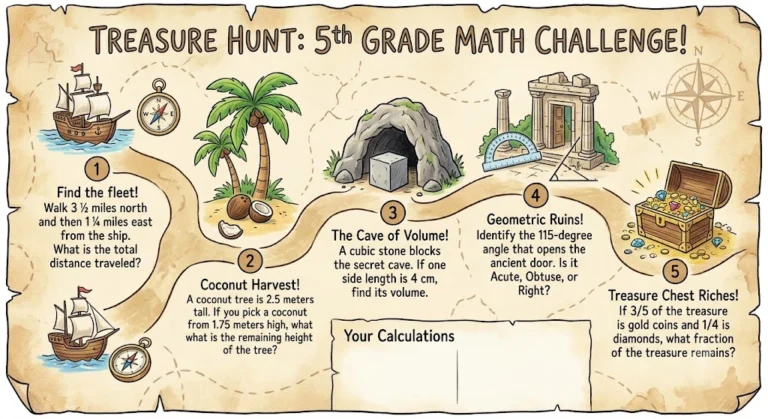
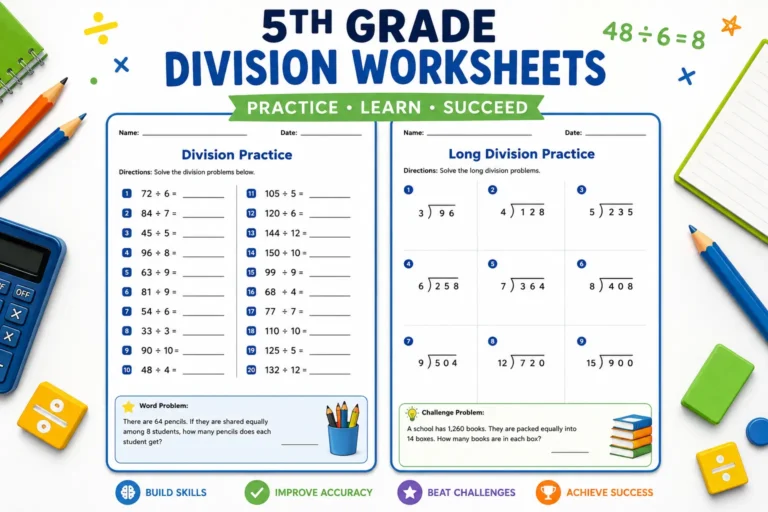
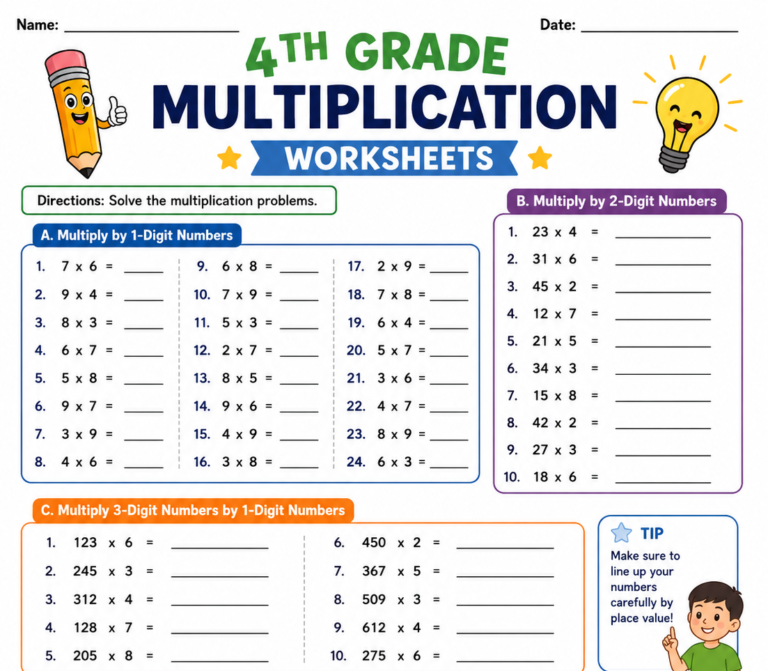
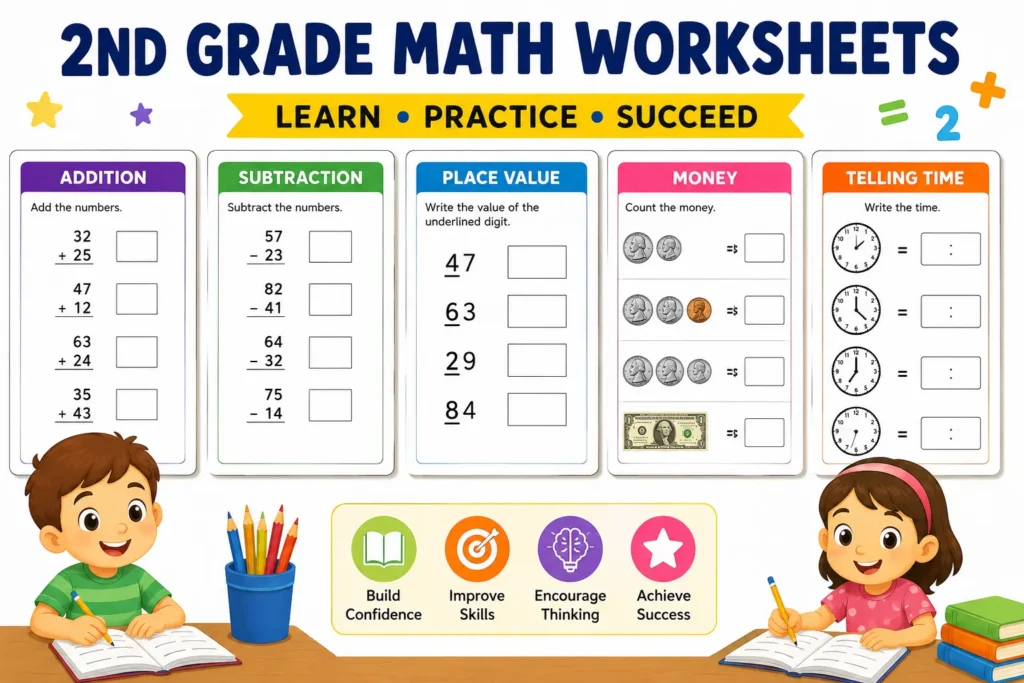
Looking for fun and printable 2nd grade math worksheets that help children build confidence in math? You’re in the right place. Our updated collection includes engaging worksheets covering addition, subtraction, place value, money, time, measurement, geometry, fractions, and word problems. Whether you’re a parent, teacher, or homeschool educator, these free printable worksheets make daily math practice simple, enjoyable, and effective.
This collection of 2nd grade math worksheets is designed to support every stage of learning. Whether a child is practicing addition, subtraction, place value, money, time, fractions, geometry, or word problems, these printable worksheets provide structured practice that matches common Grade 2 learning standards.
Each worksheet category focuses on one skill at a time while encouraging children to think independently. Parents can use them for homework support, teachers can include them in classroom lessons, and homeschool families can build complete weekly math plans around them.
All worksheets are intended to be printable, easy to follow, and suitable for regular practice. Many activities can also be used as warm-up exercises, revision sheets, or extra learning during school breaks.
What are 2nd grade math worksheets?
2nd grade math worksheets are printable learning activities that help children practice essential Grade 2 math skills. They usually include exercises on addition, subtraction, place value, skip counting, money, telling time, measurement, fractions, geometry, and word problems. They are widely used by parents, teachers, tutors, and homeschool families to strengthen daily math practice.
Why Use 2nd Grade Math Worksheets?
Second grade is one of the most important years in elementary mathematics. During this stage, children move beyond simple counting and begin solving more complex problems involving two-digit numbers, place value, time, money, measurement, and logical thinking.
Using printable 2nd grade math worksheets gives children repeated practice without overwhelming them. Instead of learning many concepts at once, worksheets allow students to focus on one skill until they become comfortable with it.
Benefits of Printable Math Worksheets
- Improve number confidence
- Build strong calculation skills
- Encourage independent learning
- Reduce math anxiety
- Support classroom learning
- Help parents monitor progress
- Prepare children for quizzes and tests
- Reinforce concepts taught at school
Many parents find that completing just one worksheet each day is enough to improve accuracy and confidence over time.
Why Teachers Like Worksheets
Teachers often use worksheets because they:
- Save lesson preparation time
- Work well as homework
- Support small-group learning
- Help assess student understanding
- Provide extra practice for struggling learners
- Can be printed whenever needed
They also make excellent activities for substitute teachers or independent classroom work.
Why Homeschool Families Use Worksheets
Homeschool parents appreciate worksheets because they offer flexibility.
Children can:
- Learn at their own pace
- Repeat difficult topics
- Review previous lessons
- Practice without screen time
- Build daily learning routines
Printable worksheets also make it easier to track improvement throughout the school year.
Benefits at a Glance
| Benefit | How It Helps |
| Daily Practice | Builds consistent learning habits |
| Printable PDFs | Easy to use at home or school |
| Topic-Based Learning | Focuses on one skill at a time |
| Homework Support | Reinforces classroom lessons |
| Answer Keys | Makes checking work simple |
| Flexible Learning | Suitable for home, school, and tutoring |
What Math Should a 2nd Grader Know?
By the end of Grade 2, students should feel comfortable working with numbers up to 1,000 while solving everyday math problems. They should also understand how numbers relate to one another and begin using logical thinking to solve multi-step questions.
Below are the main skills children are expected to develop during second grade.
Number Sense
Children learn to:
- Read numbers up to 1,000
- Write numbers in different forms
- Compare numbers
- Order numbers
- Recognize odd and even numbers
- Understand number patterns
A strong understanding of number sense supports every other math topic learned in Grade 2.
Addition
Students should be able to:
- Add two-digit numbers
- Add three-digit numbers with support
- Use regrouping (carrying)
- Solve missing-number equations
- Apply addition to word problems
Regular practice improves both speed and accuracy.
Subtraction
Important subtraction skills include:
- Two-digit subtraction
- Regrouping
- Mental subtraction
- Solving real-life problems
- Finding unknown numbers
Children should also learn to check subtraction answers using addition.
Place Value
Understanding place value is essential before moving to more advanced topics.
Students should recognize:
- Hundreds
- Tens
- Ones
They also learn to:
- Expand numbers
- Compare values
- Round numbers where appropriate
- Build numbers using place-value blocks
Skip Counting
Second graders commonly practice:
- Counting by 2s
- Counting by 5s
- Counting by 10s
- Counting by 25s
- Counting by 100s
Skip counting prepares children for multiplication later.
Multiplication Foundations
Although formal multiplication is introduced later in many curricula, Grade 2 students often begin learning:
- Equal groups
- Repeated addition
- Arrays
- Number patterns
These activities provide a smooth transition into multiplication.
Fractions
Children begin recognizing simple fractions such as:
- One-half
- One-third
- One-fourth
They learn that fractions represent equal parts of a whole.
Money
Money lessons usually include:
- Identifying coins
- Counting coins
- Counting bills
- Comparing values
- Solving shopping word problems
These activities connect math to everyday life.
Telling Time
Students learn to:
- Read analog clocks
- Read digital clocks
- Understand AM and PM
- Tell time to the nearest five minutes
- Solve simple elapsed-time questions
Measurement
Children compare and measure:
- Length
- Height
- Weight
- Capacity
They also practice selecting the correct measuring tools.
Geometry
Students identify:
- Two-dimensional shapes
- Three-dimensional shapes
- Shape attributes
- Symmetry
- Lines and angles (basic introduction)
Word Problems
Word problems help children apply math in practical situations.
Students solve questions involving:
- Addition
- Subtraction
- Money
- Time
- Measurement
- Multi-step thinking
This strengthens reasoning and comprehension skills.
Data and Graphs
Students learn how to:
- Read bar graphs
- Read picture graphs
- Compare data
- Answer questions using charts
- Organize information
These skills improve analytical thinking.
2nd Grade Math Skills Checklist
Use this checklist to monitor progress throughout the school year.
| Math Skill | Beginner | Developing | Confident |
| Count to 1,000 | ☐ | ☐ | ☐ |
| Compare Numbers | ☐ | ☐ | ☐ |
| Understand Place Value | ☐ | ☐ | ☐ |
| Add Two-Digit Numbers | ☐ | ☐ | ☐ |
| Subtract Two-Digit Numbers | ☐ | ☐ | ☐ |
| Regrouping | ☐ | ☐ | ☐ |
| Skip Counting | ☐ | ☐ | ☐ |
| Count Money | ☐ | ☐ | ☐ |
| Tell Time | ☐ | ☐ | ☐ |
| Measure Objects | ☐ | ☐ | ☐ |
| Identify Shapes | ☐ | ☐ | ☐ |
| Understand Simple Fractions | ☐ | ☐ | ☐ |
| Read Graphs | ☐ | ☐ | ☐ |
| Solve Word Problems | ☐ | ☐ | ☐ |
How to Use This Checklist
Rather than completing every worksheet at once, focus on one topic each week. For example:
- Week 1: Addition and subtraction
- Week 2: Place value and skip counting
- Week 3: Money and telling time
- Week 4: Measurement, geometry, and word problems
Review completed worksheets regularly to identify strengths and areas that need extra practice. Small, consistent study sessions are usually more effective than long practice periods completed only once a week.
Printable Worksheets by Topic
Every child learns at a different pace, which is why topic-based worksheets are so effective. Instead of practicing many skills at once, children can focus on one concept until they understand it well. This approach builds confidence and helps prevent frustration.
The worksheet categories below cover the main Grade 2 math topics. Parents and teachers can use them individually or combine several topics into a weekly learning plan.
| Worksheet Topic | Main Skill | Difficulty | Best For |
| Addition | Number Operations | Easy to Medium | Daily Practice |
| Subtraction | Number Operations | Easy to Medium | Homework |
| Place Value | Number Sense | Medium | Classroom Activities |
| Skip Counting | Number Patterns | Easy | Early Practice |
| Multiplication Basics | Repeated Addition | Medium | Skill Building |
| Fractions | Equal Parts | Medium | Concept Learning |
| Money | Real-Life Math | Medium | Everyday Practice |
| Telling Time | Time Reading | Medium | Daily Review |
| Measurement | Comparing Length & Weight | Medium | Hands-On Learning |
| Geometry | Shapes | Easy to Medium | Visual Learning |
| Word Problems | Critical Thinking | Medium to Advanced | Problem Solving |
| Graphs & Data | Data Interpretation | Medium | Classroom Review |
| Mixed Review | All Skills | Mixed | Weekly Assessment |
A balanced practice routine usually includes two or three different worksheet types each week rather than focusing on only one topic.
Addition Worksheets
Addition is one of the first major skills students develop in Grade 2. Worksheets help children improve accuracy, speed, and confidence while introducing more challenging problems step by step.
Rather than memorizing answers, students should learn different strategies for solving addition questions.
Single-Digit Addition
Single-digit worksheets reinforce basic math facts.
Typical activities include:
- Missing numbers
- Number bonds
- Vertical addition
- Horizontal addition
- Picture addition
These worksheets are excellent for students who need extra review.
Double-Digit Addition
Once students master basic facts, they move on to two-digit numbers.
Practice may include:
- Adding tens and ones
- Expanded form
- Standard form
- Mental math
- Place value strategies
Addition with Regrouping
Regrouping, sometimes called carrying, is one of the biggest learning milestones in second grade.
Worksheets should gradually increase in difficulty by introducing:
- One regrouping step
- Multiple regrouping problems
- Mixed practice
- Real-life examples
Parents should encourage children to show each step instead of rushing to the answer.
Missing Number Activities
These worksheets strengthen logical thinking.
Example:
- 34 + □ = 79
- □ + 25 = 68
- 45 + 18 = □
Students learn to work backward and understand number relationships.
Addition Skills Summary
| Skill | Practice Goal |
| Single-Digit Addition | Build confidence |
| Double-Digit Addition | Improve accuracy |
| Regrouping | Understand carrying |
| Missing Numbers | Strengthen reasoning |
| Word Problems | Apply addition in daily life |
Subtraction Worksheets
Subtraction worksheets help children understand how numbers become smaller and how subtraction relates to addition.
The best worksheets move from simple problems to more challenging exercises.
Subtraction Without Regrouping
Students begin with problems that do not require borrowing.
These worksheets improve:
- Number recognition
- Mental subtraction
- Speed
- Accuracy
Subtraction With Regrouping
Borrowing can be difficult at first.
Practice sheets usually include:
- Two-digit subtraction
- Three-digit subtraction
- Borrowing from tens
- Borrowing from hundreds
- Mixed review
Repeated practice helps children understand the process rather than memorizing it.
Subtraction Word Problems
Real-life situations help students understand why subtraction is useful.
Examples include:
- Toys remaining after giving some away
- Books left on a shelf
- Money spent
- Distance traveled
- Objects removed from a group
These activities improve both reading and mathematical thinking.
Subtraction Skills Summary
| Skill | Learning Outcome |
| Basic Subtraction | Number confidence |
| Regrouping | Advanced calculation |
| Missing Numbers | Logical thinking |
| Word Problems | Real-world application |
Place Value Worksheets
Place value is the foundation of nearly every Grade 2 math topic. Without understanding hundreds, tens, and ones, children often struggle with addition, subtraction, and comparing numbers.
Printable place value worksheets make these concepts easier to understand by breaking numbers into smaller parts.
Children practice:
- Reading three-digit numbers
- Writing numbers in standard form
- Expanded form
- Comparing numbers
- Ordering numbers
- Identifying digit values
Visual models such as place-value charts and base-ten blocks also help students understand how numbers are built.
Hundreds, Tens and Ones
Students should confidently identify:
- Hundreds
- Tens
- Ones
Example:
| Number | Hundreds | Tens | Ones |
| 483 | 4 | 8 | 3 |
| 721 | 7 | 2 | 1 |
| 156 | 1 | 5 | 6 |
Expanded Form Practice
Children learn to write:
452
as
400 + 50 + 2
This develops number understanding before working with larger calculations.
Comparing Numbers
Worksheets often include:
- Greater than (>)
- Less than (<)
- Equal to (=)
These exercises strengthen logical reasoning.
Skip Counting Worksheets
Skip counting helps children recognize number patterns and prepares them for multiplication.
Most Grade 2 worksheets include counting by:
- 2s
- 5s
- 10s
- 25s
- 100s
Activities may include:
- Fill in the blanks
- Continue the pattern
- Circle the correct answer
- Number line exercises
Skip counting also improves mental math skills.
Multiplication Worksheets
Although full multiplication is usually introduced later, Grade 2 students benefit from learning the ideas behind multiplication.
Worksheets focus on understanding rather than memorization.
Equal Groups
Students count groups of objects.
Example:
3 groups of 4 apples
This helps children understand multiplication as repeated groups.
Repeated Addition
Instead of learning multiplication tables immediately, students practice adding equal numbers.
Example:
4 + 4 + 4
becomes
3 × 4 later.
Arrays
Children use rows and columns of objects to visualize multiplication.
Arrays improve:
- Counting
- Organization
- Pattern recognition
Number Patterns
Worksheets often include:
- Counting by 2
- Counting by 5
- Counting by 10
These patterns naturally prepare students for multiplication facts.
Multiplication Readiness Table
| Skill | Why It Matters |
| Equal Groups | Builds multiplication concepts |
| Repeated Addition | Connects addition and multiplication |
| Arrays | Visual understanding |
| Skip Counting | Foundation for multiplication tables |
Fraction Worksheets
Fractions introduce children to the idea that a whole object can be divided into equal parts.
Second-grade worksheets keep this topic simple and visual.
Students practice identifying:
- One-half
- One-third
- One-fourth
Worksheets often include:
- Coloring shapes
- Dividing objects equally
- Matching pictures
- Simple fraction word problems
Using pictures helps children understand fractions before working with numbers alone.
Fraction Practice Examples
| Picture | Fraction |
| Half of a circle | 1/2 |
| One shaded part of three | 1/3 |
| One shaded part of four | 1/4 |
Parents should encourage children to focus on the idea of equal parts, which is the key concept behind fractions.
Money Worksheets
Learning about money is one of the most practical parts of second-grade math. It helps children understand the value of coins and bills while preparing them for everyday situations such as shopping, saving, and making simple purchases.
Money worksheets combine math skills with real-life decision-making. As students become familiar with different coins and notes, they also improve their addition, subtraction, and problem-solving abilities.
Identifying Coins and Bills
Children should first learn to recognize common coins and paper money.
Typical worksheet activities include:
- Matching coin names with pictures
- Identifying coin values
- Sorting coins
- Comparing coin values
- Recognizing paper bills
Visual exercises are especially helpful for younger learners who are still building number recognition skills.
Counting Money
After identifying coins, students begin combining different values.
Common exercises include:
- Counting groups of coins
- Adding coins and bills together
- Finding the total amount
- Comparing different money amounts
Children gradually learn to solve these questions mentally before writing complete solutions.
Making Change
Making change introduces subtraction using real-world examples.
Worksheets may ask students to:
- Calculate change after buying an item
- Choose the correct coins
- Find different ways to make the same amount
- Solve simple shopping word problems
These activities improve practical math skills that children will continue using throughout life.
Money Skills Summary
| Skill | Learning Outcome |
| Identify Coins | Recognize currency |
| Count Coins | Improve addition skills |
| Count Bills | Understand larger values |
| Make Change | Apply subtraction in real situations |
| Shopping Problems | Build practical problem-solving skills |
Telling Time Worksheets
Learning to tell time helps children organize daily routines and understand schedules.
Grade 2 worksheets introduce both analog and digital clocks while gradually increasing difficulty.
Reading Analog Clocks
Students practice identifying:
- Hour hand
- Minute hand
- O’clock
- Half past
- Quarter past
- Quarter to
Worksheets often include matching clocks with the correct time.
Reading Digital Clocks
Digital clock practice usually focuses on:
- Reading time correctly
- Matching digital and analog clocks
- Understanding morning and afternoon schedules
This strengthens time recognition across different clock formats.
Understanding AM and PM
Many children confuse morning and evening times.
Worksheets often include activities such as:
- School starts at ______.
- Dinner is usually at ______.
- Bedtime is usually ______.
These real-life examples make the concept easier to understand.
Elapsed Time
More advanced worksheets introduce simple elapsed-time questions.
Examples include:
- A movie starts at 2:00 PM and ends at 3:00 PM. How long is the movie?
- Reading begins at 9:30 AM and finishes at 10:00 AM. How long did it last?
These activities strengthen logical thinking.
Time Skills Summary
| Skill | Goal |
| Read Analog Clock | Tell time accurately |
| Read Digital Clock | Understand digital displays |
| AM & PM | Identify daily routines |
| Elapsed Time | Solve time-based problems |
Measurement Worksheets
Measurement helps children compare the size, weight, and capacity of everyday objects.
Hands-on activities often make these worksheets even more effective.
Students learn to measure using:
- Rulers
- Measuring tapes
- Balance scales
- Measuring cups
Length
Children compare:
- Longer
- Shorter
- Equal length
They also measure objects using standard units.
Weight
Students identify:
- Heavier
- Lighter
- Equal weight
Visual comparisons are commonly used before introducing actual measuring tools.
Capacity
Capacity worksheets teach students about:
- Full
- Empty
- Half full
- More
- Less
Pictures make these concepts easy to understand.
Comparing Measurements
Worksheets encourage children to compare:
- Two objects
- Several objects
- Different units
These activities improve observation and reasoning.
Measurement Skills Summary
| Topic | Student Learns |
| Length | Measure and compare |
| Weight | Compare heavy and light |
| Capacity | Understand volume |
| Measurement Tools | Choose the correct tool |
Geometry Worksheets
Geometry introduces children to shapes and their properties.
Because this topic is highly visual, printable worksheets are particularly effective.
2D Shapes
Students identify common flat shapes such as:
- Circle
- Square
- Rectangle
- Triangle
- Pentagon
- Hexagon
Worksheets often include coloring, tracing, matching, and identifying shapes in everyday objects.
3D Shapes
Children also learn basic solid shapes including:
- Cube
- Sphere
- Cylinder
- Cone
- Rectangular Prism
Visual comparisons help students understand how these shapes appear in real life.
Shape Attributes
Students practice identifying:
- Number of sides
- Number of corners
- Curved edges
- Straight edges
These activities strengthen observation skills.
Symmetry
Simple symmetry worksheets encourage children to:
- Draw the missing half
- Fold shapes
- Identify symmetrical pictures
This develops spatial awareness.
Geometry Skills Summary
| Skill | Learning Goal |
| Identify Shapes | Build shape recognition |
| Shape Properties | Understand attributes |
| 3D Shapes | Recognize solid figures |
| Symmetry | Improve spatial thinking |
Word Problem Worksheets
Word problems help students apply math to everyday situations instead of solving numbers alone.
These worksheets improve reading comprehension, logical thinking, and problem-solving at the same time.
Children learn to:
- Read carefully
- Identify important information
- Choose the correct operation
- Solve step by step
- Check their answers
Addition Word Problems
Examples include:
- Buying fruit
- Counting toys
- Sharing books
- Classroom supplies
Students decide when addition is needed.
Subtraction Word Problems
Typical situations include:
- Money spent
- Objects removed
- Distance remaining
- Items left over
Students learn to recognize subtraction keywords.
Mixed Operations
These worksheets combine addition and subtraction in one activity.
Children must first determine which operation is appropriate before solving the problem.
Real-Life Situations
Examples often involve:
- Shopping
- Sports
- School activities
- Family events
- Travel
- Pets
Connecting math to daily life makes learning more meaningful.
Word Problem Tips
- Read the question twice.
- Circle important numbers.
- Underline keywords.
- Decide which operation to use.
- Solve carefully.
- Check the answer.
Graphing & Data Worksheets
Graphing activities teach children how to organize and understand information.
These worksheets introduce basic data analysis using simple charts and pictures.
Picture Graphs
Students answer questions based on images instead of numbers alone.
Example questions:
- Which fruit is the most popular?
- How many students chose soccer?
- Which pet appears least often?
Bar Graphs
Children practice:
- Reading graph labels
- Comparing values
- Counting totals
- Identifying the highest and lowest values
These activities improve critical thinking.
Data Tables
Students organize information into simple tables before converting it into graphs.
This builds an understanding of how data is collected and presented.
Graph Skills Summary
| Skill | Outcome |
| Read Picture Graphs | Interpret visual data |
| Read Bar Graphs | Compare quantities |
| Complete Tables | Organize information |
| Answer Questions | Analyze data accurately |
Mixed Review Worksheets
Mixed review worksheets combine several Grade 2 math topics into a single activity. They are ideal for weekly revision, homework, classroom assessments, or end-of-unit practice.
Instead of focusing on only one skill, children solve a variety of questions that help reinforce previously learned concepts.
A mixed review worksheet may include:
- Addition
- Subtraction
- Place Value
- Skip Counting
- Money
- Time
- Fractions
- Geometry
- Measurement
- Word Problems
These worksheets help identify strengths and areas where additional practice is needed.
Weekly Review Plan
| Day | Worksheet Focus |
| Monday | Addition & Subtraction |
| Tuesday | Place Value & Skip Counting |
| Wednesday | Money & Time |
| Thursday | Geometry & Measurement |
| Friday | Mixed Review |
| Weekend | Word Problems & Revision |
Using a structured weekly plan encourages consistent learning without overwhelming students. Even 15 to 20 minutes of focused practice each day can make a noticeable difference in confidence and overall math performance.
How Parents Can Use These Worksheets
Parents play an important role in helping children develop strong math skills. While worksheets provide structured practice, the way they are used at home can make an even bigger difference.
The goal is not to complete as many worksheets as possible. Instead, focus on creating a positive learning routine that encourages understanding, confidence, and steady progress.
Create a Daily Math Routine
Children learn best through regular practice.
A simple daily routine could look like this:
| Time | Activity |
| 5 Minutes | Review yesterday’s work |
| 10 Minutes | Complete one worksheet |
| 5 Minutes | Discuss mistakes and corrections |
| 5 Minutes | Mental math or quick questions |
Short practice sessions are often more effective than long study periods.
Focus on Understanding
If a child answers a question incorrectly, avoid simply giving the correct answer.
Instead, ask questions such as:
- How did you get this answer?
- Can you solve it another way?
- Which step was confusing?
- What happens if we draw a picture?
This approach helps children develop problem-solving skills instead of memorizing answers.
Celebrate Progress
Positive encouragement motivates children to keep learning.
Simple rewards include:
- Stickers
- Progress charts
- Extra reading time
- Choosing a family game
- Verbal praise
Celebrating improvement is often more effective than focusing only on perfect scores.
Mix Different Worksheet Types
Instead of practicing only addition every day, rotate different topics throughout the week.
Example schedule:
- Monday – Addition
- Tuesday – Subtraction
- Wednesday – Place Value
- Thursday – Money
- Friday – Time
- Saturday – Word Problems
- Sunday – Mixed Review
Variety keeps learning interesting and helps children retain information.
Tips for Teachers
Printable worksheets are valuable classroom tools because they can support whole-class instruction, small-group learning, independent practice, and assessment.
When used alongside hands-on activities and discussions, worksheets reinforce the skills students learn during lessons.
Classroom Warm-Up Activities
Start each math lesson with a short worksheet.
Benefits include:
- Refreshing previous learning
- Preparing students for new concepts
- Identifying areas that need review
- Improving classroom focus
Five to ten minutes is usually enough for a warm-up activity.
Small Group Instruction
Worksheets can be adapted for different learning levels.
For example:
| Group | Activity |
| Beginning Learners | Basic addition and subtraction |
| Developing Learners | Place value and regrouping |
| Advanced Learners | Word problems and mixed review |
This allows teachers to provide targeted instruction without giving every student identical work.
Homework Assignments
Homework should reinforce classroom learning rather than introduce entirely new concepts.
Effective homework worksheets:
- Match current lessons
- Take 10–20 minutes to complete
- Include a variety of questions
- Encourage independent thinking
Short homework assignments are generally more successful than lengthy worksheets.
Assessment Preparation
Teachers can use mixed review worksheets before quizzes and tests.
These worksheets help students:
- Review multiple topics
- Build confidence
- Identify weak areas
- Reduce test anxiety
Homeschool Tips
Homeschool families have the flexibility to adjust learning based on each child’s pace.
Printable worksheets fit easily into most homeschool schedules because they require very little preparation.
Build a Weekly Learning Plan
A balanced homeschool routine might include:
| Day | Focus |
| Monday | Number Sense & Place Value |
| Tuesday | Addition & Subtraction |
| Wednesday | Money & Time |
| Thursday | Geometry & Measurement |
| Friday | Word Problems |
| Weekend | Review & Fun Math Activities |
This structure provides variety while ensuring every important Grade 2 topic is covered regularly.
Combine Worksheets with Hands-On Learning
Children often understand concepts more quickly when worksheets are combined with real objects.
Ideas include:
- Count coins while completing money worksheets.
- Measure furniture using a ruler.
- Read clocks around the house.
- Sort household objects by shape.
- Practice fractions while cutting fruit or sandwiches.
Connecting worksheets to real-life activities makes learning more meaningful.
Keep Learning Fun
Avoid making every worksheet feel like a test.
Parents can:
- Use colorful pencils
- Turn practice into games
- Let children choose worksheet topics
- Set small weekly goals
- Celebrate completed work
Children are more likely to enjoy math when learning feels positive.
Common Mistakes Students Make
Every child makes mistakes while learning math. The key is identifying misunderstandings early and practicing the correct strategy before the habit becomes permanent.
Below are some of the most common challenges second-grade students experience.
Ignoring Place Value
Many students see numbers as individual digits instead of understanding hundreds, tens, and ones.
Example:
Instead of recognizing 348 as:
- 3 hundreds
- 4 tens
- 8 ones
they may simply read each number separately.
Using place-value charts and base-ten blocks can help reinforce this concept.
Forgetting to Regroup
During addition and subtraction, students often forget to carry or borrow.
Common errors include:
- Skipping regrouping completely
- Carrying the wrong number
- Borrowing from the wrong place value
Encourage children to write each step clearly instead of solving problems mentally too soon.
Rushing Through Questions
Many mistakes happen because children hurry.
Encourage students to:
- Read each question carefully.
- Check every calculation.
- Review completed work before moving on.
Developing good habits is more important than finishing quickly.
Misreading Word Problems
Some children begin solving before understanding the question.
Teach them to:
- Read the problem twice.
- Circle important numbers.
- Underline keywords.
- Decide whether to add or subtract.
- Solve step by step.
This strategy improves both reading comprehension and mathematical reasoning
Confusing Time and Money
These topics require practical experience.
Children often confuse:
- Quarter past and quarter to
- Coin values
- AM and PM
- Different bill amounts
Regular practice with real clocks and coins helps strengthen understanding.
Common Mistakes Checklist
| Mistake | How to Fix It |
| Forgetting regrouping | Practice step-by-step solutions |
| Place value confusion | Use place-value charts |
| Guessing answers | Show complete working |
| Reading too quickly | Slow down and check work |
| Word problem errors | Highlight important information |
| Time mistakes | Practice with real clocks |
| Money confusion | Use real or play coins |
Pros & Cons of Printable Math Worksheets
Like any learning resource, printable worksheets have advantages and limitations. When used correctly, they can become an effective part of a child’s overall math education.
| Pros | Cons |
| Easy to print anytime | Requires access to a printer |
| Free or low cost | Uses paper and ink |
| Supports classroom and home learning | May become repetitive without variety |
| Reinforces important math skills | Some children need additional explanations |
| Helps parents track progress | Should be combined with hands-on learning |
| Useful for homework and revision | Not all worksheets match every curriculum |
| Encourages independent practice | Needs regular review and feedback |
The best results come from combining worksheets with discussions, games, and real-life activities.
Resource Comparison
Since this guide focuses on free printable worksheets, choosing the right type of learning resource is often more helpful than comparing prices.
| Resource | Cost | Printable | Best For |
| Printable Worksheets | Free | Yes | Daily Practice |
| Math Workbook | Paid | Yes | Structured Learning |
| Online Learning Apps | Subscription | Usually No | Interactive Practice |
| Classroom Textbooks | Paid | No | Curriculum Lessons |
| Flash Cards | Low Cost | Yes | Math Facts & Review |
Each resource has its own strengths, but printable worksheets remain one of the easiest ways to provide regular, focused math practice at home or in the classroom.
Expert Tips for Better Math Learning
Helping children succeed in math is not about making them complete dozens of worksheets every day. Consistent practice, positive encouragement, and focusing on understanding are much more effective than memorizing answers.
The following expert tips can help parents, teachers, tutors, and homeschool families get the best results from 2nd grade math worksheets.
Practice a Little Every Day
Daily practice builds confidence and improves long-term memory.
A simple routine of 15 to 20 minutes each day is usually enough for most second-grade students.
Instead of completing five worksheets in one day, spread them throughout the week.
Consistency is more important than quantity.
Start with Easier Worksheets
Children gain confidence when they experience success.
Begin with worksheets that match the child’s current ability before introducing more challenging questions.
As confidence grows, gradually increase the difficulty level.
Review Mistakes Together
Mistakes are part of learning.
Instead of simply marking answers as wrong, discuss questions together.
Ask questions like:
- Which step was difficult?
- Can you solve it another way?
- What would happen if we used a different strategy?
This develops critical thinking rather than memorization.
Use Real-Life Examples
Children often learn faster when math connects to everyday activities.
For example:
- Count fruit while shopping.
- Read the clock before leaving home.
- Measure furniture using a ruler.
- Count coins in a piggy bank.
- Divide snacks into equal parts to introduce fractions.
Real-life practice makes math meaningful.
Mix Different Topics
Avoid practicing only one skill for an entire week.
A balanced schedule could include:
- Addition
- Subtraction
- Money
- Time
- Geometry
- Word Problems
Mixing topics improves long-term retention.
Encourage Mental Math
Mental math strengthens number sense.
Simple activities include:
- Counting by 2s
- Counting by 5s
- Adding numbers during car rides
- Estimating totals while shopping
- Solving quick questions without writing
These small exercises improve confidence over time.
Track Progress
Children enjoy seeing improvement.
Create a simple progress chart showing:
- Worksheets completed
- Topics mastered
- Areas needing more practice
- Weekly goals
Celebrating progress encourages continued learning.
Common Mistakes to Avoid
Parents and teachers sometimes unintentionally make learning more difficult.
Avoid these common mistakes when using printable math worksheets.
Giving Too Many Worksheets
Large amounts of practice can overwhelm children.
Short, focused sessions are usually more effective.
Focusing Only on Correct Answers
Understanding the process is more important than getting every answer right.
Encourage children to explain how they solved each problem.
Skipping Review
Many children forget concepts if they are never revisited.
Include mixed review worksheets every week to reinforce previous learning.
Moving Too Quickly
Children should master one topic before moving to the next.
For example, make sure place value is understood before introducing more advanced regrouping questions.
Ignoring Word Problems
Some students become comfortable solving equations but struggle with reading and understanding math questions.
Include word problems regularly to improve reasoning and comprehension.
Comparing Children
Every child learns differently.
Avoid comparing one student’s progress with another.
Focus on individual improvement and celebrate small successes.
What are 2nd grade math worksheets?
2nd grade math worksheets are printable learning resources that help children practice important Grade 2 math skills such as addition, subtraction, place value, money, telling time, measurement, fractions, geometry, graphing, and word problems.
Are these worksheets free?
Many websites offer free printable Grade 2 math worksheets in PDF format. Some also provide premium workbook collections with additional exercises and teaching resources.
How can I make 2nd grade math practice more enjoyable?
Children learn better when math feels like a game instead of a task. Use these printable worksheets alongside flashcards, counting objects, math puzzles, or simple rewards. Short daily practice sessions of 15 to 20 minutes can help improve confidence and keep learning fun.
Which math skills should a second grader master?
By the end of second grade, students should be comfortable with addition, subtraction, place value, skip counting, basic fractions, telling time, counting money, measurement, simple geometry, and solving everyday word problems. Regular worksheet practice helps strengthen these essential skills.
Do printable worksheets include answer keys?
Many printable worksheets include answer keys, making it easier for parents and teachers to review completed work and explain mistakes.
What math topics should a second grader learn?
Most Grade 2 students learn:
- Addition
- Subtraction
- Place Value
- Skip Counting
- Money
- Telling Time
- Measurement
- Geometry
- Fractions
- Graphs
- Word Problems
These skills prepare students for more advanced elementary mathematics.
Can these worksheets be used for summer learning?
Yes. These printable 2nd grade math worksheets are a great choice for summer learning, holiday revision, or extra home practice. They help children retain important math skills and prepare for the next school year without feeling overwhelmed.
How often should children practice math?
A daily practice session of 15 to 20 minutes is usually enough for most second-grade students.
Regular short sessions are more effective than long study periods once a week.
Are printable worksheets suitable for homeschooling?
Yes.
Printable worksheets are one of the most popular resources used by homeschool families because they are flexible, easy to organize, and can be adapted to each child’s learning pace.
Can teachers use these worksheets in the classroom?
Absolutely.
Teachers commonly use printable worksheets for:
- Classroom practice
- Homework
- Independent learning
- Small-group instruction
- Assessment preparation
- Revision before quizzes and tests
How can parents help children improve math skills?
Parents can support learning by:
- Practicing a little every day
- Reviewing mistakes together
- Using real-life math examples
- Mixing different worksheet topics
- Encouraging mental math
- Creating a positive learning environment
What if my child finds math difficult?
Start with easier worksheets and increase the difficulty gradually.
Encourage children to ask questions, work step by step, and focus on understanding rather than speed.
Small improvements made consistently often lead to strong long-term progress.
Which worksheet topic should children start with?
Most students benefit from learning in this order:
- Number Sense
- Addition
- Subtraction
- Place Value
- Skip Counting
- Money
- Time
- Measurement
- Geometry
- Fractions
- Word Problems
- Mixed Review
This progression builds a strong mathematical foundation.
Final Verdict
2nd grade math worksheets remain one of the most effective tools for helping children develop confidence, accuracy, and problem-solving skills. Whether used at home, in the classroom, during tutoring sessions, or as part of a homeschool curriculum, printable worksheets provide structured practice that supports steady progress.
A balanced approach works best. Rather than completing large numbers of worksheets in one sitting, encourage short daily practice sessions that cover a variety of topics such as addition, subtraction, place value, money, telling time, measurement, geometry, fractions, graphing, and word problems.
Parents and teachers should focus on understanding instead of speed. Celebrating small improvements, reviewing mistakes together, and connecting math to everyday situations can make learning more enjoyable and meaningful.
By combining free printable 2nd grade math worksheets with positive encouragement and consistent practice, children can build a strong mathematical foundation that supports future learning and prepares them for more advanced concepts in the years ahead.