2nd Grade Subtraction Worksheets | Free Practice & Learning Guide
Learning subtraction in second grade is a big milestone. It’s where simple math facts begin turning into real problem-solving skills. At first, subtracting single-digit numbers feels easy enough. Then… regrouping appears. Word problems become longer. And suddenly, many kids start wondering if math has become much harder overnight.
The good news? It doesn’t have to.
The right 2nd grade subtraction worksheets give children plenty of opportunities to practice without making learning feel stressful. They reinforce classroom lessons, improve number sense, and help students gain confidence one problem at a time.
Whether you’re a parent helping after school, a teacher planning lessons, or a homeschool educator, these worksheet ideas can make subtraction practice more enjoyable—and much more effective.
1. Start with Basic Subtraction Facts
Every strong math student begins with the basics.
Before tackling larger numbers, children should become comfortable subtracting within 20. Repeated practice helps these facts become automatic, allowing students to solve bigger problems without stopping to count every number.
Good beginner worksheets usually include:
- Single-digit subtraction
- Missing number problems
- Number bond activities
- Fact families
- Mixed subtraction practice
Short practice sessions often work better than long ones. Just 10–15 minutes a day can make a noticeable difference.
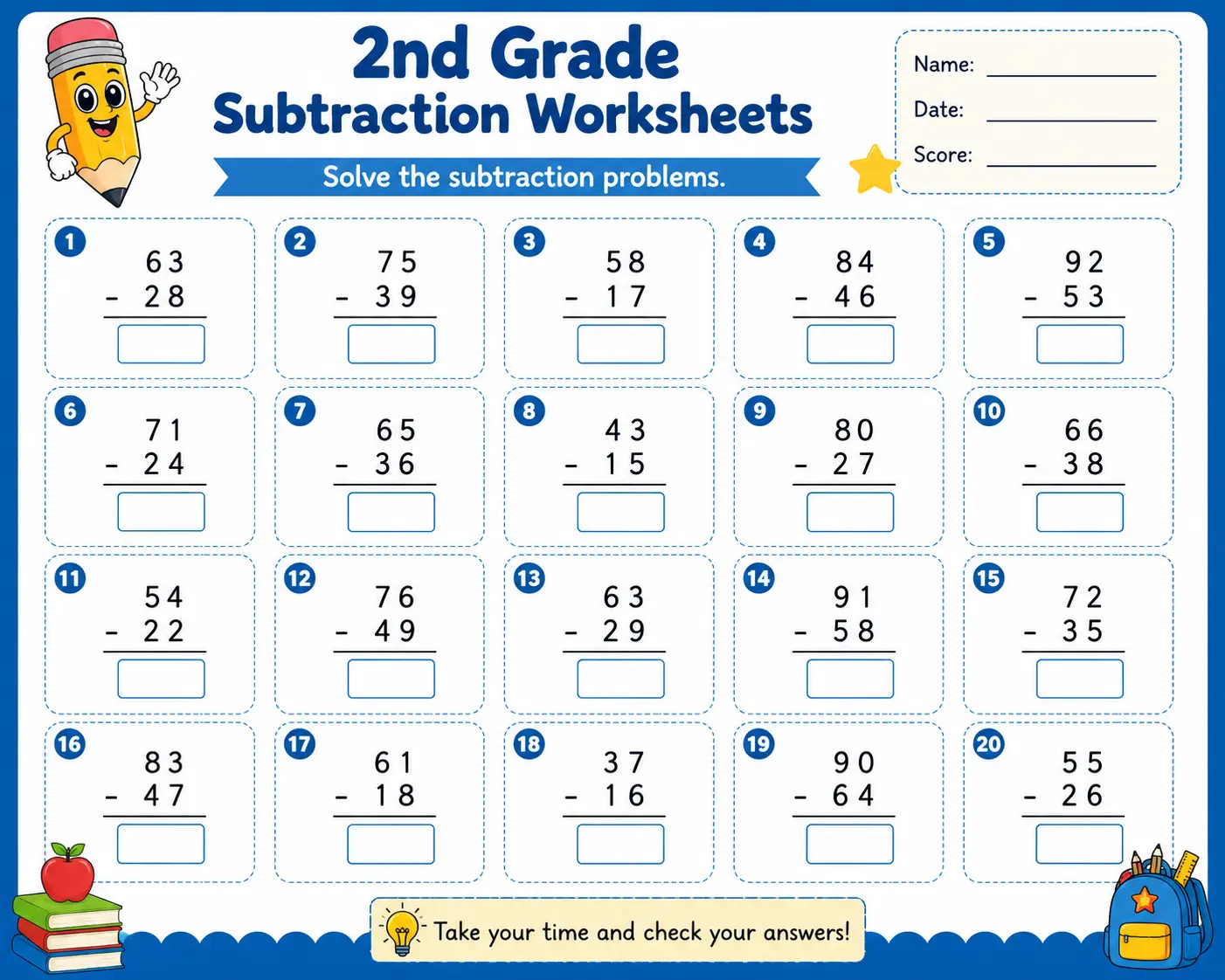
2. Practice Two-Digit Subtraction Without Regrouping
Once subtraction facts become familiar, students can move on to two-digit numbers.
These worksheets teach children how to line up numbers correctly while subtracting each place value separately. It sounds simple, but neat organization is an important skill that many young learners are still developing.
Activities might include:
- Vertical subtraction
- Horizontal subtraction
- Fill-in-the-blank questions
- Matching equations with answers
- Color-by-answer worksheets
Little successes build confidence. And confidence keeps kids motivated.
3. Introduce Regrouping Step by Step
Regrouping—or borrowing—is often the biggest challenge in second grade math.
Many students understand subtraction until they reach problems like:
52 − 27
That’s when confusion can begin.
High-quality 2nd grade subtraction worksheets introduce regrouping gradually instead of overwhelming students with dozens of difficult questions.
Helpful worksheet features include:
- Visual place-value charts
- Base-ten block illustrations
- Guided examples
- Step-by-step practice
- Gradually increasing difficulty
Some children master regrouping quickly. Others need extra repetition. That’s completely normal.
4. Make Learning Fun with Picture Worksheets
Worksheets don’t always have to look serious.
Kids naturally enjoy colorful activities, puzzles, and games. Adding visuals helps maintain attention while reinforcing subtraction concepts.
Popular worksheet ideas include:
- Color by subtraction
- Mystery pictures
- Connect-the-dots
- Maze challenges
- Hidden picture activities
- Cartoon-themed subtraction pages
Sometimes children don’t even realize they’re practicing math because they’re focused on finishing the picture.
That’s a win.
5. Strengthen Thinking with Word Problems
Real-life subtraction matters.
Word problems encourage students to understand situations rather than simply subtract numbers on a page.
For example:
“Emma had 48 stickers. She gave 19 to her friend. How many stickers does she have left?”
These problems improve:
- Reading comprehension
- Logical thinking
- Mathematical reasoning
- Decision-making skills
At first, students may struggle to identify which operation to use. But regular practice helps them recognize subtraction clues naturally.
6. Use Mixed Review Worksheets
Once children understand different subtraction skills, it’s helpful to mix everything together.
Mixed worksheets may include:
- Basic subtraction facts
- Two-digit subtraction
- Regrouping
- Missing numbers
- Word problems
- Comparing answers
This variety prevents students from relying on memorized patterns.
Instead, they learn to think through each question independently.
That’s exactly the goal.
7. Include Real-Life Subtraction Activities
Math becomes much more meaningful when children can connect it to everyday life.
Parents can pair worksheets with simple activities such as:
- Counting toys
- Subtracting snacks
- Grocery shopping
- Measuring ingredients
- Keeping score during games
For example:
“If we bought 35 apples and used 18, how many are left?”
Simple questions like these make subtraction feel useful rather than abstract.
And honestly, kids tend to remember lessons that connect to their daily routines.
8. Build Confidence with Timed Practice
Speed isn’t everything.
Accuracy comes first.
But once students understand subtraction, timed worksheets can improve fluency.
These activities encourage children to recall subtraction facts quickly without relying on counting fingers every time.
A few ideas include:
- One-minute drills
- Two-minute challenges
- Weekly fluency tests
- Classroom competitions
- Personal progress charts
The focus should always remain on improvement—not perfection.
Celebrating small gains keeps motivation high.
9. Track Progress Over Time
One worksheet doesn’t tell the whole story.
A collection of completed worksheets can show how much a child has improved over several weeks or months.
Teachers and parents may notice:
- Fewer careless mistakes
- Faster calculations
- Better handwriting
- Improved organization
- Greater confidence solving word problems
Looking back at earlier work often surprises children.
They realize just how much they’ve learned.
That feeling is incredibly motivating.
10. Choose Worksheets That Match Your Child’s Level
Not every second grader learns at the same pace.
Some students are ready for three-digit subtraction early.
Others may still need additional practice with subtraction within 20.
That’s perfectly okay.
The best 2nd grade subtraction worksheets offer multiple difficulty levels so students can progress comfortably.
Look for worksheets that include:
- Easy review pages
- Standard second-grade practice
- Challenge questions
- Visual learning supports
- Answer keys
- Mixed review sections
Learning should feel achievable—not overwhelming.
A child who enjoys math today is much more likely to enjoy math tomorrow.
Tips for Making Worksheet Practice More Effective
Worksheets are most successful when combined with positive learning habits.
Try these simple strategies:
- Keep practice sessions short.
- Encourage neat work.
- Review mistakes together.
- Praise effort instead of only correct answers.
- Let children explain how they solved a problem.
- Mix worksheets with games and hands-on activities.
- Practice several times each week instead of cramming once.
Consistency almost always beats long study sessions.
Even ten focused minutes can produce excellent results over time.
Why Subtraction Worksheets Still Matter
Technology has changed classrooms, but printable worksheets continue to play an important role.
They help students slow down, organize their thinking, and practice independently. Unlike digital games that may encourage guessing, worksheets reveal exactly where a child needs extra support.
They’re also flexible.
Teachers use them for classroom instruction.
Parents use them for homework.
Homeschool families rely on them every day.
And tutors often use them to reinforce difficult concepts.
Simple? Yes.
Effective? Absolutely.
Final Thoughts
Strong subtraction skills create the foundation for future math topics like multiplication, division, fractions, and problem-solving. That’s why choosing high-quality 2nd grade subtraction worksheets is such a smart investment in a child’s education.
The best worksheets don’t just provide pages of math problems. They encourage critical thinking, build confidence, and make learning feel rewarding rather than frustrating.
Every completed worksheet represents another step forward. Another skill mastered. Another reason for a child to believe they can succeed in math.