Free Name Tracing Worksheets: 10 Easy Ways to Help Kids Build Writing Skills
Learning to write a name is one of the biggest milestones in early childhood. It’s often the very first word a child learns to read, recognize, and write. That’s why free name tracing worksheets have become a favorite resource for parents, preschool teachers, homeschool families, and childcare centers.
The best part? You don’t need expensive workbooks or complicated learning materials. A simple personalized worksheet can turn handwriting practice into a fun daily activity that children actually enjoy. And honestly… seeing their own name on the page makes a huge difference. Kids naturally become more excited to practice.
In this guide, you’ll learn why name tracing matters, how to use printable worksheets effectively, and simple tips that make handwriting practice less stressful and much more successful.
Why Free Name Tracing Worksheets Are So Popular
Children love seeing their own names.
Instead of tracing random letters, they’re practicing something meaningful. Every worksheet feels personal, which helps maintain attention much longer than traditional handwriting exercises.
Free printable worksheets are also convenient because they:
- Cost nothing to download
- Save preparation time for teachers
- Can be printed whenever needed
- Allow unlimited handwriting practice
- Support both classroom and home learning
Many parents print a fresh worksheet every day. Others laminate one copy and use dry-erase markers for endless reuse.
Both methods work well.
1. Build Letter Recognition Naturally
Before children can write words, they first need to recognize letters.
Name tracing worksheets expose kids to the same letters repeatedly. Since these letters belong to their own name, they’re easier to remember.
For example, a child named Emma quickly becomes familiar with:
- E
- M
- M
- A
Over time, those letters become instantly recognizable in books, signs, and classroom activities.
That repeated exposure builds confidence without feeling repetitive.
2. Improve Fine Motor Skills
Writing isn’t just about knowing letters.
Children also need strong hand muscles and finger coordination.
Tracing helps develop:
- Pencil control
- Grip strength
- Wrist movement
- Hand-eye coordination
- Finger flexibility
These small motor skills are essential for future handwriting, drawing, cutting with scissors, and many everyday classroom activities.
Even five to ten minutes of tracing practice each day can make noticeable progress.
3. Encourage Correct Letter Formation
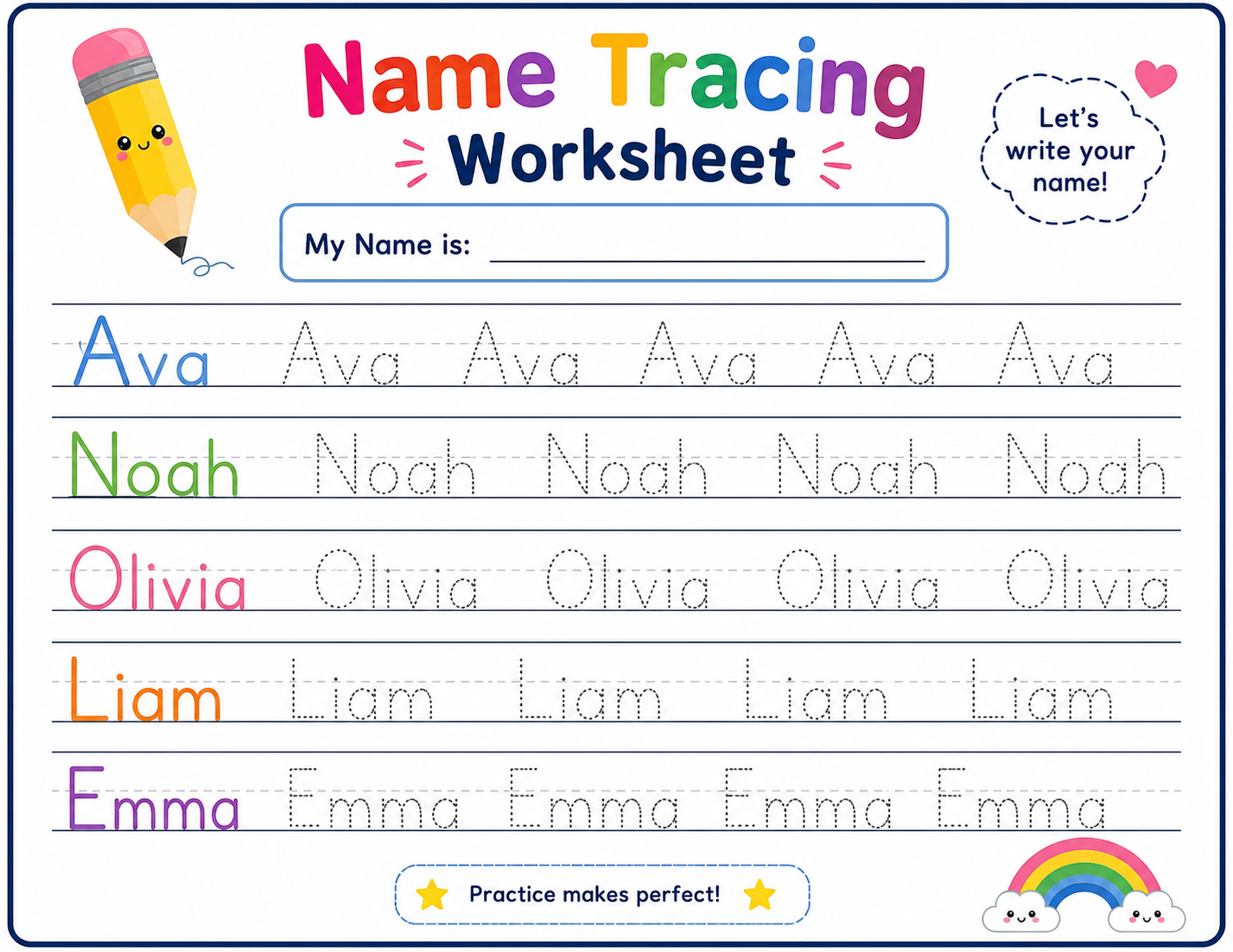
One of the biggest benefits of free name tracing worksheets is teaching proper letter formation from the beginning.
Instead of guessing how to write each letter, children follow dotted lines that demonstrate the correct path.
This reduces bad writing habits before they become difficult to correct later.
Teachers often recommend starting with:
- Large dotted letters
- Wide tracing spaces
- Directional arrows
- Simple uppercase letters
Once children gain confidence, lowercase practice can gradually be introduced.
4. Increase Writing Confidence
Many preschoolers hesitate when asked to write independently.
Blank paper can feel overwhelming.
Tracing worksheets remove that fear because children simply follow existing lines.
Every completed worksheet becomes a small achievement.
And those small wins add up.
The more successful children feel, the more willing they become to practice writing on their own.
Confidence is often the biggest step toward independent handwriting.
5. Make Learning Feel Like Play
Young children learn best when activities feel enjoyable rather than academic.
You can make tracing even more exciting by adding playful elements:
- Color each letter after tracing
- Decorate the page with stickers
- Trace using rainbow colors
- Practice with crayons or markers
- Use glitter pens occasionally
- Add favorite animals beside the name
Simple changes like these keep children interested without adding complexity.
Sometimes the smallest rewards create the biggest motivation.
6. Perfect for Preschool and Kindergarten
Name tracing worksheets fit naturally into early childhood education.
Teachers commonly include them during:
- Morning work
- Literacy centers
- Independent practice
- Handwriting lessons
- Quiet time
- Homework activities
Parents also appreciate having structured practice available at home.
Even busy families can fit a five-minute worksheet into their daily routine.
Consistency matters far more than long practice sessions.
7. Personalized Learning Works Better
Every child learns differently.
That’s why customizable worksheets are so valuable.
Instead of generic handwriting pages, personalized name tracing sheets focus on the exact letters each child needs.
Many printable generators allow you to:
- Enter any name
- Select fonts
- Adjust tracing size
- Choose uppercase or lowercase
- Add extra practice lines
- Include pictures or borders
This flexibility makes the worksheets suitable for toddlers through kindergarten.
8. Support Homeschool Learning
Homeschool families often look for affordable educational resources.
Free printable worksheets solve several problems at once.
They’re easy to organize, simple to print, and adaptable to different learning levels.
Parents can gradually increase difficulty by moving from:
- Thick dotted tracing
- Thin tracing lines
- Copying the name independently
- Writing without guidance
This step-by-step progression helps children develop handwriting naturally without unnecessary pressure.
9. Reinforce Daily Practice
Like any skill, handwriting improves through repetition.
Daily name tracing creates a routine that strengthens muscle memory.
Children begin remembering:
- Letter order
- Letter shapes
- Pencil movements
- Proper spacing
Eventually, they no longer rely on tracing lines.
Instead, they confidently write their names from memory.
That’s the goal.
Short daily practice usually produces better results than one long weekly session.
10. Prepare Children for School Success
Being able to write their own name gives children an important advantage before entering school.
Teachers often ask students to write their names on:
- Worksheets
- Art projects
- Name tags
- Homework
- Attendance sheets
- Classroom activities
Children who have practiced regularly feel comfortable completing these tasks independently.
That confidence often carries over into reading, spelling, and other language activities as well.
Tips for Getting the Best Results
Using free name tracing worksheets effectively doesn’t require special teaching experience.
A few simple habits make a noticeable difference.
Keep Sessions Short
Five to ten minutes is usually enough.
Young children have limited attention spans, and stopping before frustration begins helps maintain enthusiasm.
Celebrate Progress
Focus on improvement rather than perfection.
Praise effort, neatness, and consistency instead of expecting flawless handwriting.
Practice Regularly
Daily practice creates stronger handwriting habits than occasional long sessions.
Even three worksheets each week can produce excellent results over time.
Use Different Writing Tools
Switch between:
- Crayons
- Colored pencils
- Washable markers
- Standard pencils
- Dry-erase markers
Different tools strengthen different hand muscles and keep practice interesting.
Be Patient
Every child develops handwriting skills at a different pace.
Some master tracing quickly.
Others need weeks—or even months—before writing confidently.
That’s completely normal.
Common Mistakes to Avoid
Parents sometimes unintentionally make handwriting practice harder than necessary.
Try to avoid these common mistakes:
- Forcing long practice sessions
- Correcting every tiny mistake
- Using worksheets that are too difficult
- Expecting perfect handwriting immediately
- Skipping practice for long periods
A relaxed, encouraging approach almost always produces better long-term results.
Final Thoughts
Free name tracing worksheets are one of the simplest yet most effective educational tools for early learners. They help children recognize letters, strengthen fine motor skills, improve pencil control, and build the confidence needed for independent writing.
Whether you’re a parent teaching at home, a preschool educator preparing classroom activities, or a homeschool family looking for printable resources, personalized name tracing worksheets offer a fun and practical way to support handwriting development.
Remember, learning to write doesn’t happen overnight. A few minutes of consistent practice, lots of encouragement, and worksheets that feature a child’s own name can make the journey enjoyable—and surprisingly rewarding. Before long, those carefully traced dotted letters become confident handwriting, one name at a time.