Division Worksheets Grade 3: 10 Fun Ways to Build Strong Division Skills
Learning division worksheets grade 3 can feel like a big step for many third graders. After all, they’re moving from simple multiplication facts to splitting numbers into equal groups, sharing items fairly, and understanding remainders. It can seem tricky at first.
That’s exactly why division worksheets grade 3 are such a helpful learning tool.
Instead of memorizing answers without understanding the process, children get plenty of chances to practice. They make mistakes, fix them, and slowly build confidence. And honestly… that’s how real learning happens.
Whether you’re a parent helping with homework, a teacher planning tomorrow’s math lesson, or a homeschool educator looking for printable activities, the right worksheets can make division worksheets grade 3 much less stressful—and much more enjoyable.
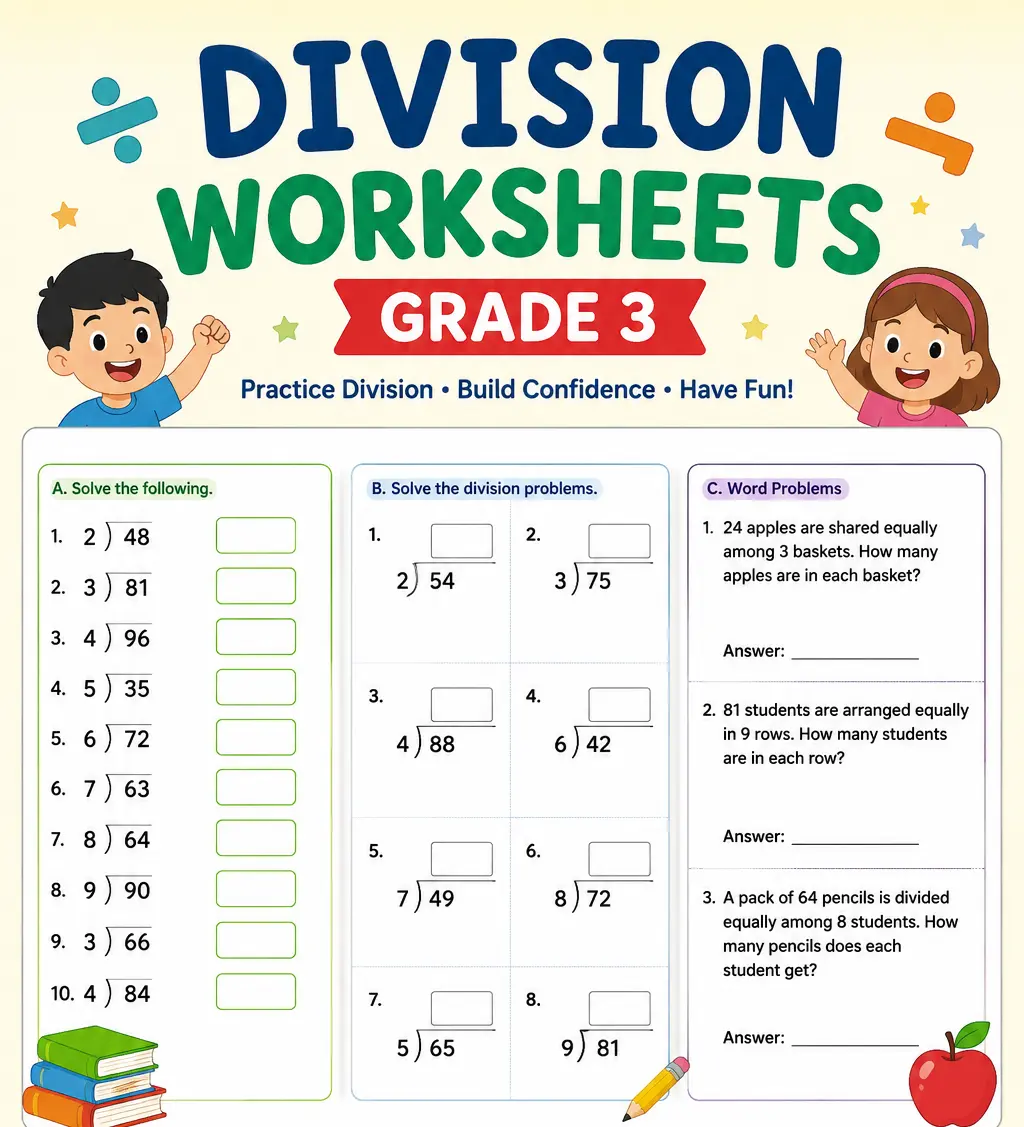
Let’s explore the best types of Grade division worksheets grade 3 and how they help children master this essential math skill.
1. Basic Division Facts Worksheets
Every strong math foundation starts with basic facts.
These worksheets focus on simple division problems like:
- 8 ÷ 2
- 12 ÷ 3
- 20 ÷ 5
- 18 ÷ 6
Children begin recognizing division patterns while strengthening their multiplication knowledge at the same time.
The more they practice these facts, the faster they’ll solve larger problems later.
2. Equal Groups Division Worksheets
Before children understand division symbols, they need to understand the idea behind division.
Equal group worksheets teach students to answer questions like:
- Divide 15 apples into 3 baskets.
- Share 20 candies among 5 children.
- Put 12 toys into groups of 4.
Pictures make these worksheets especially effective.
Students actually see how numbers are divided instead of simply calculating answers.
And that’s a huge confidence booster.
3. Division Using Arrays
Arrays connect multiplication and division worksheets grade 3 beautifully.
Instead of seeing random numbers, students learn to organize objects into rows and columns.
Example:
24 objects arranged in 4 rows.
Children discover:
24 ÷ 4 = 6
Then they connect it back:
4 × 6 = 24
This visual learning helps many students understand why division worksheets grade 3 rather than simply memorizing equations.
4. Missing Number Division Worksheets
These worksheets turn ordinary practice into a small puzzle.
Examples include:
- □ ÷ 5 = 4
- 24 ÷ □ = 6
- □ ÷ 3 = 7
Children must think backwards using multiplication facts.
It strengthens logical reasoning.
And honestly… many kids enjoy solving these much more than standard equations.
5. Division Word Problems
Math becomes meaningful when children can connect it to everyday life.
Word problem worksheets include situations like:
- Emma has 18 cookies. She shares them equally with 6 friends. How many cookies does each friend receive?
- There are 27 pencils placed equally into 9 boxes. How many pencils are in each box?
These exercises improve:
- Reading comprehension
- Critical thinking
- Real-world problem solving
- Mathematical reasoning
They’re excellent preparation for classroom assessments.
6. Division with Pictures
Visual learners often struggle with pages full of numbers.
Picture-based worksheets solve that problem.
Students count:
- Stars
- Animals
- Fruits
- Shapes
- Toys
Then they divide them into equal groups.
It feels less like homework and more like an activity.
That little difference matters.
7. Division and Multiplication Relationship Worksheets
Multiplication and division worksheets grade 3 are inverse operations.
Understanding this relationship makes both subjects easier.
Example:
If:
6 × 5 = 30
Then students also know:
30 ÷ 5 = 6
30 ÷ 6 = 5
Worksheets that combine both operations help children recognize patterns instead of treating multiplication and division as completely separate topics.
8. Division with Remainders
Eventually, students discover that not every number divides evenly.
That’s where remainder worksheets come in.
Example:
17 ÷ 5 = 3 R2
These worksheets teach children:
- When leftovers happen
- How to write remainders correctly
- Why remainders appear
Many Grade 3 students initially find this confusing.
With enough practice, though, it starts making perfect sense.
9. Mixed Division Review Worksheets
Once students understand individual concepts, mixed review worksheets bring everything together.
These pages may include:
- Basic facts
- Word problems
- Missing numbers
- Arrays
- Equal groups
- Remainders
The variety keeps practice interesting.
Instead of repeating the same type of question 30 times, children stay engaged because every few problems feel different.
10. Timed Division Practice Worksheets
Speed isn’t everything.
Accuracy comes first.
Still, once children understand division worksheets grade 3 concepts, timed worksheets help improve fluency.
Short practice sessions of:
- 2 minutes
- 3 minutes
- 5 minutes
encourage quick thinking without creating unnecessary pressure.
Many teachers use these as warm-up activities before beginning daily math lessons.
Benefits of Using Division Worksheets Grade 3
Good worksheets do much more than provide homework.
They help students:
- Build confidence
- Improve number sense
- Strengthen multiplication recall
- Develop logical thinking
- Practice independently
- Prepare for classroom tests
- Learn from mistakes
- Increase problem-solving skills
Small amounts of daily practice often produce better results than one long study session every week.
Tips for Parents
Helping your child doesn’t require being a math expert.
A few simple habits can make a huge difference.
Try these ideas:
- Practice for 10–15 minutes each day.
- Use real objects like coins, snacks, or blocks.
- Celebrate improvement instead of perfection.
- Review incorrect answers together.
- Mix worksheets with educational math games.
- Encourage children to explain how they found each answer.
Sometimes hearing their own explanation helps them understand the concept even better.
Tips for Teachers
Classroom worksheets become even more effective when combined with hands-on learning.
Consider using:
- Partner activities
- Math centers
- Small group instruction
- Exit tickets
- Weekly review packets
- Interactive whiteboard demonstrations
Differentiated worksheets also help meet the needs of students learning at different speeds.
Some children may still need picture support, while others are ready for challenging word problems.
What Makes a Great Grade 3 Division Worksheet?
Not every worksheet is equally helpful.
The best ones usually include:
- Clear instructions
- Large, readable numbers
- Age-appropriate questions
- Gradually increasing difficulty
- Plenty of practice
- Visual models
- Word problems
- Answer keys for checking work
A balanced worksheet keeps students challenged without becoming frustrating.
That’s the sweet spot.
Common Mistakes Third Graders Make
Every learner makes mistakes.
Some of the most common include:
- Confusing multiplication with division
- Forgetting multiplication facts
- Ignoring remainders
- Dividing unevenly into groups
- Misreading word problems
- Rushing through calculations
Regular practice helps reduce these errors over time.
Patience helps too.
Final Thoughts
Using division worksheets grade 3 is one of the easiest and most effective ways to strengthen early math skills. They give children the repetition they need while introducing division worksheets grade 3 in a simple, approachable way. From equal groups and arrays to word problems and remainders, each worksheet builds another layer of understanding.
The key isn’t completing dozens of pages in one sitting. It’s consistent practice, encouragement, and allowing children to learn at their own pace. With engaging activities and well-designed worksheets, third graders can develop the confidence to tackle division—and enjoy math a little more along the way.