4th Grade Division Worksheets: 10 Fun Ways to Build Strong Division Skills
Division can feel tricky at first. For many fourth graders, it’s the first time they move beyond simple sharing problems and start working with larger numbers, remainders, and long division. That’s exactly why 4th grade division worksheets are such valuable learning tools.
The right worksheet doesn’t just provide practice—it builds confidence. One problem at a time, students begin recognizing patterns, checking their work, and solving division questions faster without feeling overwhelmed.
Whether you’re a parent helping with homework, a teacher planning classroom activities, or a homeschool educator creating daily lessons, these worksheets make learning more enjoyable. And honestly… they also make teaching easier.
Let’s explore the best types of division worksheets every fourth grader should use.
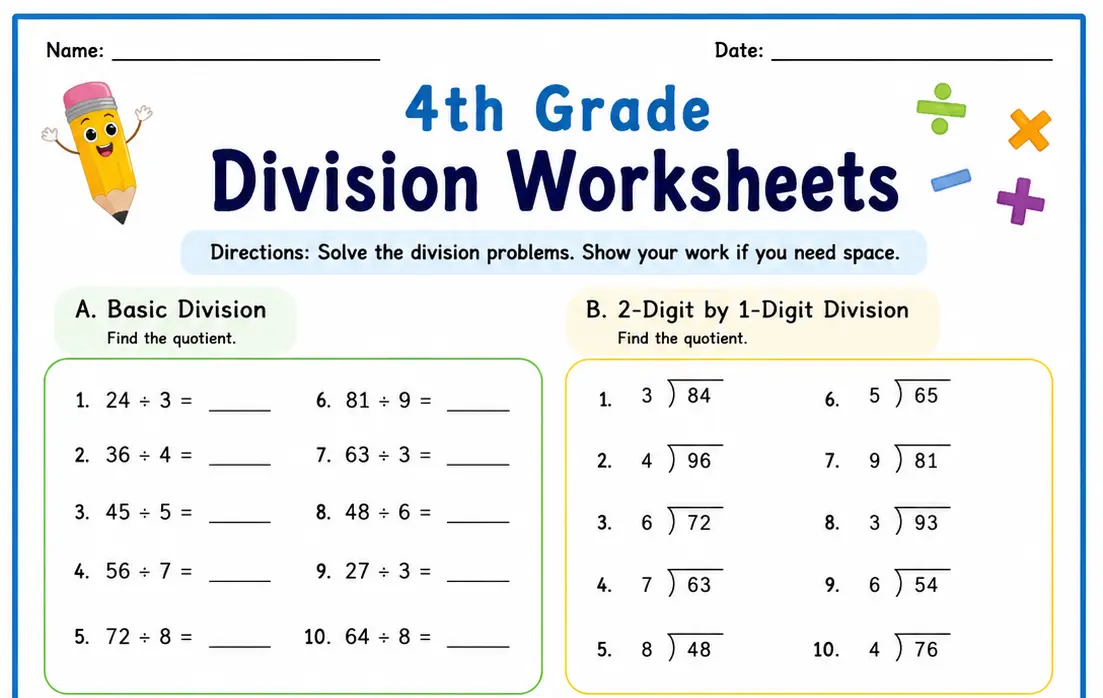
1. Basic Division Facts Worksheets
Everything starts with the basics.
Before students can solve long division problems, they need to know simple division facts almost automatically. Just like multiplication tables, quick recall saves time and reduces frustration.
These worksheets usually include:
- Division facts from 1 to 12
- Missing number problems
- Timed practice activities
- Fact family exercises
- Multiplication and division connections
Practicing for just 10–15 minutes a day can make a noticeable difference.
And the best part? Kids begin answering questions without counting on their fingers.
2. Long Division Worksheets
Long division is one of the biggest milestones in fourth grade math.
At first, many students think it looks confusing. Lots of numbers. Multiple steps. Easy to make mistakes.
But consistent practice changes everything.
A good worksheet introduces long division gradually by covering:
- One-digit divisors
- Two-digit dividends
- Step-by-step solving
- Quotient placement
- Checking answers using multiplication
The more students practice, the more natural the process becomes.
3. Division with Remainders Worksheets
Life doesn’t always divide evenly.
That’s where remainders come in.
Many 4th grade division worksheets include problems that leave extra numbers after dividing. Learning how to handle remainders prepares students for more advanced math later.
These worksheets often feature:
- Single-digit divisors
- Word problems with leftovers
- Identifying the quotient and remainder
- Comparing exact and non-exact division
Once children understand why remainders happen, the concept becomes much less intimidating.
4. Division Word Problems
Math isn’t only about numbers on a page.
Students also need to understand how division works in everyday situations.
Word problem worksheets encourage critical thinking by asking questions like:
- Sharing cookies among friends
- Packing books into boxes
- Dividing classroom supplies
- Splitting sports teams evenly
- Organizing groups for projects
These activities improve both reading comprehension and mathematical reasoning.
Sometimes the hardest part isn’t the division…
It’s figuring out which operation to use.
5. Division Arrays and Visual Models
Visual learners often understand concepts much faster when they can actually see them.
Division arrays use rows and columns to represent equal groups. Instead of memorizing answers, students build a deeper understanding of how division works.
Visual worksheets may include:
- Picture models
- Equal groups
- Area models
- Number lines
- Array diagrams
These illustrations make abstract math feel much more concrete.
Especially for students who struggle with traditional methods.
6. Mixed Multiplication and Division Worksheets
Multiplication and division are closely connected.
Teaching them together helps students understand that they’re inverse operations.
Mixed worksheets usually include:
- Multiplication review
- Division practice
- Fact families
- Missing numbers
- Reverse operations
This reinforces previous lessons while introducing new skills.
And yes—it also helps students catch mistakes more easily.
7. Division Color-by-Answer Activities
Learning should be fun.
Every child deserves worksheets that don’t feel like endless homework.
Color-by-answer activities combine math with creativity. Students solve division problems, then color sections according to the correct answers.
Benefits include:
- Better engagement
- Reduced math anxiety
- Improved focus
- Instant visual rewards
- Longer attention spans
Even reluctant learners often enjoy these worksheets.
Sometimes they don’t even realize how much practice they’re getting.
8. Challenge Division Worksheets
Some fourth graders master division quickly.
They need something a little more exciting.
Challenge worksheets include:
- Larger dividends
- Multi-step problems
- Logic puzzles
- Division riddles
- Critical thinking activities
These worksheets encourage deeper problem-solving without simply adding more repetitive questions.
Keeping advanced learners challenged is just as important as supporting struggling students.
9. Printable Homework Worksheets
Printable worksheets remain one of the easiest resources for parents and teachers.
No complicated setup.
Just print… and start learning.
Homework worksheets often include:
- Daily practice pages
- Weekly review packets
- Mixed difficulty levels
- Answer keys
- Progress tracking
Many families appreciate having ready-to-use resources available whenever extra practice is needed.
Especially before quizzes and math tests.
10. Seasonal and Themed Division Worksheets
Children love variety.
Themed worksheets make routine practice feel fresh again.
Popular themes include:
- Halloween division puzzles
- Christmas math activities
- Spring worksheets
- Summer review pages
- Animal-themed problems
- Space adventures
- Sports division games
A simple change in design can dramatically increase student motivation.
Funny how that works.
Tips for Choosing the Best 4th Grade Division Worksheets
Not every worksheet is equally effective.
When selecting materials, look for worksheets that:
- Match fourth-grade curriculum standards
- Progress from easy to challenging
- Include answer keys
- Offer clear instructions
- Balance computation with word problems
- Encourage independent thinking
- Provide enough practice without becoming repetitive
Quality matters much more than quantity.
Completing five thoughtful problems often teaches more than rushing through fifty.
How Parents Can Make Division Practice More Enjoyable
Practice doesn’t have to feel like homework every single day.
Try these simple ideas:
- Set a timer for 10 minutes.
- Celebrate improvement instead of perfection.
- Use small rewards for completed worksheets.
- Turn mistakes into learning opportunities.
- Mix worksheets with educational games.
- Practice consistently instead of cramming.
Children usually gain confidence through small daily successes rather than long study sessions.
And confidence changes everything.
Why Regular Division Practice Matters
Strong division skills support many future math topics.
Students who understand division often find it easier to learn:
- Fractions
- Decimals
- Ratios
- Percentages
- Algebra
- Problem solving
That’s why consistent practice during fourth grade creates a strong mathematical foundation.
It isn’t only about passing the next test.
It’s about preparing for years of learning ahead.
Final Thoughts
Finding the right 4th grade division worksheets can transform the way children learn math. Instead of seeing division as confusing or frustrating, students begin viewing it as a series of manageable steps.
From basic division facts and long division to engaging word problems and colorful activities, every worksheet adds another piece to the puzzle. Over time, those small improvements become real confidence.
So don’t worry if division feels difficult today. Keep practicing, stay patient, and choose worksheets that make learning enjoyable. Little by little… those challenging problems become surprisingly simple.