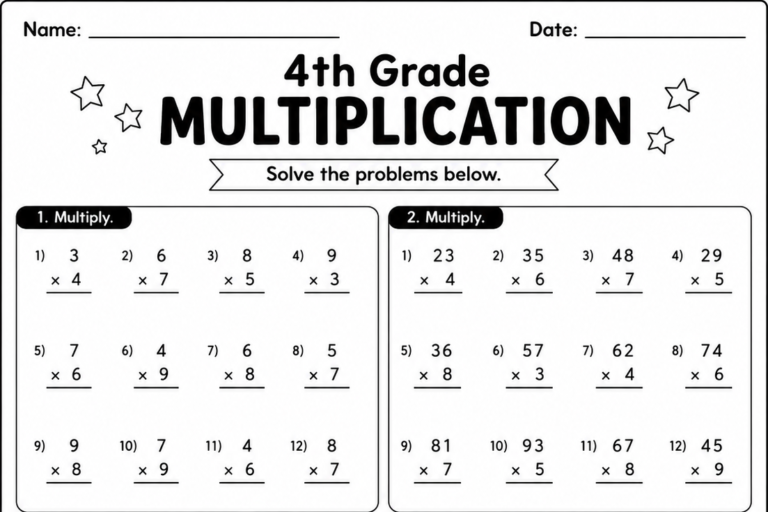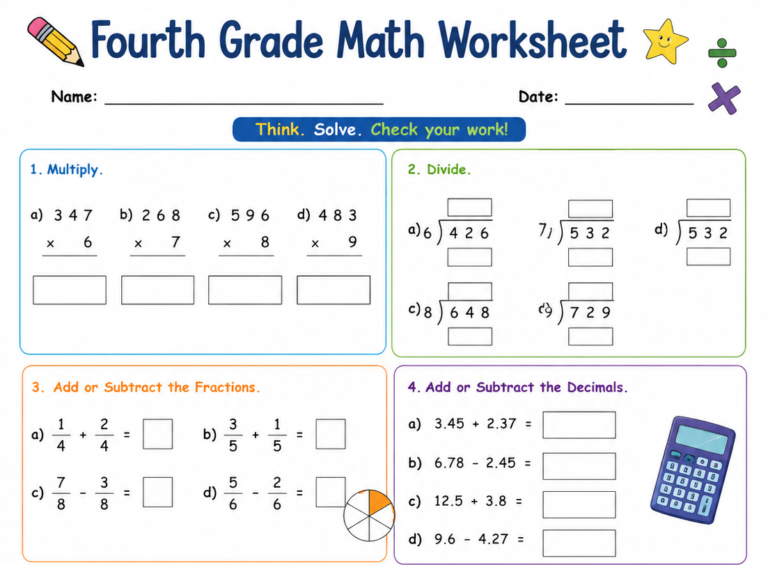
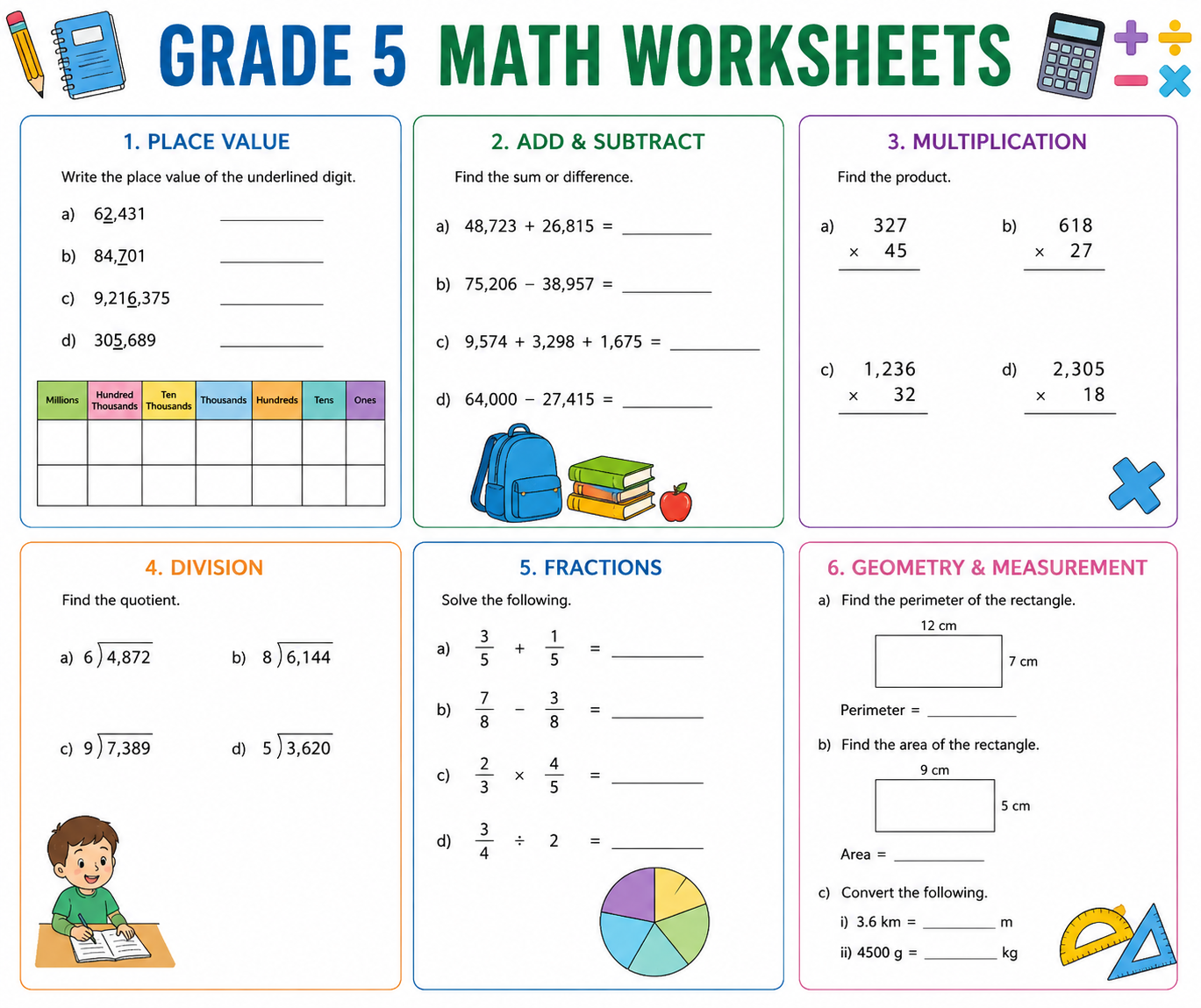
Grade 5 Math Worksheets: The Complete Practice Guide for Better
Grade 5 is one of the most important years in a child’s math journey. During this stage, students move beyond basic arithmetic and begin solving more challenging problems involving fractions, decimals, geometry, measurement, percentages, and multi-step word problems. Regular practice helps children understand these concepts more clearly and prepares them for higher grades.
Grade 5 math worksheets are one of the easiest and most effective learning tools for students, parents, teachers, and homeschool families. They provide focused practice, improve problem-solving skills, build confidence, and help identify weak areas before exams.
This complete guide explains everything you need to know about Grade 5 math worksheets, the topics they cover, how to use them effectively, common mistakes students make, and practical study tips that lead to better results.
Why Grade 5 Math Worksheets Are Important
Math is a skill that improves through practice. Reading formulas is helpful, but solving different types of questions is what truly develops understanding.
Well-designed worksheets help students:
- Practice important math skills regularly.
- Improve calculation speed and accuracy.
- Understand different question types.
- Build confidence before tests.
- Develop logical thinking.
- Reduce common mistakes.
- Learn to solve multi-step problems independently.
Instead of memorizing answers, students learn how to think through each problem step by step.
Skills Every Grade 5 Student Should Learn
By the end of Grade 5, students should feel comfortable with several important math topics. These skills create the foundation for middle school mathematics.
Students should understand:
- Whole numbers
- Large number place values
- Addition and subtraction
- Multiplication
- Division
- Fractions
- Decimals
- Percentages
- Geometry
- Measurement
- Data handling
- Graphs
- Algebra basics
- Word problems
- Order of operations
Each skill builds on the previous one, making consistent practice essential.
How Grade 5 Math Worksheets Improve Learning
Worksheets are more than just pages filled with questions. When used correctly, they become powerful learning tools.
Better Understanding
Students solve different question styles instead of repeating the same problem. This improves understanding rather than memorization.
Stronger Memory
Regular practice helps mathematical methods stay fresh in the student’s memory.
Faster Calculations
The more students practice, the faster they become at solving problems without sacrificing accuracy.
Higher Confidence
Completing worksheets successfully gives students confidence before quizzes, classroom tests, and final exams.
Easier Progress Tracking
Parents and teachers can quickly identify topics where students need extra support.
Topics Covered in Grade 5 Math Worksheets
A complete worksheet collection should cover every major topic taught during the school year.
Place Value
Students learn how numbers increase in value depending on their position.
Practice includes:
- Reading large numbers
- Writing numbers in words
- Expanded form
- Comparing numbers
- Ordering numbers
- Rounding numbers
These exercises build number sense and improve calculation accuracy.
Addition and Subtraction
Grade 5 students solve problems involving larger numbers and multiple steps.
Worksheets often include:
- Multi-digit addition
- Multi-digit subtraction
- Missing numbers
- Estimation
- Mental math
- Real-life applications
These questions improve accuracy while reducing careless mistakes.
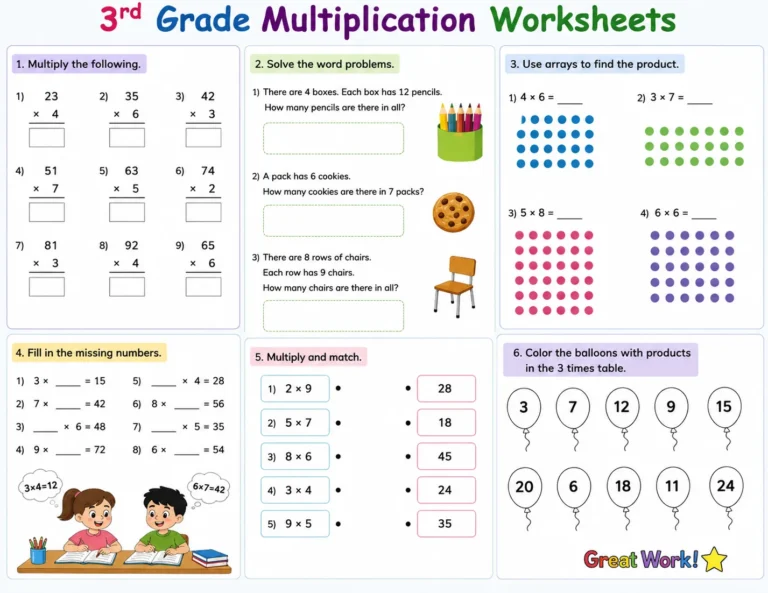
Multiplication
Students practice multiplying larger numbers using different methods.
Common worksheet exercises include:
- Two-digit multiplication
- Three-digit multiplication
- Long multiplication
- Multiples
- Factors
- Multiplication patterns
Learning multiplication thoroughly makes future topics much easier.
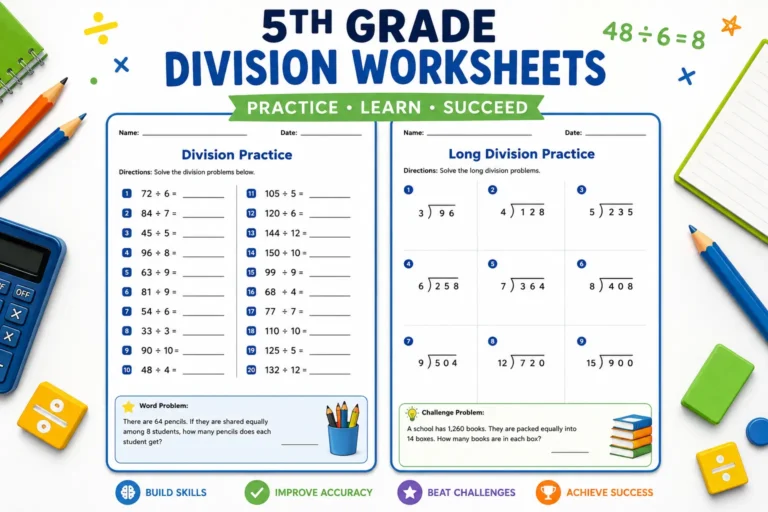
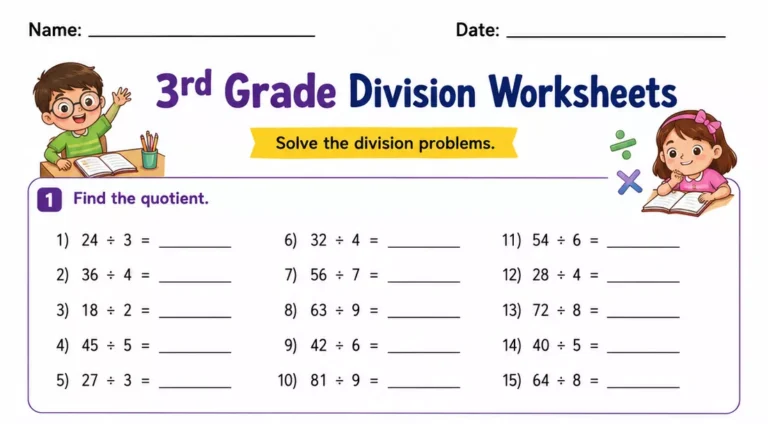
Division
Division becomes more advanced during Grade 5.
Students practice:
- Long division
- Division with remainders
- Word problems
- Checking answers
- Divisibility rules
Understanding division helps students perform better with fractions and algebra later.
Fractions
Fractions are one of the biggest Grade 5 topics.
Worksheets usually cover:
- Equivalent fractions
- Simplifying fractions
- Comparing fractions
- Adding fractions
- Subtracting fractions
- Multiplying fractions
- Dividing fractions
- Mixed numbers
- Improper fractions
Regular practice helps students overcome one of the most challenging areas in mathematics.
Decimals
Students learn how decimals relate to fractions and whole numbers.
Worksheet activities include:
- Decimal place values
- Comparing decimals
- Ordering decimals
- Addition
- Subtraction
- Multiplication
- Division
- Decimal word problems
Understanding decimals prepares students for percentages and financial math.
Percentages
Students begin learning how percentages represent parts of a whole.
Practice questions include:
- Percentage basics
- Percentage of numbers
- Converting fractions to percentages
- Decimals to percentages
- Everyday percentage problems
These skills become useful in daily life.
Geometry
Geometry introduces shapes, angles, and spatial reasoning.
Worksheets may include:
- Types of angles
- Triangles
- Quadrilaterals
- Circles
- Symmetry
- Perimeter
- Area
- Volume basics
Visual learning helps students understand these concepts more easily.
Measurement
Measurement worksheets teach students to calculate and compare different units.
Students practice:
- Length
- Weight
- Capacity
- Time
- Temperature
- Unit conversions
These exercises connect mathematics with real-life situations.
Data and Graphs
Students learn how to organize and interpret information.
Worksheet topics include:
- Bar graphs
- Line graphs
- Tables
- Picture graphs
- Average
- Reading charts
These skills improve analytical thinking.
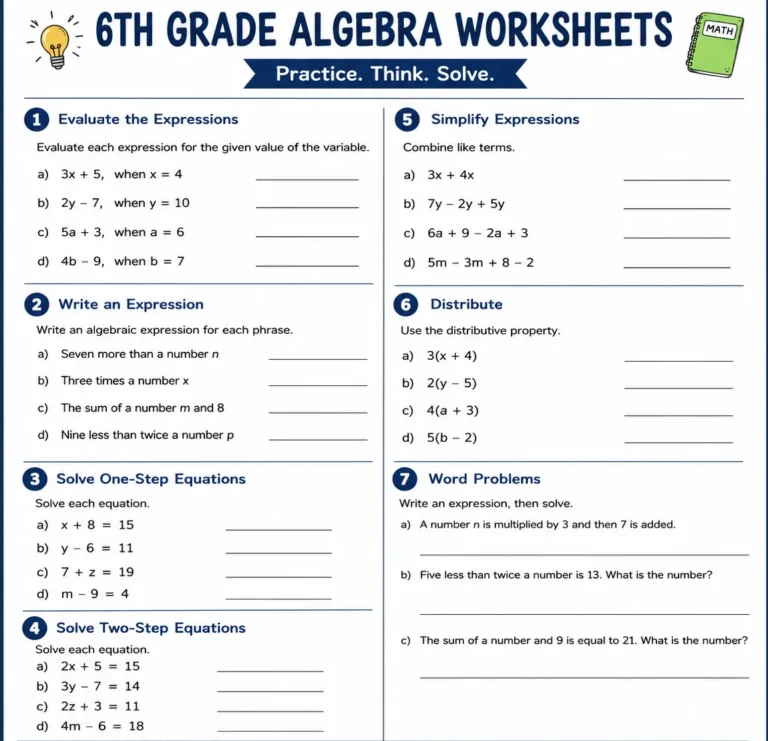
Algebra Basics
Grade 5 introduces simple algebraic thinking.
Students solve:
- Missing numbers
- Number patterns
- Simple equations
- Variables
- Function tables
This creates a smooth transition into higher-level mathematics.
Word Problems
Word problems combine several mathematical skills.
Students learn how to:
- Read carefully
- Identify important information
- Choose the correct operation
- Solve step by step
- Check answers
These questions improve critical thinking more than simple calculations.
A Simple Learning Order That Works
Many students struggle because they practice random topics instead of following a logical sequence.
A better learning path is:
- Place Value
- Addition
- Subtraction
- Multiplication
- Division
- Fractions
- Decimals
- Percentages
- Geometry
- Measurement
- Data Handling
- Algebra
- Mixed Revision
- Full Practice Tests
Following this order helps students build skills naturally.
How Often Should Students Practice?
Daily practice is much more effective than studying for long hours once a week.
A simple weekly schedule can look like this:
- Monday: Multiplication
- Tuesday: Division
- Wednesday: Fractions
- Thursday: Decimals
- Friday: Geometry
- Saturday: Mixed Practice
- Sunday: Review Mistakes
Even 20 to 30 minutes of focused practice each day can lead to significant improvement.
Common Mistakes Grade 5 Students Make
Recognizing mistakes early helps students improve faster.
Some of the most common errors include:
- Forgetting place values
- Incorrect carrying or borrowing
- Multiplication table mistakes
- Division calculation errors
- Confusing numerators and denominators
- Incorrect decimal placement
- Missing units in measurement questions
- Skipping important words in word problems
- Not checking final answers
Reviewing mistakes after every worksheet is just as important as completing it.
Tips for Parents
Parents play a major role in helping children succeed in mathematics.
Helpful strategies include:
- Create a regular study routine.
- Encourage effort instead of perfection.
- Let children solve questions independently.
- Discuss mistakes calmly.
- Celebrate small improvements.
- Use everyday examples while shopping or cooking.
- Keep learning positive and enjoyable.
Avoid comparing children with classmates because every student learns at a different pace.
Tips for Teachers
Teachers can make worksheets even more effective by:
- Starting with easy questions.
- Gradually increasing difficulty.
- Mixing different topics.
- Encouraging group discussions.
- Reviewing common mistakes together.
- Giving regular feedback.
- Tracking student progress over time.
Balanced practice improves long-term understanding.
Printable Worksheets vs Digital Worksheets
Both formats have advantages.
Printable worksheets help students write calculations, improve handwriting, and reduce screen time.
Digital worksheets provide instant feedback, automatic scoring, and easy access from anywhere.
Using both together often gives the best learning experience.
Signs That a Student Needs More Practice
Extra worksheet practice may be helpful if a student:
- Takes a long time to solve simple questions.
- Makes repeated calculation mistakes.
- Avoids math homework.
- Gets confused with fractions or decimals.
- Struggles with word problems.
- Feels anxious during math tests.
Early practice prevents small problems from becoming larger learning gaps.
How to Check Worksheet Answers
Simply marking answers as right or wrong is not enough.
Students should:
- Compare answers carefully.
- Understand why mistakes happened.
- Solve incorrect questions again without looking at the solution.
- Repeat similar questions until they become comfortable.
Learning from mistakes is one of the fastest ways to improve.
Exam Preparation Using Worksheets
Worksheets are excellent preparation tools before exams.
A successful revision plan includes:
- Reviewing one topic each day.
- Solving mixed practice sets.
- Timing practice sessions.
- Revising difficult questions.
- Taking full-length practice tests.
- Checking every incorrect answer.
This approach builds confidence before the actual exam.
Real-Life Uses of Grade 5 Math
Students often ask why they need mathematics. The answer becomes clear in everyday situations.
Math is used for:
- Shopping and budgeting
- Measuring ingredients while cooking
- Reading maps
- Planning travel time
- Understanding discounts
- Managing savings
- Sports statistics
- Home improvement projects
Showing these real-world connections makes learning more meaningful.
Building Long-Term Math Confidence
Confidence grows through steady improvement, not perfection.
Students who complete regular worksheets usually become:
- Faster problem solvers
- Better logical thinkers
- More confident during exams
- More independent learners
- Better prepared for higher grades
Consistency matters far more than completing hundreds of questions in one day.
What are Grade 5 math worksheets?
Grade 5 math worksheets are practice sheets designed to help students strengthen important mathematical skills such as fractions, decimals, multiplication, division, geometry, measurement, and problem-solving.
How many worksheets should a Grade 5 student complete each week?
Completing five to seven worksheets each week, along with reviewing mistakes, provides enough practice for most students without causing burnout.
Which topic is usually the most difficult?
Many students find fractions and decimals challenging because these topics require a strong understanding of earlier math concepts. Regular practice makes them much easier over time.
Are worksheets enough to improve math skills?
Worksheets are highly effective when combined with classroom learning, clear explanations, and regular revision. Students should focus on understanding methods rather than memorizing answers.
How long should each practice session be?
Most Grade 5 students benefit from 20 to 30 minutes of focused practice each day. Short, consistent sessions are usually more effective than long study periods.
Should students time themselves while solving worksheets?
Yes. Once students understand a topic, solving worksheets within a time limit helps improve speed, accuracy, and confidence for classroom tests and exams.
Final Thoughts
Grade 5 is a key stage in every student’s mathematical development. The concepts learned during this year form the foundation for future success in middle school and beyond. Regular practice with well-structured Grade 5 math worksheets helps students improve accuracy, strengthen logical thinking, and gain confidence in solving a wide range of problems.
The best results come from practicing consistently, reviewing mistakes carefully, and progressing from simple concepts to more advanced topics. Whether learning at home, in the classroom, or through homeschooling, high-quality worksheets provide an organized and effective way to master every essential Grade 5 math skill.
With patience, regular practice, and the right learning approach, every student can develop strong mathematical abilities and enjoy greater success in school and everyday life.