Fibonacci Grade 5 Worksheet: 10 Fun Ways to Help Kids Master Number Patterns
Math becomes much more exciting when students discover patterns hidden inside numbers. One of the most interesting patterns is the Fibonacci sequence, where every new number is created by adding the previous two numbers together. It sounds simple at first. But once children start exploring it, they notice the sequence appearing in flowers, shells, pinecones, and even famous works of art.
A Fibonacci Grade 5 worksheet is a fantastic way to introduce these ideas without overwhelming young learners. Instead of memorizing rules, students practice recognizing patterns, solving puzzles, and thinking logically. That’s exactly what Grade 5 math should encourage.
Let’s explore why Fibonacci worksheets are valuable and how they can make learning feel less like homework—and more like a challenge students actually enjoy.
What Is the Fibonacci Sequence?
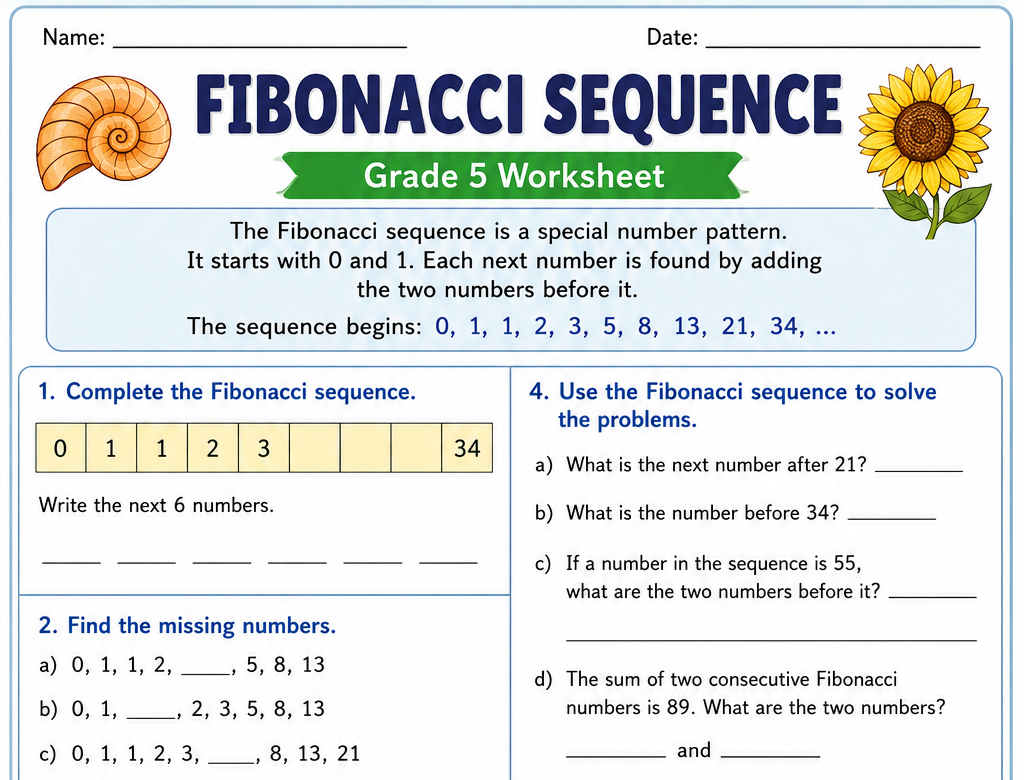
The Fibonacci sequence starts with:
0, 1, 1, 2, 3, 5, 8, 13, 21, 34…
Each number equals the sum of the two numbers before it.
For example:
- 0 + 1 = 1
- 1 + 1 = 2
- 1 + 2 = 3
- 2 + 3 = 5
- 3 + 5 = 8
And the pattern just keeps going.
Grade 5 students usually understand addition well enough to recognize this sequence quickly, making it an excellent enrichment activity.
Why Use a Fibonacci Grade 5 Worksheet?
Worksheets provide structured practice while keeping students focused on one mathematical concept at a time.
A good worksheet helps students:
- Identify number patterns
- Improve addition skills
- Develop logical thinking
- Practice sequencing
- Strengthen problem-solving abilities
- Build confidence with challenging math concepts
And honestly…many kids enjoy pattern puzzles because they feel like solving mysteries instead of completing ordinary exercises.
1. Complete the Missing Numbers
This is the most common worksheet activity.
Example:
0, 1, 1, __, 3, __, 8, 13, __Students fill in the blanks by adding the previous two numbers.
This simple exercise builds confidence before moving to harder questions.
2. Continue the Fibonacci Pattern
Students receive part of the sequence and continue writing the next several numbers.
Example:
5, 8, 13, 21, __, __, __, __Answers:
- 34
- 55
- 89
- 144
It reinforces repeated addition while improving concentration.
3. Find the Rule
Instead of giving the rule immediately, let students discover it themselves.
Example:
2
3
5
8
13
21
Questions:
- What do you notice?
- How is each number created?
- Predict the next three numbers.
Children remember concepts longer when they figure them out independently.
4. Fibonacci Word Problems
Real-life examples make math meaningful.
Example:
“A rabbit population grows following the Fibonacci sequence. If there are 5 rabbits one month and 8 rabbits the next month, how many will there be after another month?”
Students calculate:
5 + 8 = 13
Simple stories make abstract numbers easier to understand.
5. Color-by-Number Fibonacci Activities
These worksheets combine creativity with math.
Students solve Fibonacci questions first.
Each correct answer matches a color.
Eventually, the worksheet reveals a picture.
This approach works especially well for visual learners who enjoy art alongside mathematics.
6. Fibonacci Puzzle Grids
Puzzle worksheets keep students engaged longer.
Example:
| Number | Next Number |
|---|---|
| 1 | ? |
| 2 | ? |
| 5 | ? |
| 13 | ? |
Students complete the grid while identifying missing values.
It feels more like solving a game than doing schoolwork.
7. Match the Correct Sequence
Students compare several number lists.
Example:
Which one is Fibonacci?
A)
2,4,6,8,10
B)
1,3,5,7,9
C)
1,1,2,3,5,8,13
Correct answer:
C
These comparison activities improve observation skills and encourage careful thinking.
8. Fibonacci in Nature
One of the most exciting worksheet sections connects math with science.
Students look at pictures of:
- Sunflowers
- Pinecones
- Pineapples
- Shells
- Fern leaves
Then answer questions about where Fibonacci patterns appear.
Children often remember these examples because they’re surprising.
Math suddenly exists outside the classroom.
9. Create Your Own Fibonacci Pattern
Creative worksheets ask students to build something using the sequence.
Ideas include:
- Draw squares using Fibonacci numbers
- Create dot patterns
- Design pixel art
- Make staircase shapes
- Build simple mosaics
This combines geometry with number patterns in a fun, hands-on way.
10. Challenge Questions for Advanced Learners
Some Grade 5 students finish quickly.
Challenge questions keep them engaged.
Examples:
- Find the 15th Fibonacci number.
- Is every Fibonacci number odd?
- Can two even numbers appear together?
- Explain your reasoning.
- Write your own Fibonacci puzzle.
These open-ended questions encourage mathematical reasoning instead of memorization.
Tips for Parents Using Fibonacci Worksheets
Parents don’t need advanced math knowledge to help.
A few simple strategies make a big difference:
- Let children explain the pattern aloud.
- Encourage mental addition before using paper.
- Celebrate effort instead of speed.
- Use coins, blocks, or counters to show the sequence visually.
- Practice for 10–15 minutes rather than long study sessions.
Small, consistent practice often produces better results than lengthy homework sessions.
Tips for Teachers
Teachers can make Fibonacci lessons even more engaging by mixing worksheets with classroom activities.
Some ideas include:
- Group challenges
- Math stations
- Interactive whiteboard games
- Partner discussions
- Pattern hunts around the classroom
- STEM projects
And don’t worry if students make mistakes. Pattern recognition develops gradually through repeated practice.
Skills Students Build
A well-designed Fibonacci Grade 5 worksheet supports much more than simple addition.
Students strengthen:
- Number sense
- Logical reasoning
- Critical thinking
- Pattern recognition
- Mental math
- Sequencing skills
- Mathematical communication
- Problem-solving confidence
These are skills they’ll continue using throughout middle school and beyond.
What Makes a Great Fibonacci Grade 5 Worksheet?
The best worksheets are clear, engaging, and appropriately challenging.
Look for worksheets that include:
- Easy-to-read instructions
- Progressive difficulty levels
- Plenty of practice questions
- Fun puzzles
- Real-world examples
- Space for students to show their work
- Answer keys for self-checking
Worksheets that mix different activity types keep students interested much longer than pages filled with repetitive questions.
Final Thoughts
A Fibonacci Grade 5 worksheet offers far more than simple number practice. It introduces students to one of mathematics’ most fascinating patterns while building logical thinking, confidence, and problem-solving skills. Through puzzles, missing-number activities, real-life examples, and creative challenges, children begin to see that math is full of patterns waiting to be discovered.
Whether you’re a parent looking for extra practice at home or a teacher planning engaging classroom activities, Fibonacci worksheets provide an enjoyable way to strengthen essential math skills. Keep the lessons interactive, encourage curiosity, and let students explore the sequence at their own pace. Before long, they’ll be spotting Fibonacci patterns everywhere—from textbook exercises to the natural world around them.