Math Worksheets Grade 3: 10 Fun Ways to Help Kids Build Strong Math Skills
Third grade is where math starts getting exciting. Kids move beyond simple counting and begin solving multiplication problems, working with fractions, measuring objects, and understanding place value in greater depth. It can feel like a big jump—but that’s exactly where math worksheets grade 3 become incredibly helpful.
The right worksheets don’t just give children more questions to answer. They build confidence, encourage independent learning, and reinforce classroom lessons without making practice feel overwhelming.
If you’re looking for engaging ways to help your child master third-grade math, these worksheet ideas can make learning more enjoyable while strengthening essential skills.
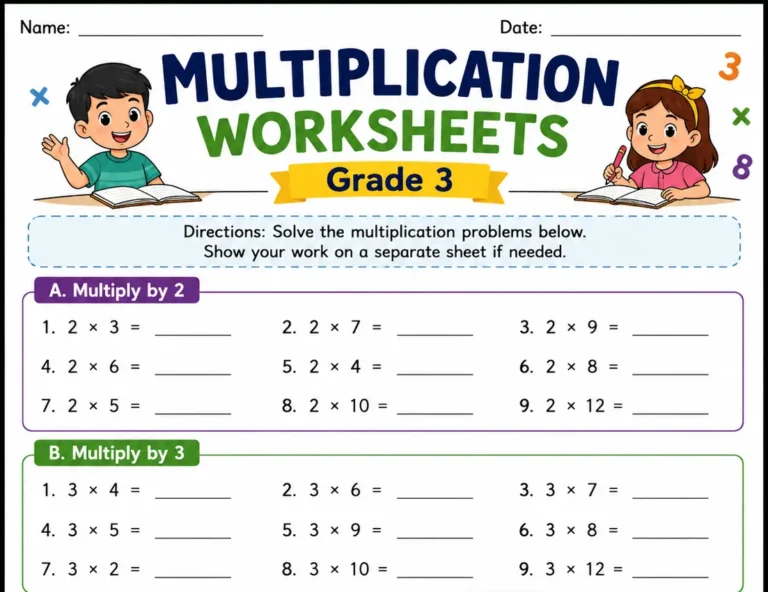
1. Multiplication Practice Worksheets
By third grade, multiplication becomes one of the biggest learning goals.
Worksheets that focus on multiplication tables, missing factors, arrays, and word problems help children understand the concept instead of simply memorizing answers.
Good multiplication worksheets often include:
- Times tables from 1–12
- Picture-based multiplication
- Equal groups
- Arrays
- Mixed multiplication review
- Word problems
A little daily practice—just 10 to 15 minutes—can make multiplication much easier over time.
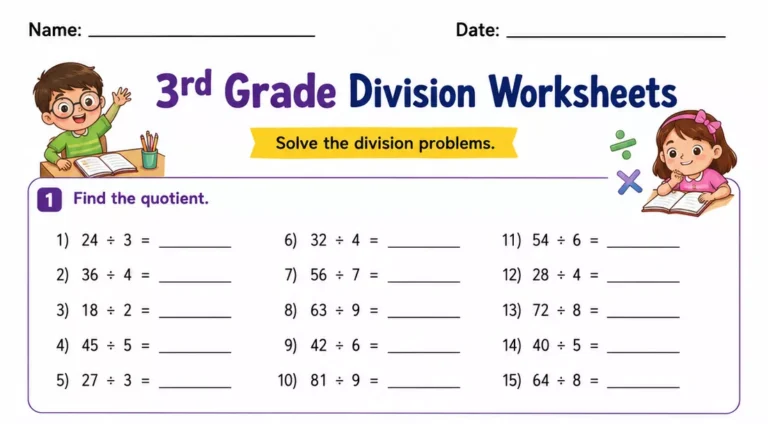
2. Division Worksheets That Build Understanding
Division often feels tricky at first.
That’s why worksheets should begin with visual models before moving into traditional division problems.
Children learn better when they see:
- Equal sharing
- Grouping objects
- Fact families
- Missing numbers
- Simple long division preparation
And once they recognize the relationship between multiplication and division, everything starts making more sense.
3. Addition and Subtraction with Larger Numbers
Third graders usually work with three-digit and sometimes four-digit numbers.
Worksheets focusing on regrouping help students practice accuracy while improving mental math.
Useful worksheet activities include:
- Vertical addition
- Horizontal addition
- Regrouping
- Borrowing
- Mixed operations
- Puzzle challenges
Repeating these skills regularly helps reduce simple calculation mistakes.
4. Place Value Worksheets
Understanding place value is one of the foundations of higher-level math.
Children should become comfortable identifying:
- Ones
- Tens
- Hundreds
- Thousands
Quality math worksheets grade 3 often include exercises like:
- Expanded form
- Standard form
- Comparing numbers
- Ordering numbers
- Rounding
These activities strengthen number sense and improve problem-solving ability.
5. Fractions Made Simple
Fractions can seem confusing at first.
But colorful worksheets with visual models make them much easier to understand.
Popular fraction worksheet topics include:
- Equal parts
- Numerator and denominator
- Fraction matching
- Shading fractions
- Comparing fractions
- Number line fractions
Children often enjoy these because they involve pictures instead of only numbers.
6. Measurement and Time Worksheets
Math isn’t limited to solving equations.
Measurement worksheets connect classroom learning with real life.
Students practice:
- Measuring length
- Reading rulers
- Weight
- Capacity
- Temperature
- Elapsed time
- Reading clocks
These practical exercises help children see how math is used every day.
And honestly…they’re often more fun than standard computation pages.
7. Geometry Worksheets for Young Learners
Geometry introduces children to shapes and spatial thinking.
Third-grade geometry worksheets may cover:
- Angles
- Quadrilaterals
- Triangles
- Symmetry
- Perimeter
- Area basics
Many worksheets include drawing, coloring, and matching activities that keep students engaged.
Visual learners especially benefit from these exercises.
8. Word Problem Worksheets
Knowing how to calculate is important.
Knowing when to use those calculations is even more important.
Word problems encourage children to think critically before solving.
Strong worksheets combine:
- Real-life situations
- Multi-step questions
- Mixed operations
- Money problems
- Time problems
- Measurement scenarios
These exercises improve both reading comprehension and mathematical reasoning.
9. Mixed Review Worksheets
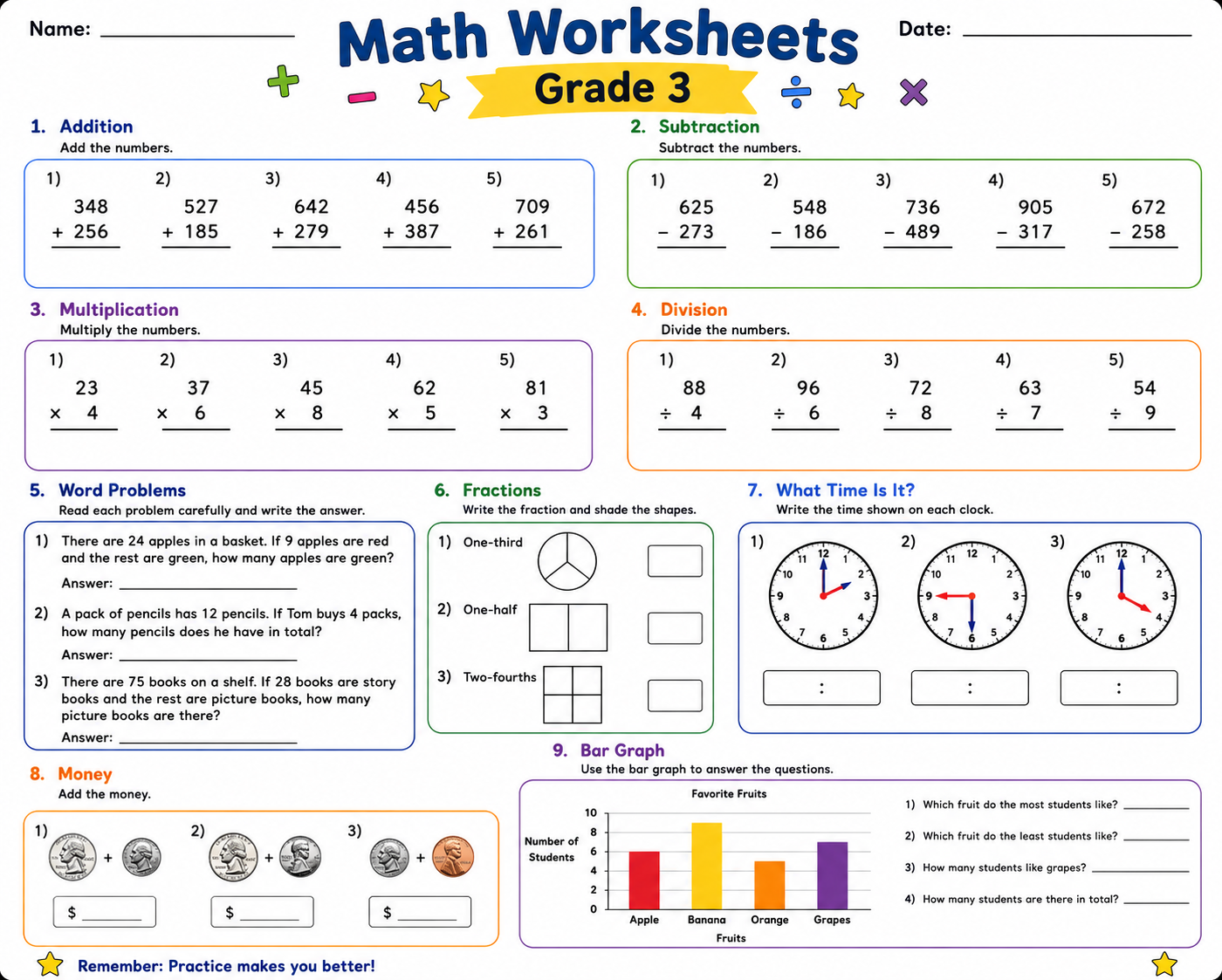
Instead of focusing on just one topic, mixed review worksheets combine multiple concepts on a single page.
A typical review sheet might include:
- Addition
- Subtraction
- Multiplication
- Division
- Fractions
- Geometry
- Measurement
This approach prepares children for classroom tests while helping them switch between different types of problems confidently.
It also keeps practice sessions from becoming repetitive.
10. Fun Math Games and Puzzle Worksheets
Worksheets don’t always need rows of numbers.
Many children stay motivated when learning feels like a game.
Popular worksheet styles include:
- Math mazes
- Color-by-number activities
- Sudoku for kids
- Mystery picture puzzles
- Logic challenges
- Crosswords
- Matching games
These activities reinforce core math concepts while making practice feel more like playtime.
Sometimes kids don’t even realize they’re learning.
Benefits of Using Math Worksheets Grade 3
Consistent worksheet practice offers several advantages beyond improving grades.
Children develop:
- Better problem-solving skills
- Faster calculation speed
- Improved concentration
- Stronger number sense
- Greater confidence
- Independent learning habits
Parents also find worksheets convenient because they require very little preparation.
Print one page, grab a pencil, and learning can begin almost immediately.
Tips for Making Worksheet Practice More Effective
Even the best worksheet won’t help much if children lose interest after five minutes.
Here are a few simple ways to keep learning enjoyable:
- Keep sessions between 10–20 minutes.
- Praise effort, not just correct answers.
- Mix easy questions with more challenging ones.
- Use colorful worksheets whenever possible.
- Review mistakes together instead of rushing.
- Let children explain how they found each answer.
And don’t worry if every answer isn’t correct the first time. Learning math is a process.
Choosing the Best Math Worksheets Grade 3
Not every worksheet is created equally.
Look for worksheets that:
- Match your child’s current skill level
- Include answer keys
- Feature clear instructions
- Use large, readable fonts
- Contain engaging illustrations
- Offer a balance of practice and challenge
A gradual increase in difficulty helps children build confidence while avoiding frustration.
Final Thoughts
Finding the right math worksheets grade 3 can make a noticeable difference in a child’s learning journey. From multiplication and division to fractions, geometry, measurement, and problem-solving, worksheets provide structured practice that reinforces classroom lessons while encouraging independent thinking.
The key isn’t completing dozens of pages every day. Small, consistent practice sessions often produce the best results. Mix different worksheet types, celebrate progress, and keep learning fun. Over time, children develop stronger math skills, greater confidence, and a positive attitude toward solving problems—skills that will benefit them far beyond third grade.