Cursive Alphabet Worksheet Free: 10 Easy Ways to Build Better Handwriting Skills
Learning cursive is still one of the most enjoyable ways for children to improve handwriting, strengthen fine motor skills, and gain confidence in writing. If you’re searching for a cursive alphabet worksheet free, you’ve already taken the first step toward making handwriting practice easier and more engaging.
The best part? You don’t need expensive workbooks to help kids master cursive. High-quality printable worksheets allow students to practice each letter at their own pace while keeping learning fun. Whether you’re a parent teaching at home, a teacher preparing classroom activities, or even an adult wanting to improve handwriting, free cursive alphabet worksheets can make a noticeable difference.
Let’s explore why these worksheets work so well—and how to get the most out of them.
Why Use a Cursive Alphabet Worksheet Free?
Cursive writing isn’t just about making pretty letters. It develops several important skills that benefit learners in everyday life.
Some of the biggest advantages include:
- Improves hand-eye coordination
- Builds muscle memory
- Develops fine motor skills
- Increases writing speed
- Encourages neat handwriting
- Helps children recognize letter patterns
- Boosts confidence through daily practice
And honestly… kids usually enjoy tracing letters more than repeatedly copying words from a textbook.
1. Learn Every Letter Step by Step
One of the biggest benefits of using a cursive alphabet worksheet free is that children focus on one letter at a time.
Instead of feeling overwhelmed by the entire alphabet, they learn:
- Uppercase letters
- Lowercase letters
- Correct starting points
- Proper pencil movement
- Letter spacing
This gradual approach makes learning much less frustrating.
2. Perfect for Beginners
Many free cursive worksheets are designed specifically for first-time learners.
They often include:
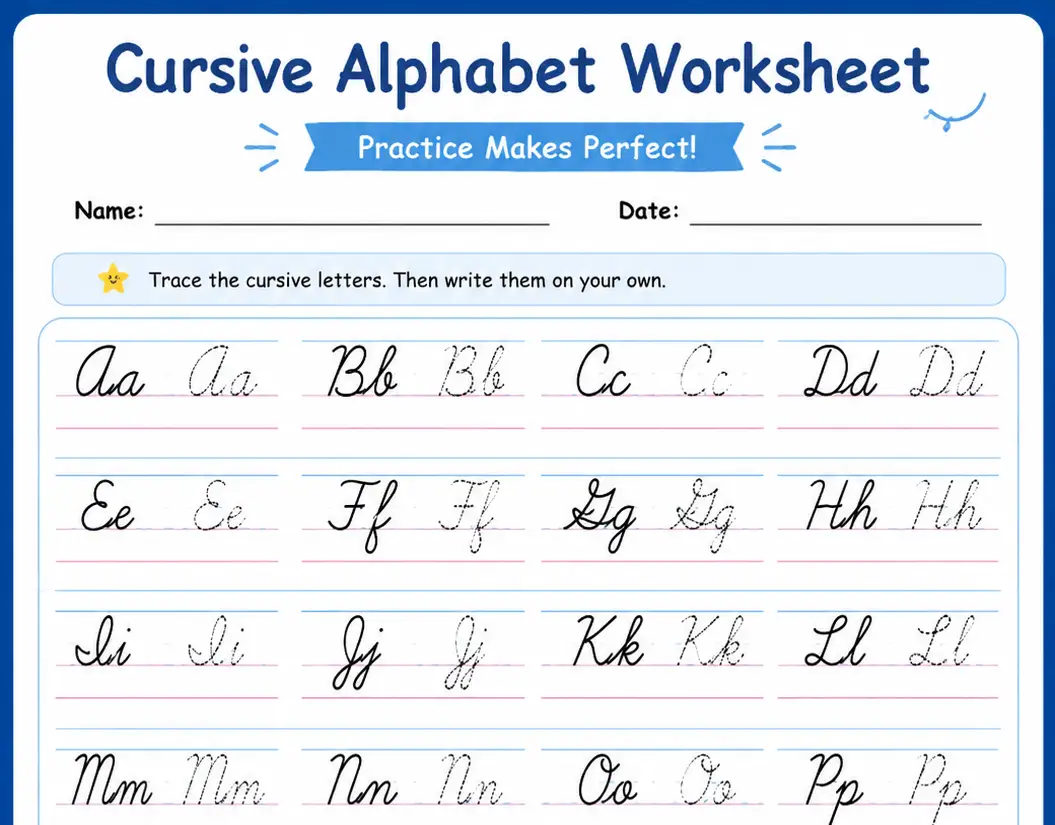
- Directional arrows
- Dotted tracing lines
- Large practice letters
- Guided writing spaces
- Independent writing rows
These simple features help children understand how cursive letters connect naturally.
3. Strengthens Fine Motor Skills
Writing cursive requires smooth and controlled hand movements.
Regular practice helps strengthen:
- Finger muscles
- Wrist control
- Pencil grip
- Hand coordination
These skills support many other classroom activities, including drawing, coloring, and writing paragraphs.
4. Makes Daily Practice Easy
Consistency matters more than long study sessions.
Even spending just 10–15 minutes each day with a cursive alphabet worksheet free can produce steady improvement over time.
A simple practice routine might look like this:
- Trace one letter
- Write it independently
- Practice a matching word
- Review yesterday’s letters
That’s it. Short sessions often work better than hour-long handwriting lessons.
5. Helps Kids Recognize Letter Patterns
Many cursive letters share similar strokes.
For example:
Curve Family
- a
- c
- d
- g
- q
Loop Family
- e
- l
- h
- b
- k
Learning these patterns makes new letters much easier to remember.
Instead of memorizing 52 individual uppercase and lowercase letters separately, students begin noticing similarities.
6. Encourages Better Handwriting Habits
Good handwriting develops through repetition.
Free cursive worksheets reinforce:
- Correct letter size
- Consistent slant
- Proper spacing
- Smooth connections
- Clean line placement
And while perfection isn’t necessary, good habits formed early usually stay with students for years.
7. Suitable for Home and Classroom Learning
One reason printable worksheets remain popular is their flexibility.
Parents can print extra copies whenever needed.
Teachers can:
- Use them as morning work
- Add them to handwriting centers
- Assign homework
- Include them in literacy stations
- Create weekly handwriting packets
No complicated setup required.
Just print… and start writing.
8. Builds Confidence Through Small Wins
Children feel motivated when they can actually see progress.
After completing several worksheets, they often notice:
- Cleaner handwriting
- Faster writing speed
- Better letter formation
- More readable sentences
Those small improvements encourage them to keep practicing.
Confidence grows naturally when success becomes visible.
9. Great for Adults Too
Cursive practice isn’t only for children.
Many adults download a cursive alphabet worksheet free to:
- Improve handwriting
- Practice calligraphy basics
- Journal neatly
- Write greeting cards
- Develop better penmanship
Some even find cursive writing surprisingly relaxing after busy workdays.
It’s almost like handwriting meditation.
10. Completely Free and Easy to Print
Perhaps the biggest advantage is accessibility.
Most printable cursive worksheets are:
- Free to download
- Printable at home
- Easy to organize
- Reusable with sheet protectors
- Suitable for repeated practice
This makes them an affordable learning resource for families, teachers, and homeschoolers alike.
Tips for Using Free Cursive Alphabet Worksheets
To make each worksheet more effective, try these simple ideas.
Practice Every Day
Five or ten minutes is usually enough.
Regular practice creates stronger muscle memory than occasional long sessions.
Use a Comfortable Pencil
Young learners often write better with thicker pencils or beginner grips.
Comfort matters.
Start Slowly
Speed comes later.
Focus first on forming each letter correctly.
Celebrate Progress
Praise effort instead of perfection.
Even slightly improved handwriting deserves encouragement.
Practice Words After Letters
Once students know individual letters, begin writing:
- Names
- Sight words
- Short sentences
- Favorite animals
- Simple stories
Real writing makes practice meaningful.
Common Mistakes to Avoid
While practicing cursive, beginners sometimes develop habits that slow progress.
Watch for these common mistakes:
- Pressing too hard on the pencil
- Rushing through worksheets
- Incorrect pencil grip
- Skipping tracing lines
- Making letters different sizes
- Not connecting letters smoothly
Fortunately, these habits are easy to fix with patient practice.
Who Can Use These Worksheets?
A cursive alphabet worksheet free works well for many learners.
Including:
- Preschool graduates
- Kindergarten review students
- Elementary school children
- Homeschool families
- Classroom teachers
- Tutors
- Adults improving handwriting
- ESL learners
Because handwriting develops differently for everyone, printable worksheets can easily match individual learning speeds.
How Often Should Children Practice?
Experts generally recommend frequent, short practice sessions.
A balanced weekly schedule could be:
| Day | Activity |
|---|---|
| Monday | Trace lowercase letters |
| Tuesday | Practice uppercase letters |
| Wednesday | Write simple words |
| Thursday | Connect letters into sentences |
| Friday | Review difficult letters |
| Weekend | Fun handwriting activities |
Keeping practice enjoyable helps children stay motivated.
Final Thoughts
Finding a cursive alphabet worksheet free is one of the easiest ways to support better handwriting without spending money on expensive workbooks. Whether you’re helping a young learner master the alphabet or improving your own penmanship, printable cursive worksheets provide a simple, effective path to success.
The key isn’t practicing for hours. It’s showing up consistently—even if it’s only for a few minutes each day. Over time, those small sessions add up. Letters become smoother, words become more natural, and handwriting grows more confident.
So print a worksheet, grab a pencil, and start with one letter today. Sometimes the smallest steps create the biggest improvements in learning.