Free ABC Tracing Worksheets: A Fun and Easy Way to Help Kids Learn the Alphabet
Learning the alphabet is one of the biggest milestones in early childhood. Before children can confidently read books or write simple words, they need to recognize letters and understand how to form them. That’s exactly where free ABC tracing worksheets come in. They make learning feel less like work and more like play.
Whether you’re a parent teaching at home, a preschool teacher planning classroom activities, or a homeschool educator looking for printable resources, alphabet tracing worksheets are a simple yet effective tool. They’re easy to use, require very little preparation, and help children build essential handwriting skills from day one.
Let’s explore why these worksheets are so valuable—and how to get the most out of them.
Why Free ABC Tracing Worksheets Matter
Young children learn best through repetition. They don’t usually master a new skill after just one try. Instead, they improve little by little with regular practice.
ABC tracing worksheets encourage children to:
- Recognize uppercase and lowercase letters
- Practice correct letter formation
- Improve pencil grip
- Build fine motor skills
- Strengthen hand-eye coordination
- Develop confidence before independent writing
And honestly, there’s something satisfying about tracing dotted letters. Kids often enjoy watching their writing become neater with every page they complete.
Benefits of Using ABC Tracing Worksheets Every Day
Daily practice doesn’t have to take hours. Even 10 to 15 minutes can make a noticeable difference over time.
Some of the biggest benefits include:
1. Builds Strong Handwriting Skills
Tracing teaches children where to start each letter, which direction to move the pencil, and where to finish. These small habits create the foundation for neat handwriting later on.
Instead of guessing how to write an “M” or an “S,” children develop muscle memory through repetition.
2. Improves Fine Motor Development
Holding a pencil correctly takes practice.
Every tracing activity strengthens the small muscles in children’s hands and fingers. These same muscles are also used for:
- Cutting with scissors
- Coloring
- Buttoning clothes
- Drawing pictures
- Writing sentences
It’s amazing how one simple worksheet supports several developmental skills at once.
3. Increases Letter Recognition
Children begin connecting the shape of each letter with its name.
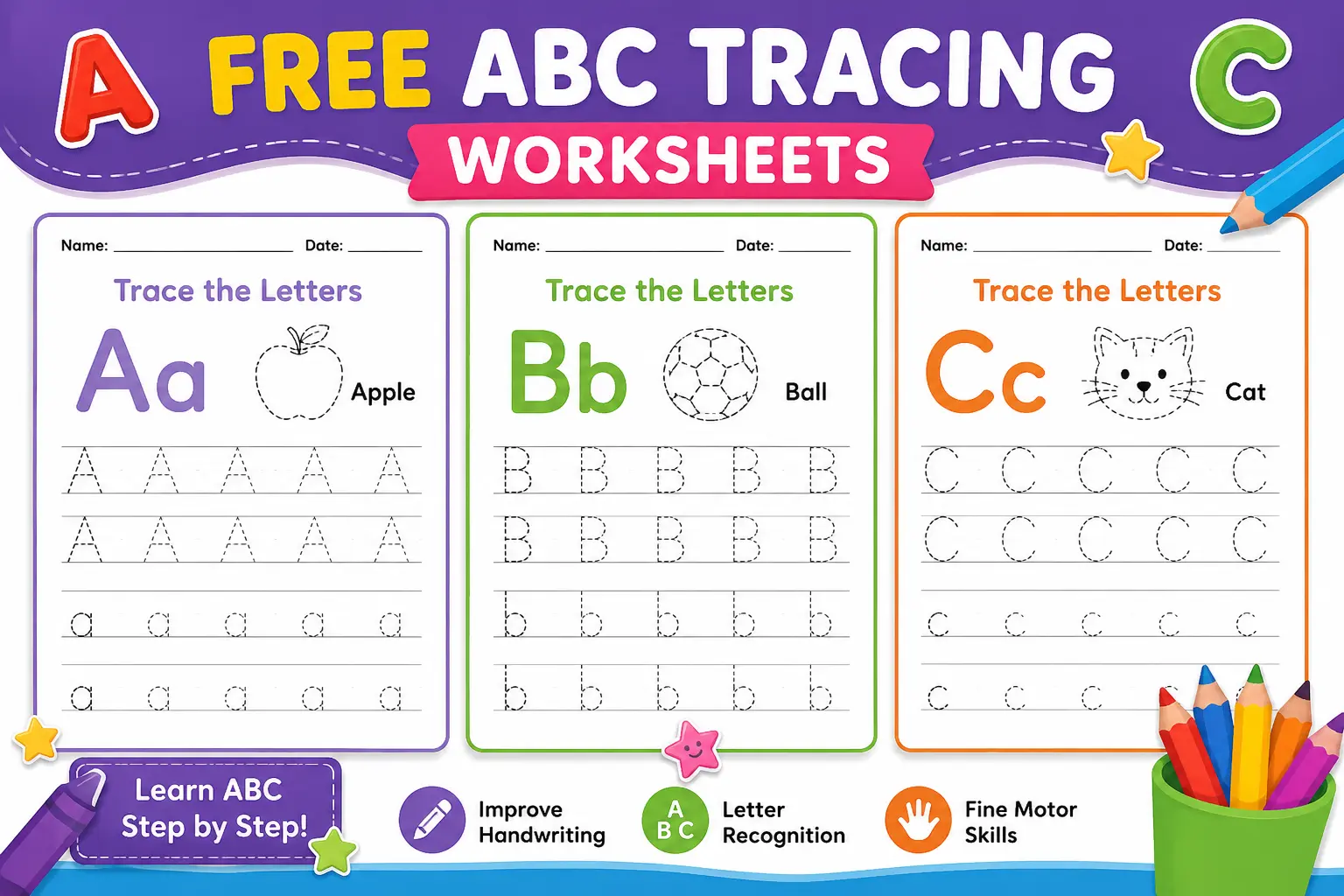
Many worksheets also include pictures that match the featured letter. For example:
- A for Apple
- B for Ball
- C for Cat
These visual connections help children remember letters more naturally.
4. Encourages Independent Learning
Once children understand how tracing works, many can complete worksheets on their own.
That independence builds confidence.
And confident learners usually become more motivated to keep practicing.
What Makes High-Quality Free ABC Tracing Worksheets?
Not every worksheet is equally helpful.
The best printable worksheets usually include several important features.
Clear Dotted Letters
Letters should be large enough for beginners to trace comfortably.
Tiny tracing lines can frustrate young learners.
Uppercase and Lowercase Practice
Children should practice both versions of every letter.
Learning that “A” and “a” represent the same sound is an important reading skill.
Directional Arrows
Some worksheets include arrows showing where each pencil stroke begins.
This helps children learn correct handwriting habits from the start.
Fun Pictures
Colorful illustrations make learning much more engaging.
Children love tracing “D” when it’s paired with a dinosaur or “F” alongside a fish.
Little details like these keep learning exciting.
Extra Writing Space
After tracing, children should have blank lines where they can try writing the letter independently.
That’s where real progress begins.
Creative Ways to Use ABC Tracing Worksheets
Worksheets don’t always have to stay on the table.
A little creativity goes a long way.
Here are some fun ideas:
- Trace letters with crayons first, then pencils.
- Color the matching pictures.
- Say each letter aloud while tracing.
- Find objects around the room that start with the same letter.
- Practice the letter using playdough.
- Write the letter in sand or shaving cream afterward.
- Turn worksheet time into a five-minute daily challenge.
Kids love variety.
Changing the activity every few days keeps them interested.
Tips for Helping Children Stay Engaged
Some children finish an entire alphabet workbook in a week.
Others need extra encouragement.
Both are completely normal.
Here are a few helpful strategies:
Keep Sessions Short
Young learners have short attention spans.
Ten focused minutes often work better than thirty distracted ones.
Celebrate Small Wins
Praise effort rather than perfection.
A child who correctly traces three letters deserves encouragement just as much as one who finishes the entire page.
Avoid Too Much Pressure
Learning should feel enjoyable.
If a child becomes frustrated, take a short break and come back later.
Progress doesn’t happen overnight.
Practice Regularly
Consistency matters far more than long study sessions.
A few worksheets each day often produce better results than one long practice session every weekend.
Who Can Benefit from Free ABC Tracing Worksheets?
These printable resources are useful for many different learners.
They’re ideal for:
- Preschool children
- Kindergarten students
- Homeschool families
- Daycare centers
- Early childhood classrooms
- Special education support
- Children learning English as a second language
Even older children who struggle with handwriting can benefit from tracing practice.
Sometimes going back to the basics is exactly what’s needed.
Printable Worksheets vs Digital Learning
Today’s children grow up surrounded by screens.
Educational apps certainly have their place.
But printable worksheets still offer unique advantages.
Writing on paper develops muscle memory differently than tapping on a tablet.
Children learn pencil control, pressure, spacing, and letter formation through real handwriting practice.
Many parents find that combining digital games with printable tracing worksheets creates a balanced learning experience.
It’s not about choosing one or the other.
Both can work together.
How Often Should Children Practice?
There’s no universal rule.
Every child learns at a different pace.
Still, many early education experts recommend practicing handwriting several times each week.
A simple routine could look like this:
- Monday: Letters A–E
- Tuesday: Letters F–J
- Wednesday: Letters K–O
- Thursday: Letters P–T
- Friday: Letters U–Z
- Weekend: Review favorite letters
This schedule keeps practice manageable without becoming overwhelming.
And honestly… repeating letters is completely okay.
Children often need dozens of repetitions before a new skill feels natural.
Final Thoughts
Free ABC tracing worksheets remain one of the easiest and most effective learning resources for young children. They help build handwriting skills, improve letter recognition, strengthen fine motor development, and prepare kids for future reading and writing success.
The best part? They’re simple, accessible, and fun.
Whether you’re teaching one child at home or an entire classroom, these printable worksheets provide structured practice without making learning feel stressful. Start with just a few pages each week, celebrate every little improvement, and let children learn at their own pace.
Before long, those carefully traced dotted letters become confident, independent handwriting—and that’s a milestone worth celebrating.