Free Cursive Alphabet Worksheets: 10 Simple Ways to Help Kids Master Cursive
Learning cursive writing is still a valuable skill, even in today’s digital world. It improves handwriting, strengthens fine motor skills, and helps children develop better letter recognition. The good news? You don’t have to spend money on expensive practice books. Free cursive alphabet worksheets provide an easy and effective way for kids to practice every letter at their own pace.
Whether you’re a parent teaching at home, a classroom teacher, or a homeschool educator, printable cursive worksheets make learning enjoyable. They offer structured practice while keeping children engaged. And honestly… kids usually learn faster when they can trace, copy, and repeat letters several times.
Let’s explore why these worksheets work so well and how to get the most out of them.
Why Free Cursive Alphabet Worksheets Are Worth Using
Many parents wonder if cursive is still necessary. While schools vary in their curriculum, cursive continues to offer several educational benefits.
Some of the biggest advantages include:
- Improves hand-eye coordination
- Builds stronger fine motor skills
- Encourages better pencil control
- Helps children write faster over time
- Makes reading historical documents easier
- Strengthens memory through repeated movement
- Boosts confidence in handwriting
And there’s something satisfying about writing a neat cursive sentence. Kids often feel proud when they finally connect letters smoothly.
1. Learn One Letter at a Time
One of the biggest mistakes is trying to teach the entire alphabet in one sitting.
Instead, use worksheets that focus on a single letter. Practice uppercase and lowercase versions before moving to the next one.
For example:
- Monday: Letter A
- Tuesday: Letter B
- Wednesday: Letter C
Small daily lessons usually produce better results than long practice sessions.
2. Start with Tracing Activities
Tracing helps children understand the proper direction and flow of each letter.
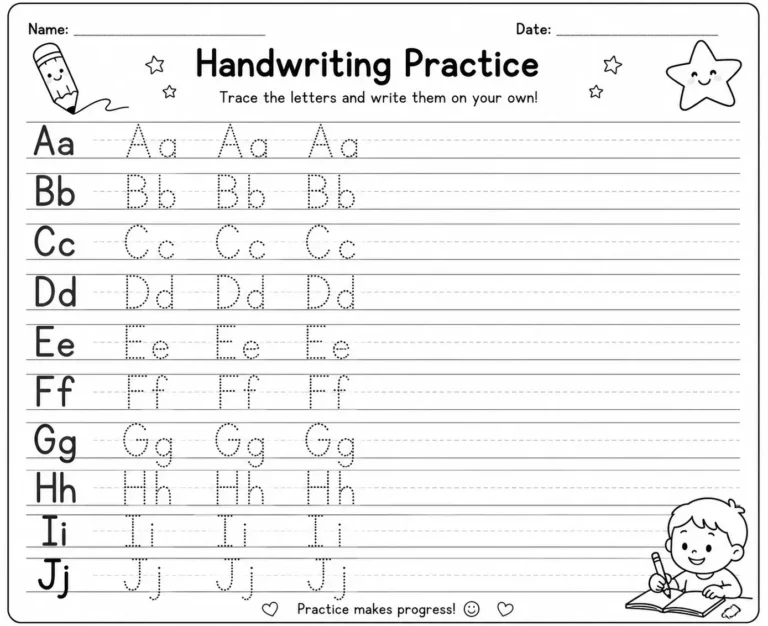
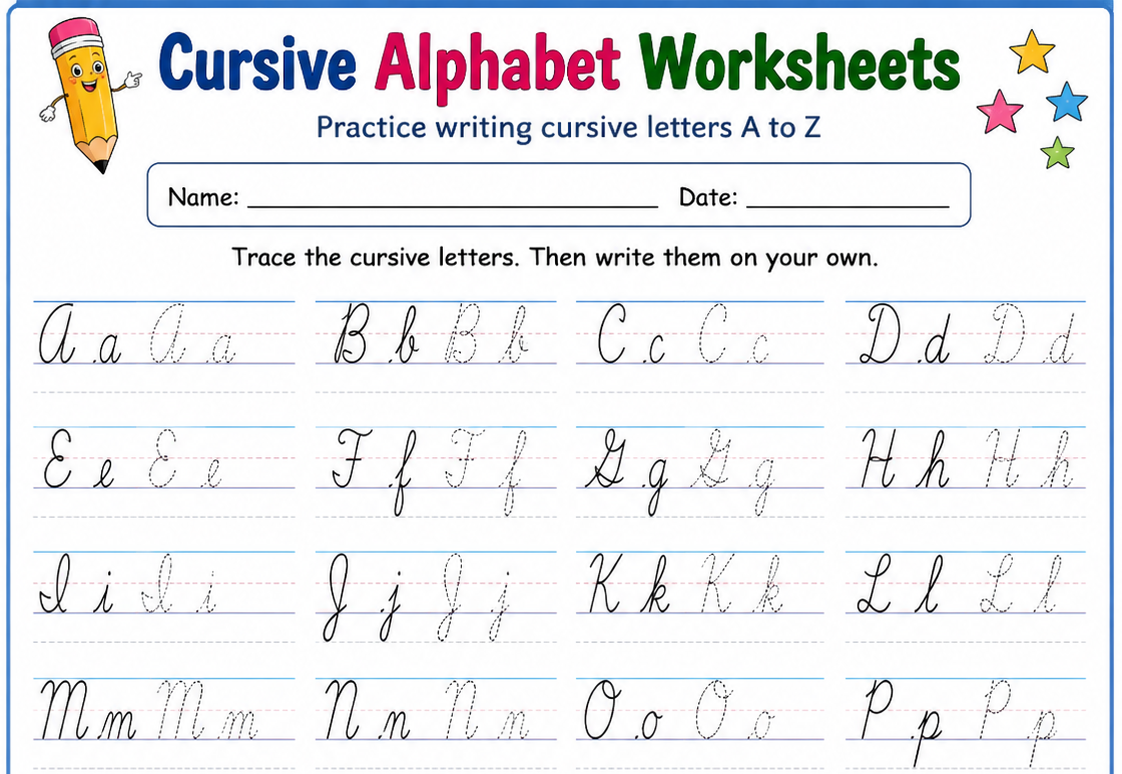
Most free cursive alphabet worksheets include:
- Dotted letters
- Direction arrows
- Guided strokes
- Practice lines
These features reduce frustration and build muscle memory naturally.
After tracing several rows, children can begin writing letters independently.
3. Practice Uppercase and Lowercase Together
Kids often learn lowercase letters faster because they use them more frequently.
Still, uppercase letters are just as important.
A good worksheet should include:
- Capital letter tracing
- Lowercase tracing
- Independent writing space
- Simple example words
Seeing both forms together helps children recognize how they’re used in everyday writing.
4. Move from Letters to Words
Once individual letters become easier, it’s time to connect them.
Begin with short words such as:
- Cat
- Dog
- Sun
- Tree
- Book
- Fish
Connecting letters is where many students struggle.
But repeated practice with simple words builds confidence surprisingly quickly.
5. Use Fun Themes
Children stay interested longer when worksheets include familiar topics.
Popular themes include:
- Animals
- Seasons
- Holidays
- Sports
- Space
- Dinosaurs
- Ocean life
Instead of writing random letters, kids practice words they already enjoy reading.
It feels less like homework… and more like a game.
6. Build a Daily Handwriting Routine
Consistency matters far more than long practice sessions.
Even 10–15 minutes each day can make a noticeable difference after a few weeks.
A simple routine might look like this:
- Warm-up strokes
- Trace one new letter
- Write the letter independently
- Practice one or two words
- Finish with a short sentence
That’s it.
No complicated lesson plans needed.
7. Encourage Correct Pencil Grip
Beautiful cursive starts with proper hand positioning.
Watch for these habits:
- Relaxed grip
- Straight posture
- Paper slightly tilted
- Smooth wrist movement
- Light pencil pressure
Some children press far too hard.
Gentle reminders usually help them write more comfortably.
8. Practice Common Letter Connections
Cursive isn’t just about individual letters.
It’s about how letters join together.
Certain combinations appear repeatedly, including:
- th
- ch
- ing
- er
- st
- oo
- ll
Many free cursive alphabet worksheets include connection exercises because they improve writing speed and flow.
This step often makes cursive feel much more natural.
9. Celebrate Progress
Children respond well to encouragement.
Instead of pointing out every mistake, celebrate improvements.
You might say:
- “Your lowercase m looks much smoother today.”
- “Nice job keeping your letters on the line.”
- “Your spacing has really improved.”
Small victories build motivation.
And motivated learners usually practice more.
10. Print New Worksheets Regularly
Repetition is essential for mastering cursive.
Fortunately, printable worksheets allow unlimited practice.
You can:
- Reprint favorite letters
- Focus on difficult characters
- Create weekly handwriting packets
- Mix review pages with new lessons
Having fresh practice sheets keeps learning interesting while reinforcing previous skills.
Features to Look for in Quality Worksheets
Not every printable worksheet offers the same learning experience.
The best free cursive alphabet worksheets usually include:
- Large tracing letters
- Clear writing guidelines
- Stroke direction arrows
- Uppercase and lowercase practice
- Letter connection exercises
- Word tracing
- Sentence writing
- Plenty of blank practice lines
Clean layouts also reduce distractions, especially for younger learners.
Tips for Parents and Teachers
Helping children learn cursive doesn’t require special training.
A few simple habits make a big difference.
Try these ideas:
- Practice together.
- Keep lessons short.
- Praise effort, not perfection.
- Review difficult letters often.
- Use colorful pencils occasionally.
- Allow breaks when hands become tired.
- Focus on neatness before speed.
And remember… every child learns differently.
Some master cursive within weeks.
Others need a little more time.
That’s perfectly normal.
Common Mistakes to Avoid
Many beginners face similar challenges.
Watch out for these common mistakes:
- Rushing through letters
- Skipping tracing practice
- Holding the pencil too tightly
- Writing letters too large
- Ignoring spacing
- Practicing for too long without breaks
Correcting these habits early makes future writing much smoother.
Final Thoughts
Learning cursive is a journey, not a race. With the right approach, children can develop neat, confident handwriting that lasts a lifetime. The best part is that free cursive alphabet worksheets make this process affordable, accessible, and enjoyable for families and educators alike.
Whether you’re introducing cursive for the first time or helping a child improve existing skills, regular practice is the secret. Start with individual letters, move on to words, and eventually write complete sentences. Before long, those once-difficult loops and curves will feel completely natural.
Print a few worksheets, grab a pencil, and let the learning begin. Sometimes the simplest resources really do produce the biggest results.